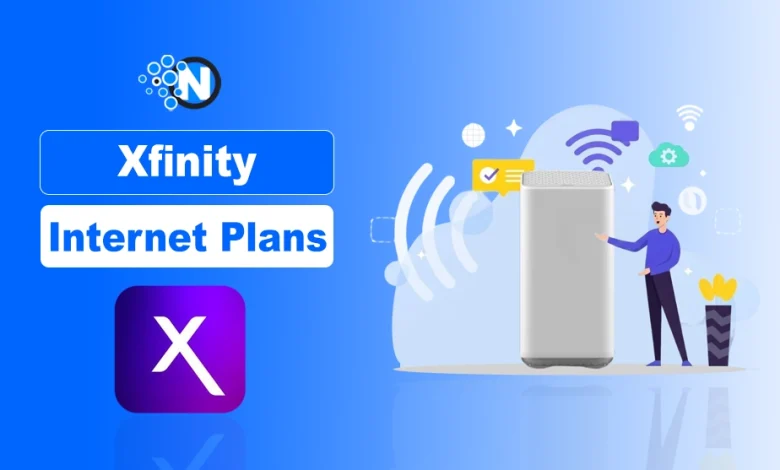
Xfinity (Comcast) remains the largest cable internet provider in the U.S., currently bridging the gap between traditional hybrid fiber-coaxial (HFC) networks and the next-generation X-Class symmetrical fiber speeds.
The home connectivity landscape is no longer just about “getting online.” With the mainstream adoption of 8K streaming, high-fidelity VR, and AI-driven smart home automation, your internet plan is the central nervous system of your household.
Home broadband is already the norm in the U.S. According to the Pew Research Center, 78% of U.S. adults said they subscribe to broadband internet at home, based on last year’s survey.
Now, moving next, you will explore a complete range, from the budget-friendly “Connect” options to the multi-gigabit powerhouses, to ensure you choose the right bandwidth for your lifestyle.
What Are the Available Xfinity Internet Plans?
Xfinity’s internet service currently offers several internet plans designed for different types of households.
Entry-level plans are suitable for browsing, streaming, and remote work, while Gigabit and multi-gig plans are built for larger families, competitive gaming, 4K streaming, and modern smart home technology that relies on multiple connected devices throughout the home.
Available Xfinity plans include 300 Mbps, 500 Mbps, and 1 Gig speed tiers, as shown in the official screenshot below.
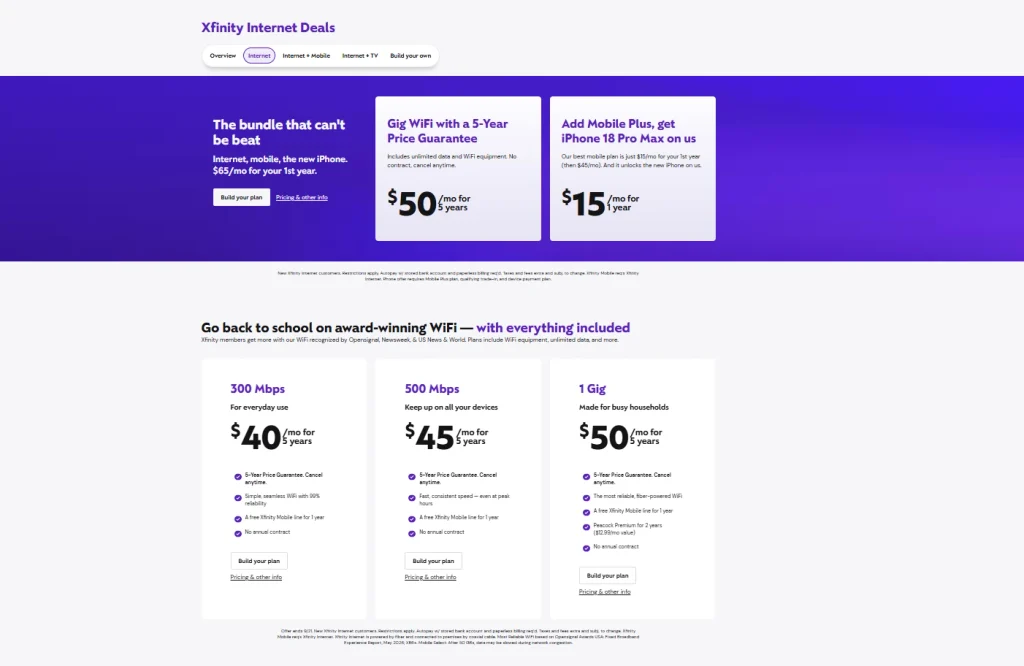
The main difference between Xfinity Internet plans is speed. Higher-tier plans support more connected devices, faster downloads, better upload performance, and smoother streaming during peak hours.
Hierarchy of Xfinity’s Internet Plans
Xfinity’s current internet offers are structured around different speed tiers, with pricing and availability varying by address. The following nationally advertised offers are available to qualifying new customers under Xfinity’s 5-Year Price Guarantee.
| Plan | Download Speed | Current Promo Price | Included Perks |
|---|---|---|---|
| 300 Mbps WiFi | 300 Mbps | $40/mo | Xfinity Mobile Select free for 1 year |
| 500 Mbps WiFi | 500 Mbps | $45/mo | Xfinity Mobile Select free for 1 year |
| 1 Gig WiFi | 1,000 Mbps | $50/mo | Mobile Select for 1 year + Peacock Premium for 2 years |
Then add:
Pricing note: These offers are for qualifying new Xfinity Internet customers and require paperless billing and automatic payments with a stored bank account. Taxes and other applicable charges are extra. Plans, speeds, promotions, and availability can vary by address.
And this is the major reason: Xfinity vs. AT&T Fiber comparison is getting attention.
What about the Xfinity NOW Internet Plan?
Xfinity NOW Internet is Comcast’s prepaid home internet option for customers who want simpler month-to-month service. It includes unlimited data and WiFi equipment with no annual contract or credit check, and taxes and fees are included in the monthly price. Current options include 100 Mbps for $30/month and 200 Mbps for $45/month.
This is not like Xfinity’s standard postpaid Internet plans; NOW Internet offers fewer speed choices and requires customers to prepay for service, making it more suitable for budget-conscious users who don’t need gigabit or multi-gig speeds.
For the table, I’d use:
| Feature | Xfinity Internet | Xfinity NOW Internet |
|---|---|---|
| Service Type | Postpaid | Prepaid |
| Annual Contract | No current offers | No |
| Credit Check | May depend on signup/account | No |
| Unlimited Data | Included with current plans | Yes |
| WiFi Equipment | Included with current plans | Included |
| Speed Options | Up to multi-gig | 100 or 200 Mbps |
| Starting Price | Varies by offer/address | $30/mo |
| Best For | Higher-speed households | Budget-conscious/light-to-moderate users |
For a complete breakdown of pricing, speed tests, hardware setup, and who should choose this prepaid service, read NogenTech’s full guide to Xfinity NOW Internet.
Key Features of Xfinity Internet Plans
Internet plans go beyond speed, with different technologies, pricing benefits, hardware, prepaid options, and streaming bundles.
1) The X-Class: Symmetrical Fiber-Powered Tiers
Available in select areas, Xfinity’s X-Class Internet offers symmetrical Internet speed, meaning upload speeds can match download speeds. Xfinity currently identifies four X-Class tiers:
- X-300: 300/300 Mbps
- X-500: 500/500 Mbps
- X-Gig: 1,000/1,000 Mbps
- X-2Gig: 2,000/2,000 Mbps
X-Class is available only in limited areas, so pricing and availability should be checked for the customer’s specific address.
Unlimited Data on Current Xfinity Plans
Xfinity’s current Internet plans include unlimited data with no data caps. However, customers who remain on older or legacy plans may still be subject to the 1.2 TB monthly data limit.
If you’re still on an older capped plan, understanding how to remove Internet data caps in the USA can help you compare your available unlimited-data options.
2) The 5-Year Price Guarantee
One of the major changes to Xfinity’s current pricing is its 5-Year Price Guarantee, which locks the base monthly Internet rate for 60 months for qualifying new customers. Unlike a long-term contract, customers can cancel without an early termination penalty.
What’s included in the 2026 Guarantee:
- Unlimited Data: Current plans include unlimited data without a monthly data cap.
- Equipment Included: An Xfinity Gateway is included at no additional equipment cost.
- No Annual Contract: Customers can cancel service without an early termination penalty.
Eligibility requires being a new Xfinity Internet customer, enrolling in paperless billing, setting up qualifying automatic payments, and having service available at the address. Taxes, fees, and installation charges are not covered by the guaranteed base price.
3. Hardware Innovations: The XB10 and WiFi 7
Xfinity is also introducing newer Gateway technology alongside upgrades to its cable network. The XB10 is associated with Xfinity’s newer X-Class service and supports technologies designed for faster home networking.
For users deciding between the XB8 and XB10, the newer model introduces updated networking capabilities for households using newer Xfinity services.
Why Do Advanced Gateways Matter?
Newer Gateway technologies such as WiFi 7 (802.11be) can provide greater wireless capacity and performance when paired with compatible devices.
Xfinity is also upgrading portions of its cable network to deliver faster upload speeds, while X-Class takes this further by providing symmetrical speeds in supported areas. DOCSIS 4.0 is part of the cable industry’s move toward multi-gigabit and symmetrical performance over HFC infrastructure, while DOCSIS 3.1 remains widely used.
For larger homes with weak WiFi areas, compatible xFi Pods can extend coverage beyond the Gateway’s normal range.
4. Streaming and Bundling: The StreamSaver Era
Xfinity also offers Xfinity StreamSaver, which bundles several major streaming services.
For eligible NOW Internet customers, StreamSaver costs $18/mo and includes:
- Netflix Standard with ads
- Apple TV
- Peacock Premium with ads
Customers who also want live television can choose NOW StreamSaver for $30/mo, which combines these streaming services with 270+ live TV channels.
Can You Upgrade Your Xfinity Internet Plan?
Yes. Xfinity customers can upgrade their internet service through their Xfinity account or app, with available speed tiers depending on their address.
Before upgrading, check whether your current modem, router, or Gateway supports the higher-speed tier. Xfinity specifically recommends verifying customer-owned equipment through My Device Info to make sure it can support your subscribed internet speed.
If your equipment is outdated or unsupported, you may need to upgrade it to take full advantage of the faster plan.
How to Choose the Right Xfinity Plan for You?
Choose an Xfinity plan based on your household size, connected devices, online activities, and budget rather than simply buying the fastest available tier.
- Basic browsing and streaming: NOW Internet may be enough for lighter usage and smaller households.
- Remote work and larger households: A 500 Mbps tier provides more capacity for simultaneous streaming, video calls, and downloads.
- Gaming and heavy usage: Gigabit service provides more bandwidth for busy households, but latency, WiFi conditions, and Ethernet also affect gaming performance.
- Frequent large uploads: If available at your address, symmetrical X-Class service can be more useful for cloud backups, content creation, and other upload-heavy tasks.
Then finish with one sentence, not three paragraphs:
Whichever tier you choose, compatible equipment and good WiFi coverage are important for getting consistent performance from your connection.