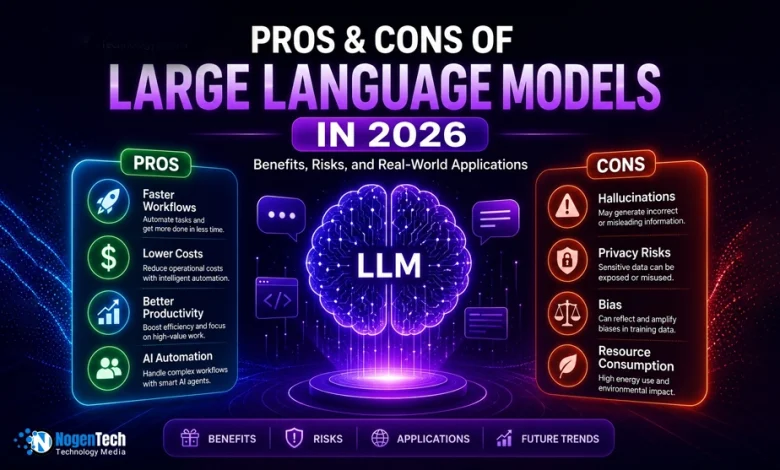
Large Language Models are changing how we work, learn, and create, but do their advantages overshadow their risks?
Using ChatGPT to write SEO optimized content, asking Claude to analyze documents, or relying on Gemini for research has become common in 2026. Large Language Models (LLMs) are helping businesses automate workflows, developers write code faster, and teams improve productivity across industries.
However, as adoption of Artificial Intelligence grows, so do concerns about its reliability. While LLMs can save time, reduce costs, and streamline complex tasks, they can also produce inaccurate information, reflect biases, and raise privacy concerns.
So, do the benefits outweigh the risks?
Moving forward, I’ll explain what Large Language Models (LLMs) are, how they work, their key advantages and disadvantages, and whether they can be trusted for real-world use.
As a data science student actively building with these technologies, I interact with LLMs almost every single day. I use Claude to debug code, ChatGPT to clarify concepts, and Perplexity to explore research topics. That daily experience gives me a practical perspective on both what these models do brilliantly and where they quietly fail.
What are Large Language Models (LLMs)?
Large Language Models (LLMs) are systems designed to understand, summarize, generate, and predict new content, such as text and code. They are powered by:
- Artificial intelligence.
- Massive data sets.
- Natural language processing (NLP)
- Machine learning Algorithms.
They use deep learning and token-based prediction. In 2026, these LLMs, such as ChatGPT, Gemini, and Perplexity, can handle complex tasks such as small business operations and marketing trends, adapt to different tones, and connect with tools, databases, and APIs.
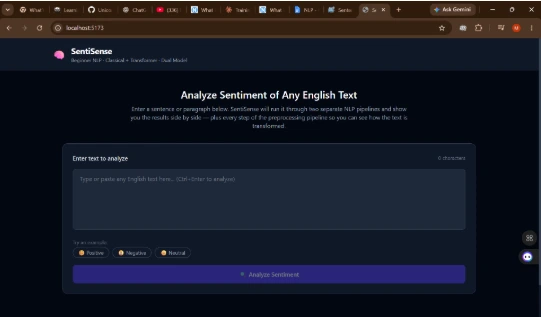
What helped me understand LLMs practically was building SentiSense, my beginner NLP sentiment analysis project. One of its two pipelines uses DistilBERT, which is itself a smaller, distilled version of BERT, a Large Language Model. Without realizing it at first, I had already been working with LLMs before I formally studied them.
Pros and Cons of Large Language Models in 2026
Now I’ll walk you through some of the most important pros and cons of LLMs that you should understand before getting into AI:
What are the Pros of Large Language Models? Explained
LLMs assist businesses in automating workflows, improving decision-making, and personalizing user experiences through real-time data processing.
1. Massive Productivity Gains
LLMs significantly reduce the time required for research, coding, and documentation. Tasks that previously took hours are now completed in minutes, allowing teams to shift focus toward strategy and problem-solving instead of repetitive execution.
In 2026, studies from ScienceDirect report productivity gains of up to 30–50% in content and software workflows, especially in fast-paced digital teams.
As a student, I experience this personally. Debugging a FastAPI error that once took me two hours now takes fifteen minutes with Claude. That saved time goes directly into understanding why the fix works, not just copying it. That shift in how I use recovered time is what separates productive AI use from lazy dependence.
2. Cost Efficiency for Businesses
LLMs help reduce operational costs on repetitive tasks while maintaining scalability by automating customer support, content creation, reporting, and basic development tasks. Businesses, especially startups and SMEs, use them to replace or reduce repetitive workload roles.
However, companies looking to build proprietary systems must weigh these savings against the real-world costs of in-house RAG development.
3. Advanced Natural Language Understanding
Modern LLMs can process long context windows, follow multi-step instructions, and adapt tone across different use cases.
This improvement in Natural Language Processing and Generative AI allows more human-like interactions in chatbots, assistants, and enterprise tools. Models can reliably handle complex prompts that earlier systems struggled with, making them more useful in professional environments.
This advancement became very clear to me when I compared my own RuleBot chatbot against modern LLMs. RuleBot was entirely rule-based, meaning hardcoded responses for specific keywords. The moment a user typed something slightly unexpected, it failed. LLMs handle that same unpredictability effortlessly because they understand context, not just keywords.
4. Versatility Across Industries
LLMs are now deployed in marketing, software engineering, education, mental healthcare research, legal analysis, and finance. Their adaptability makes them a core productivity layer across digital ecosystems.
From generating code in development pipelines to assisting with legal document review, they reduce dependency on specialized manual effort across multiple sectors.
5. Enhanced Creativity and Ideation
LLMs support ideation tasks such as generating blog topics, ad copy, product descriptions, and creative storytelling on Social Media. They act as brainstorming partners that help users overcome creative blocks.
Content teams widely use LLMs to speed up campaign ideation cycles and improve output variety without increasing workload.
6. Improved Accessibility and Inclusion
LLMs improve accessibility by simplifying complex information, translating languages, generating summaries, and supporting assistive technologies for users with disabilities.
They help bridge communication gaps globally, making digital content more inclusive and easier to understand across different literacy and language levels.
This matters deeply to me as a Pakistani developer. I am currently planning to build a Pakistani Sign Language detection system – PSL Vision specifically because deaf communities in Pakistan lack accessible digital tools. LLMs are increasingly part of making technology genuinely inclusive, not just technically impressive.
7. AI Agents and Workflow Automation
In 2026, LLMs don’t just generate text. They can:
- Browse websites
- Use tools
- Access databases
- Schedule tasks
- Automate multi-step workflows
Developers building these automated pipelines often implement an LLM aggregator to reduce API costs while keeping system uptime and response speeds high. This is a major evolution from traditional chatbots.
I am currently learning RAG, which is one of the most practical workflow automation techniques built on top of LLMs. RAG allows models to search through private documents before generating answers. It directly solves one of LLMs’ most discussed limitations, which is outdated or fabricated knowledge.
What are the Cons of Large Language Models? Explained
Despite the rapid adoption of LLM systems, they still carry serious limitations. Hostinger reports highlight that over 70% of enterprise users report concerns related to bias, inaccuracy, or data safety when using LLM-based tools in real workflows.
1. Hallucinations and Inaccurate Outputs
LLMs can generate responses that sound correct but are factually wrong, outdated, or entirely fabricated.
These hallucinations become especially risky in areas like healthcare, law, and finance, where even small errors can lead to major consequences. This remains one of the most reported reliability issues in AI adoption studies.
I have experienced this firsthand. I once asked an LLM about a specific Python library version, and it confidently gave me documentation that did not exist. The syntax was wrong, the function names were invented, and nothing worked when I ran it. The confidence in the response made it worse, as there was no indication it was guessing. That single experience permanently changed how I verify AI-generated code.
2. Lack of True Understanding
Even in advanced models, LLMs do not truly “understand” language. They rely on statistical pattern prediction rather than reasoning or awareness.
This limitation can lead to confident but shallow answers, especially in complex decision-making or multi-layered problem-solving tasks.
3. Bias and Ethical Concerns
Since LLMs are trained on large-scale internet data, they can inherit and amplify biases related to gender, culture, race, or ideology.
This creates ethical challenges in deployment, particularly in Artificial Intelligence systems used for hiring, education, or public communication, where fairness is critical.
4. Data Privacy and Security Risks
When users input sensitive or proprietary data into LLM-based systems, there is a risk of exposure through storage, logging, or third-party processing.
Nowadays, with increasing cloud computing and AI integration, privacy compliance and data governance have become major concerns for enterprises worldwide.
5. Over-Reliance and Skill Degradation
As LLMs handle writing, coding, and research tasks, users risk becoming overly dependent on them. This dependency can reduce critical thinking, creativity, and foundational problem-solving skills over time, especially among students and early-career professionals who rely heavily on AI tools.
This concern is real, and I think about it regularly. My rule for myself is simple that I never copy code I do not understand. If an LLM gives me a solution, I read every line, explain it back to myself, and then type it manually. That discipline is the only thing preventing AI assistance from becoming a substitute for actual learning.
6. Copyright and Intellectual Property Concerns
Copyright issues are the hottest AI debates in the US. These include:
- Ownership of AI-generated content
- Training data disputes
- Copyright infringement claims
- Legal uncertainty for businesses
7. Regulatory and Compliance Challenges
Governments and enterprises are introducing AI governance requirements. Organizations now have to consider:
- Data compliance
- Transparency requirements
- Industry regulations
- AI risk management
This is highly relevant for businesses evaluating LLM adoption.
8. Environmental and Resource Consumption
Training and operating LLMs require significant computing power, data centers, and cooling systems. Researchers estimate that generating around 10–50 AI queries consumes about 500 mL of fresh water.
With the expansion of AI infrastructure, the environmental impact and sustainability of Large Language Models have become growing concerns for researchers and policymakers.
How Do Large Language Models Work? (Brief Overview)
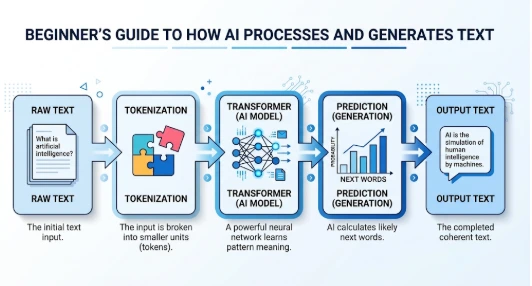
Large Language Models (LLMs) work by generating responses by learning patterns from massive text datasets and predicting the next token, rather than truly understanding language.
- Fine-Tuning & Alignment: After initial training, models are refined using human feedback and safety rules. This improves usefulness, reduces harmful outputs, and aligns responses with real-world expectations and user intent.
- Training on Massive Data: LLMs are trained on billions of examples from books, websites, research papers, and code. During training, they repeatedly predict the next token and adjust when they are wrong, allowing them to learn language patterns, structure, and context over time.
- Tokenization: Before processing text, the model breaks it into smaller units called tokens, such as words, subwords, or characters. This helps the model efficiently process and generate language step by step rather than handling full sentences at once.
- Transformer & Attention Mechanism: LLMs use a transformer architecture, a breakthrough in modern AI. The attention mechanism helps the model focus on the most relevant parts of the input, even across long texts, improving context retention and response quality.
- Prediction, Not Understanding: When you ask a question, the model does not retrieve facts or “think.” Instead, it predicts the most likely next token based on learned probabilities, building responses one step at a time.
Real-World Applications of LLMs in 2026
Large Language Models (LLMs) are now used across industries to automate tasks, improve productivity, and support decision-making.
Their ability to process and generate human-like language makes them valuable for both businesses and individual users.
- Customer Support and AI Chatbots: Businesses use LLMs to handle customer inquiries, provide instant support, and reduce response times. Modern AI assistants can resolve common issues, answer questions, and operate around the clock without human intervention.
- Content Creation and Marketing: LLMs help marketers generate blog posts, product descriptions, social media content, email campaigns, and advertising copy. This reduces content production time while maintaining consistency across channels.
- Software Development and Coding: Developers use LLMs to generate code, identify bugs, explain technical concepts, and automate documentation. These capabilities help accelerate development cycles and improve productivity.
- Education and Learning: LLMs assist students and educators by explaining concepts, summarizing information, creating study materials, and supporting personalized learning experiences.
- Business Automation and Productivity: Organizations use LLMs to automate reporting, document analysis, research, data organization, and internal workflows, allowing teams to focus on higher-value tasks.
The education application is the one I experience most directly. As a data science student, I use LLMs daily to understand research papers, debug projects, and explore concepts that my university curriculum has not covered yet. The gap between what universities teach and what the industry currently uses is significant. LLMs have become my way of closing that gap independently.
People Also Ask
What is the difference between an LLM and Generative AI?
An LLM is a type of Generative AI focused on understanding and generating human language. Generative AI is a broader category that includes technologies capable of creating text, images, audio, video, and code.
What industries benefit the most from Large Language Models?
Marketing, software development, customer service, education, finance, and healthcare are among the industries that benefit most from Large Language Models. These systems help automate repetitive tasks, improve efficiency, and support decision-making.
Do Large Language Models learn from every conversation?
No, most Large Language Models do not learn from every conversation in real time. Updates and improvements are typically made through separate training and fine-tuning processes conducted by developers.
What is the difference between traditional chatbots and LLMs?
Traditional chatbots rely on predefined rules, while LLMs generate responses based on context and language patterns. This allows LLMs to handle more complex and natural conversations.
What are the biggest risks of using LLMs for businesses in the US?
The main risks include inaccurate outputs, data privacy concerns, regulatory compliance issues, and over-reliance on AI for decision-making, especially in sectors like finance, healthcare, and legal services.
Why do LLMs sometimes give wrong answers even when they sound confident?
Because LLMs are based on probability, not real understanding. They generate text by predicting the most likely next word, which can sometimes lead to “hallucinated” or incorrect but convincing responses.
Should I trust LLM outputs for research or decision-making?
LLMs should be used as support tools, not final decision-makers. In the US, professionals verify AI outputs with trusted sources, especially in academic, legal, or medical contexts.
Final Thoughts on Pros and Cons of LLMs
Large Language Models (LLMs) work by learning patterns, breaking text into tokens, and predicting responses rather than truly understanding language.
As explored above, you may have been clear that users often ask whether they can be trusted for real-world tasks.
From my perspective, their value lies in speed and scalability, but they still require careful human oversight. Understanding this balance is key to using them effectively in 2026.
LLMs are genuinely powerful, but they reward critical users more than passive ones. Every time I used one blindly, I paid for it with wasted hours fixing hallucinated code. Every time I used one deliberately, I gained hours back.
I am currently working toward building RAG-based applications, meaning systems that give LLMs access to specific private documents before generating answers. That approach directly addresses the hallucination problem by grounding responses in verified sources. If you are exploring LLMs seriously, RAG is the next concept worth understanding after the fundamentals covered in this guide.