I have been covering AI tools and workflows from their early days. But things changed in January 2026. At the NRF Big Show, Google unveiled its Universal Commerce Protocol.
Meanwhile, tech breakthroughs demonstrated autonomous agents negotiating in real time, and TCL’s RayNeo Air 4 Pro showed AI embedded in the glasses on your face.
The shift was not gradual. AI stopped being a tool you use and started becoming a participant in decisions you make, products you buy, and how entire industries operate.
I am a data science student actively building with AI right now. Currently, I am learning RAG and using Claude and ChatGPT daily. I also completed a data labeling simulation that showed me how AI decisions are built from the ground up. That combination of building, using, and studying AI gives me a perspective on its future that goes beyond headlines.
Now, moving forward, I will walk you through where AI is headed, agentic AI, generative AI, industry transformations, the future of work, risks, and what 2030 may actually look like.
What Is the Future of AI?
The future of AI is autonomous, agentic, and deeply embedded in business infrastructure, scientific research, and daily life.
AI is no longer a chatbot; it is becoming a participant in the global economy.
How Has AI Evolved? From Narrow Rules to Agentic Systems
AI has evolved through three major phases: Narrow AI, Generative AI, and Agentic AI.
Narrow AI (1990s–2015)
Rule-based systems are designed for single tasks like fraud detection, image recognition, and spam filtering.
Generative AI (2020–2024)
Models like GPT-4, Gemini, and Claude enabled AI to write, code, reason, and create media, driving mass adoption worldwide. ChatGPT adoption went from zero to over 100 million weekly users.
Agentic AI (2025–Present)
AI systems now go beyond generation. They can plan, use tools, coordinate with other agents, and complete multi-step tasks with minimal human intervention.
Each phase built on the previous one. Agentic AI is built on top of generative AI, which itself evolved from deep learning systems.
As someone currently learning RAG, I can see exactly where I sit in this timeline. RAG is a bridge technology; it takes a generative LLM and enables it to retrieve, reason over, and act on specific information before responding. That retrieval-before-generation pattern is one of the foundational ideas behind agentic AI.
How Is AI in 2026 Different from Every Previous Cycle?
AI in 2026 is different from earlier waves because of three major shifts: live infrastructure, reasoning models, and mass enterprise adoption.
Infrastructure Is Live
Google’s UCP, Agent2Agent (A2A), and Agent Payments Protocol (AP2) are already deployed, allowing AI agents to interact directly with retailers, banks, and logistics systems.
Reasoning Models Exist
Models like OpenAI o3, Gemini 2.5 Pro, and Claude 3.7 can break problems into steps, verify outputs, and handle complex multi-step reasoning far beyond simple autocomplete.
Enterprise Adoption Has Crossed the Threshold
AI is no longer experimental. The 2026 index report of Stanford’s HAI found that AI is used in at least 1 business operation of 70% of organizations.
What Experts Predict for AI in the Next Five Years?
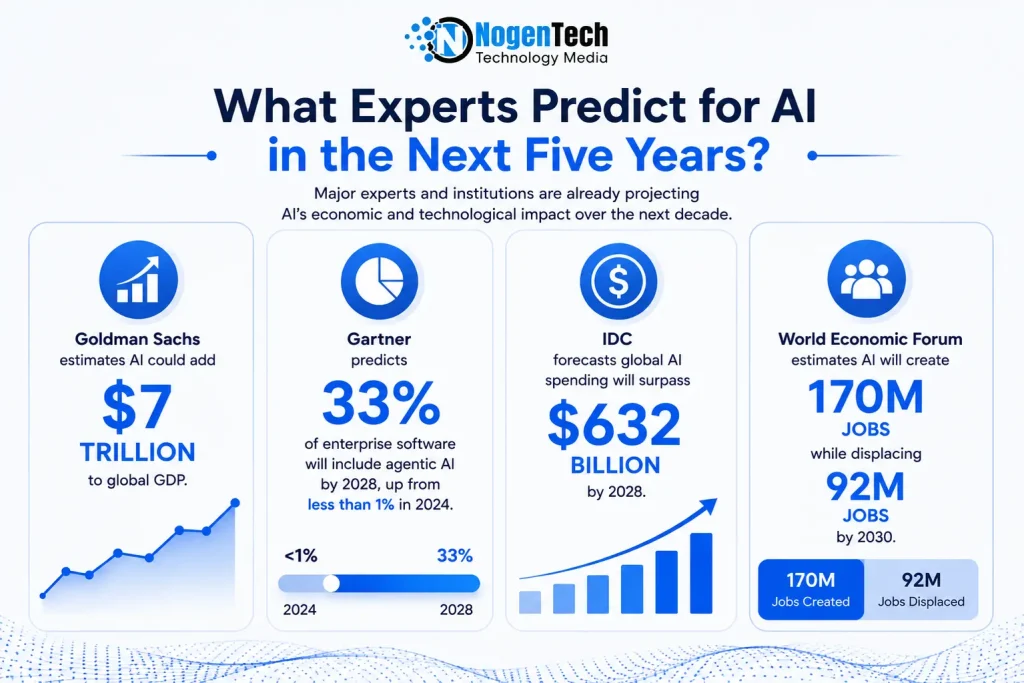
Major experts and institutions are already projecting AI’s economic and technological impact over the next decade:
- Goldman Sachs estimates AI could add $7 trillion to global GDP.
- Gartner predicts 33% of enterprise software will include agentic AI by 2028, up from less than 1% in 2024.
- IDC forecasts global AI spending will surpass $632 billion by 2028.
The World Economic Forum estimates AI will create 170 million jobs while displacing 92 million by 2030.
That last statistic sits with me personally. I am a student entering the job market in an era where 92 million roles may be displaced, but 170 million new ones are created. The net number sounds positive. But the transition period, the gap between which jobs disappear and which new ones appear, is where students like me actually live.
What Are the Key Trends in AI Technology in 2026?
AI in 2026 is being shaped by five major trends: generative AI, agentic AI, AI copilots, autonomous automation, and conversational commerce.
How is Generative AI Evolving Beyond Chatbots?
Generative AI is no longer limited to text-based chatbots. Modern multimodal models can process and generate images, audio, video, and code in a single workflow.
- Content: Microsoft reported that AI writing tools now assist over 60% of knowledge workers in drafting and editing.
- Code: GitHub Copilot says more than 55% of code in supported files is AI-generated, while Cursor and Replit AI are accelerating autonomous coding workflows.
- Video: OpenAI Sora, Google Veo 2, and Kling AI can generate cinematic multi-minute videos from prompts.
- Multimodal AI: Gemini 2.5 and Claude 3.7 can analyze PDFs, inspect code, watch videos, and return unified responses in one interaction.
What Is Driving the Rise of Agentic AI?
The evolution of AI from response generation to autonomous execution is driving the rise of agentic AI.
Unlike traditional chatbots, AI agents can set goals, choose tools, execute subtasks, and complete workflows independently.
Google’s Business Agent demonstrates this shift: users provide a budget and preference, while the AI handles product discovery, comparison, discounts, and checkout automatically.
This evolution is exactly why I am investing time in learning RAG before moving to full agentic systems. RAG teaches the retrieval and reasoning patterns that agentic AI builds on. Understanding how a model searches, selects, and grounds its response in real information is the prerequisite for understanding how an agent plans, acts, and evaluates its own outputs.
How is AI changing work?
AI assistants are completely changing the work environment by differentiating themselves between personal AI companions and enterprise copilots.
- Personal AI: Claude, ChatGPT, and Gemini Live assist with research, scheduling, drafting, and decision-making.
- Enterprise copilots: Microsoft 365 Copilot, Salesforce Einstein, and ServiceNow AI automate workflows directly inside business software.
Role of AI Automation in Business Operations
AI automation has evolved beyond traditional Robotic Process Automation (RPA). Modern systems now handle judgment-based tasks such as:
- Analyzing customer sentiment
- Adjusting ad campaigns in real time
- Routing support tickets based on emotional tone
- Optimizing workflows autonomously
How is AI changing e-commerce? From AI Commerce and Conversational Search
Search engines are evolving into conversational commerce platforms powered by AI. Google AI Mode and Gemini can now recommend products, answer objections, apply discounts, and complete purchases directly inside AI conversations.
Instead of competing only for search rankings, retailers are increasingly competing foompeting for visibility inside AI-generated recommendations and shopping experiences.
How Is AI Becoming Agentic? From Chatbots to Autonomous Systems
Artificial Intelligence is becoming agentic by evolving from simple, response-only chatbots into systems that can independently plan and execute tasks.
What Is Agentic AI?
Agentic AI refers to systems that can understand goals, plan tasks, use tools like APIs and browsers, and complete workflows without human intervention at every step.
An AI agent is different from a chatbot. For example, a chatbot may explain how to research competitors. An AI agent can search the web, collect pricing data, compare competitors, and return a formatted report automatically.
How Do AI Agents Work?
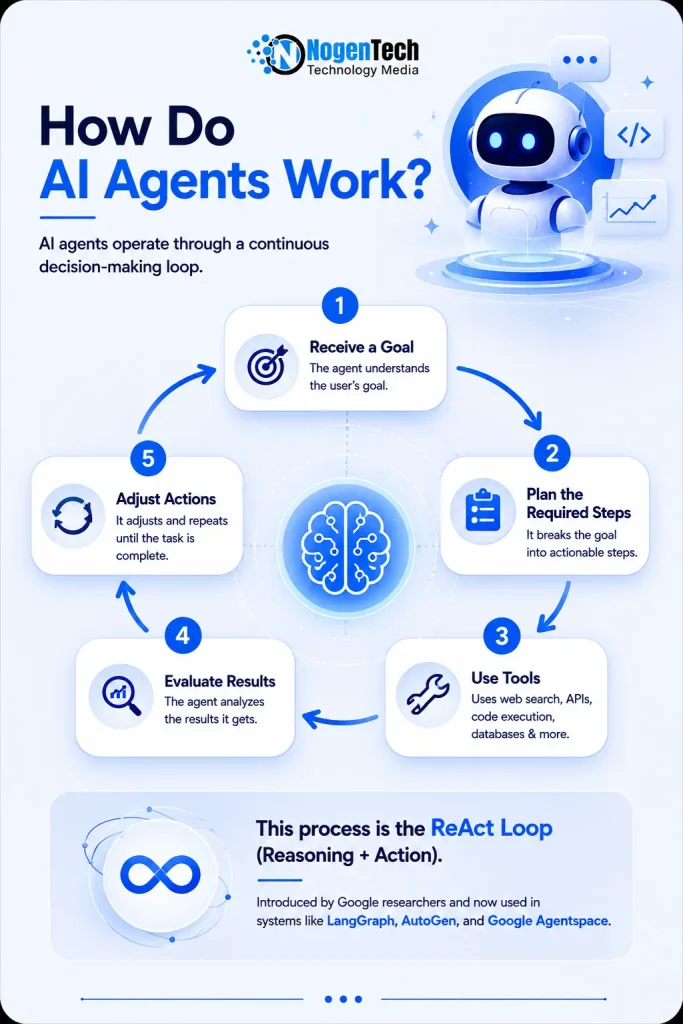
AI agents operate through a continuous decision-making loop:
- Adjust actions until the task is complete
- Receive a goal
- Plan the required steps
- Use tools like web search, APIs, code execution, or databases
- Evaluate results
This process is known as the ReAct loop (Reasoning + Action), introduced by Google researchers and now used in systems like LangGraph, AutoGen, and Google Agentspace.
The ReAct loop is something I have been studying directly as part of learning RAG and agentic workflows. What strikes me about it is how similar it is to how I approach debugging a broken project.
When I debug a broken project, I have a goal, which is to fix the error. Then I plan steps by reading the traceback and isolating the problem. After that, I use tools like Claude, Codex, and test runs. Then, I evaluate whether it worked, and if not, I adjust and try again. AI agents formalize exactly this process. The only difference is that humans do it intuitively without ever naming it
What Are Real Examples of Agentic AI in 2026?
Some of the real-world examples of Agentic AI models include:
- Google Business Agent: shops, negotiates prices, and completes checkout inside Google Search
- Devin (Cognition AI): autonomous software engineer that writes code, runs tests, and opens pull requests
- Harvey AI: handles legal research, drafting, and clause review for law firms
- Salesforce Agentforce: automates customer outreach, lead qualification, and CRM updates
How Is AI Becoming the New Interface for Shopping?
AI is becoming the new interface for shopping by replacing traditional product browsing with conversational, agentic experiences where you tell an AI what you want and it handles the entire purchase flow for you.
Conversational Commerce Replacing Traditional Browsing
With Google AI Mode, Gemini, and Business Agent, the shopping journey is collapsing from:
Search > Browse > Compare > Checkout
into:
Tell AI what you want > AI handles the rest
As an example, a user can say, “Buy me a modern rug for my dining room under $300,” and the AI agent searches retailers, compares options, applies discounts, and completes the purchase automatically.
AI-Powered Product Discovery
Traditional search matches keywords, while AI-powered discovery matches intent. An NLP system can understand that “something cozy for winter evenings” may refer to a throw blanket or space heater, even without explicit keywords.
This is why systems like Google Business Agent and Amazon Rufus AI are outperforming traditional search in categories like fashion, home goods, and electronics.
AI Checkout and Transactions
AI agents can now access saved payment methods, loyalty programs, and shipping details through protocols like Agent Payments Protocol (AP2).
Instead of manually adding products to a cart, users simply confirm intent while AI handles payment, checkout, and delivery automatically.
How Retailers Are Competing Inside AI Conversations?
Retailers are no longer optimizing only for traditional Google rankings. They are optimizing for AI visibility by ensuring:
- Products are indexed inside AI shopping systems
- Pricing APIs are accessible
- Inventory data is updated in real time
This shift is driving the rise of AEO (Answer Engine Optimization), where visibility inside AI-generated recommendations becomes as important as traditional SEO.
How Is the Internet Becoming an Agent-to-Agent Network?
The internet is shifting from human-driven browsing to AI agents autonomously communicating, negotiating, and transacting through protocols like UCP, A2A, and AP2.
What Is Google’s Universal Commerce Protocol (UCP)?
Google’s Universal Commerce Protocol (UCP), launched in 2026, allows AI agents to query product catalogs, compare prices, check inventory, and initiate purchases across retailers without visiting websites directly.
It acts as a commerce infrastructure layer built for AI systems rather than human browsing.
What Is Agent2Agent (A2A) Communication?
Agent2Agent (A2A) is Google’s protocol for direct AI-to-AI communication. It allows one AI agent to delegate tasks to another. For example, a shopping agent can coordinate with logistics and payment agents automatically without human involvement.
This multi-agent coordination enables businesses to automate workflows that previously required large operations teams.
What Is Agent Payments Protocol (AP2)?
Agent Payments Protocol (AP2) extends AI communication into autonomous financial transactions.
AI agents can:
- Request payment authorization
- Apply loyalty rewards
- Split invoices
- Complete transactions securely
Although regulations around autonomous payments are still evolving, AP2 infrastructure is already being used in retail and B2B re is already being used in retail and B2B procurement systems.
How Will AI Change the Future of Work and Everyday Life?
AI will automate routine work, augment knowledge roles, transform customer service, and deeply integrate into daily tools and decisions.
What Jobs Will AI Automate First?
The World Economic Forum’s Future of Jobs Report identifies the roles most exposed to AI automation:
- Data entry and administrative processing
- Tier-1 customer support
- Bookkeeping and financial reconciliation
- Template-based content creation
- Basic QA testing and code review
These roles are not disappearing overnight, but teams are becoming significantly smaller as AI handles repetitive workflows.
What New Jobs Is AI Creating?
AI is also creating entirely new career categories focused on building, managing, and governing AI systems.
Some of the fastest-growing roles include:
- AI Agent Architects designing autonomous AI workflows
- AI Compliance and Ethics Auditors testing systems for bias and regulatory risks
- Context Modernization Specialists preparing enterprise data for AI systems
- Human-in-the-Loop (HITL) Managers supervising AI decisions in high-risk industries
- Prompt Engineers and AI System Designers optimizing AI instructions and workflows
These new roles align with what I am building toward. Every project I complete, whether it is a sign language detector, a sentiment analysis system, or a RAG application, is preparing me for roles that require someone who can build AI systems, evaluate their outputs, and understand where they fail.
How Will Humans and AI Work Together?
The most effective organizations are redesigning workflows instead of replacing people entirely.
Humans increasingly focus on:
- Judgment
- Creativity
- Relationships
- Strategic decisions
AI handles:
- Scale
- Speed
- Consistency
- Data-heavy processing
It is described as the “talent × technology” model, where productivity depends on how effectively humans use AI systems.
How Is AI Changing Everyday Life?
AI is becoming embedded in everyday experiences beyond the workplace.
- Voice assistants can now handle complex multi-step tasks instead of simple commands.
- Smart home systems learn user behavior and automate energy, comfort, and security settings.
- AI health assistants monitor wearable data and detect anomalies proactively.
- AI finance tools categorize spending, identify savings opportunities, and automate recurring financial tasks.
How Will AI Transform Major Industries in the Future?
AI is becoming deeply integrated into healthcare, education, finance, cybersecurity, and global supply chains, reshaping how industries operate and make decisions.
How Is AI Changing Healthcare?
AI is improving diagnostics, personalized medicine, drug discovery, and robotic surgery.
- Google DeepMind’s systems can detect enormous eye diseases from retinal scans with specialist-level accuracy.
- AI pathology tools now identify cancerous tissue with accuracy.
- DeepMind’s AlphaFold accelerated protein-folding research, helping reduce drug discovery timelines.
- Systems like Tempus AI and Foundation Medicine are already using AI-driven personalized treatment recommendations in oncology.
AI-assisted surgery platforms like Intuitive Surgical’s da Vinci also improve precision and reduce surgical fatigue.
However, healthcare AI still faces major challenges, including algorithmic bias, hallucinations, and over-reliance on automated recommendations.
How Is AI Transforming Education?
AI is making personalized learning scalable through intelligent tutoring systems and adaptive classrooms.
- AI tutors and learning apps like Khanmigo, Synthesis Tutor, and Google LearnLM customize lessons based on student progress and learning style.
- Harvard research found that students using AI tutoring systems learned significantly faster than traditional classroom groups.
- AI grading tools are reducing teacher workload by automating assessments and administrative tasks.
Instead of banning AI, many schools are shifting toward teaching students how to use AI as a learning and thinking assistant responsibly.
I experience the educational application of AI firsthand every single day. My university curriculum covers foundational concepts but moves slowly compared to what the industry actually uses right now.
LLMs have become how I close that gap independently, understanding research papers faster, exploring new frameworks, and getting unstuck when a project breaks at midnight. AI has not replaced my learning. It has just accelerated it significantly.
How Is AI Changing Business and Enterprise Operations?
AI is becoming core business infrastructure rather than an optional productivity tool. Companies are using AI for:
- Workflow automation
- Marketing and sales optimization
- Decision intelligence
- Customer support
- Forecasting and operations
AI-leading companies are already achieving significantly higher profit margins than competitors, while businesses like Klarna, Salesforce, and Duolingo are integrating AI across entire operational workflows.
How Is AI Reshaping Finance?
AI can significantly improve your critical thinking, which enables you to manage expenses and profits and find new investing opportunities. AI systems now handle:
- Fraud detection
- Autonomous financial analysis
- AI investing
- Personalized banking
- Robo-advisory services
Mastercard’s AI fraud systems process billions of transactions annually, while AI-powered investment platforms are bringing institutional-grade portfolio management to retail investors.
How Is AI Transforming Cybersecurity?
Cybersecurity is evolving into an AI-versus-AI environment. AI security systems from CrowdStrike, Darktrace, and SentinelOne can:
- Detect threats in real time
- Monitor cloud infrastructure
- Identify unusual network behavior
- Automatically isolate compromised systems
At the same time, attackers are using AI for email phishing, deepfakes, and automated malware generation, increasing the importance of autonomous security systems.
How Is AI Changing Supply Chains and Logistics?
AI is improving supply chain resilience, forecasting, warehouse automation, and autonomous logistics.
- Amazon, Walmart, and DHL already operate AI-coordinated warehouse systems.
- AI forecasting models help retailers reduce stockouts and inventory waste.
- Autonomous freight and delivery systems from Aurora Innovation are already operating on selected routes.
- AI procurement systems can analyze suppliers, compare contracts, and automate purchasing decisions.
These systems are helping businesses build a faster, more adaptive supply chain network.
What Is the Future of Generative AI?
Generative AI is evolving from simple text generation into a multimodal platform capable of creating content, video, code, and interactive experiences.
How Is AI Changing Content Creation?
AI-generated content in 2026 can closely match human-written output at the surface level. However, human insight, experience, and originality remain the key differentiators.
For creators and marketers, AI increasingly handles:
- Research
- Outlining
- Drafting
- Design assistance
while humans provide strategic thinking and an authentic perspective.
How Is AI Transforming Video and Media Generation?
AI video generation has reached commercial quality.
AI video creation tools like Fotor, Google Veo 2, Runway ML, and Kling AI can generate photorealistic videos from prompts, dramatically reducing production costs and lowering the barrier to high-quality media creation.
How Is AI Changing Software Development?
AI coding tools are evolving from autocomplete systems into active development assistants. Platforms like Devin, GitHub Copilot Workspace, and Cursor can:
- Generate working code
- Debug issues
- Write tests
- Create documentation
- Open pull requests
Stack Overflow’s developer survey last year found that 84% of developers now use AI coding tools in their workflows.
Will Generative AI Replace Human Creativity?
Generative AI can automate production, but it cannot replace human judgment, lived experience, or creative direction.
The most successful professionals are using AI as a creative multiplier rather than a replacement for original thinking.
This is something I think about carefully as someone who writes code and builds projects using AI assistance daily. When I use Claude to debug a FastAPI error, I am not being replaced.
I am spending the time I saved on understanding the fix, planning the next feature, and making architectural decisions the AI cannot make for me. The human layer does not disappear. It moves upstream.
What Are the Biggest Risks and Challenges of AI?
AI is creating major economic and technological opportunities, but it also introduces serious ethical, social, and regulatory challenges.
Which Jobs Are Most Vulnerable to AI Automation?
The most exposed job roles that are vulnerable to AI include:
- Administrative processing
- Repetitive white-collar tasks
- Entry-level coordination roles
- Repetitive data workflows
The larger challenge is managing workforce transition and reskilling at scale.
How Does AI Create Bias and Ethical Risks?
AI systems learn from historical data, which can contain existing social and institutional biases. A well-known example was Amazon’s AI recruiting tool, which was discontinued after showing gender bias in hiring recommendations.
This has increased pressure for AI audits and regulatory oversight under frameworks like the EU AI Act.
I saw this problem from a different angle when I completed the data labeling simulation on Forage. The task was labeling real customer feedback for intent, sentiment, and personally identifiable information. What surprised me was how many edge cases existed. Some feedback was sarcastic. Some had mixed sentiments. Some had PII hidden in casual phrasing.
Every label was a judgment call. And I realized that every wrong label quietly poisons the model trained on it downstream. Bias in AI does not usually come from malicious intent. It comes from thousands of small labeling decisions made under ambiguity, exactly like the ones I was making during that simulation.
How Are Deepfakes and AI Misinformation Becoming a Problem?
AI-generated audio and video now make it possible to create highly convincing fake media. This has accelerated concerns around:
- Election misinformation
- Identity fraud
- Social engineering
- Media authenticity
- Cyber Security Threats
Technologies like Google SynthID and C2PA standards are being developed to verify AI-generated content.
What Privacy Risks Does AI Create?
Modern AI systems can infer highly sensitive information from behavioral and personal data. Its concerns are around:
- Facial recognition
- Consumer profiling
- Health predictions
- Financial behavior tracking
These have pushed governments toward stricter privacy and AI governance regulations.
How Are Governments Regulating AI?
Major AI regulations are already emerging globally:
- EU AI Act: risk-based AI regulation with strict requirements for high-risk systems
- US AI Executive Orders: safety testing and AI governance guidance
- China’s AI Rules: mandatory labeling and restrictions on AI-generated content
- UN AI Governance Efforts: international AI safety and oversight recommendations
What Are the Long-Term Risks of AGI?
Artificial General Intelligence (AGI) does not exist yet, but researchers at OpenAI, DeepMind, and Anthropic are actively studying long-term AI safety risks.
The core concern is ensuring increasingly autonomous AI systems remain aligned with human goals and values as capabilities continue advancing.
What Could AI Look Like by 2030 and Beyond?
AI will automate routine work, augment knowledge roles, transform customer service, and deeply integrate into daily tools and decisions.
What Will AI Systems Be Capable of by 2030?
Current projections suggest that by 2030:
- AI agents may become standard business infrastructure
- Multimodal AI could be embedded into everyday devices
- AI tutors may support hundreds of millions of students
- AI research systems could accelerate scientific discovery significantly
Will Autonomous Businesses Become Common?
AI automation is enabling companies to operate with far smaller teams than previously possible.
Businesses using coordinated AI systems for operations, marketing, technical support, and logistics may achieve revenue scales that once required large departments and operational staff.
How Could AI Change the Global Economy?
Goldman Sachs projects that AI productivity gains could significantly increase global GDP growth during the next decade.
Countries with stronger AI infrastructure, talent, and regulation are expected to capture the largest economic advantages.
Will AI Replace Humans or Extend Human Capability?
The long-term trend is less about AI replacing humans and more about amplifying human capability.
Doctors, researchers, teachers, and engineers using advanced AI systems may become dramatically more productive and effective than current workflows allow.
What Are the Biggest Long-Term Questions About AI?
Leading AI researchers continue to debate:
- AI safety and alignment
- AGI governance
- Distribution of AI benefits
- Global regulation
- Long-term societal impact
As AI capabilities advance, governance and safety research are becoming just as important as technical progress itself.
People Also Ask
Will AI Agents Replace Traditional Apps and Websites?
AI agents are unlikely to fully replace apps and websites, but they will increasingly become the primary interface people use to interact with digital services and complete tasks.
What Skills Will Be Most Valuable in the AI Era?
Strategic thinking, creativity, communication, AI workflow management, and human judgment will become more valuable as repetitive tasks are automated.
How Will AI Change SEO and Digital Marketing?
AI is shifting SEO toward AEO (Answer Engine Optimization), where businesses optimize for visibility inside AI-generated answers and conversational search experiences.
Can AI Systems Work Together Autonomously?
Yes. Protocols like Agent2Agent (A2A) allow AI systems to communicate, delegate tasks, and coordinate workflows without direct human involvement.
What Is the Difference Between Generative AI and Agentic AI?
Generative AI creates content like text, images, and code, while agentic AI can plan tasks, use tools, make decisions, and complete workflows autonomously.
What Companies Are Leading AI Development in 2026?
Companies like Google, OpenAI, Anthropic, Microsoft, and NVIDIA are leading in AI infrastructure, reasoning models, and enterprise AI deployment.
Will AI Create More Jobs Than It Replaces?
AI is expected to automate some repetitive roles while creating new careers focused on AI systems, governance, automation, and human-AI collaboration.
How Should Businesses Prepare for AI-Driven Commerce?
Businesses should prepare for AI-driven commerce by optimizing for AI discovery, exposing structured product data, enabling API accessibility, and adapting to conversational search experiences.
My Final Opinion on the Future of AI
After following AI from early automation tools to agentic systems like Google UCP, Gemini, Claude, and autonomous AI agents, my biggest realization is that AI is no longer just software people interact with occasionally.
It is becoming infrastructure that quietly powers commerce, decision-making, communication, and everyday life behind the scenes.
What makes 2026 different is not simply smarter chatbots, but AI systems that can reason, coordinate, transact, and act independently across industries like healthcare, finance, cybersecurity, education, and e-commerce.
In my opinion, the biggest advantage in the next decade will belong to people and businesses that combine AI speed and automation with human judgment, creativity, trust, and strategic thinking rather than relying entirely on either humans or machines alone.
As a student standing at the beginning of this era, my honest perspective is that the most important thing is not which AI tool you use. It is whether you understand what it is doing and why. I have made more mistakes using AI blindly than I have made not using it at all.
The students and professionals who will matter most in 2030 are not the ones who use the most AI. They are the ones who understand it well enough to know when to trust it, when to question it, and when to set it aside entirely.