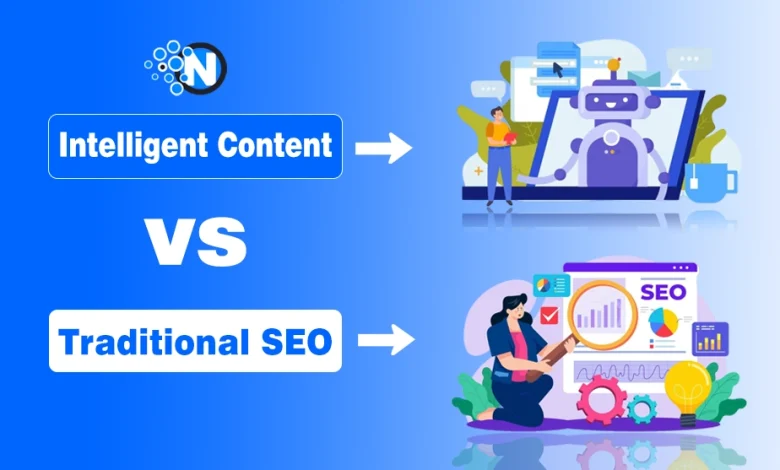
Intelligent Content vs Traditional SEO: What’s the Modern Way to Success?

- Traditional SEO alone is no longer enough for modern search visibility.
- AI-powered search platforms now prioritize context, intent, and quality.
- AI-friendly content focuses on expertise, clarity, and user value.
- Intelligent content earns natural backlinks through real value and insights.
- Businesses adapting to AI-driven search trends will gain a competitive advantage.
Search has changed faster in the last two years than it did in the previous decade.
Traditional SEO once focused mainly on rankings, keywords, and backlinks. Today, AI-powered platforms like OpenAI ChatGPT, Google AI Overviews, and Perplexity AI are changing how users discover information online.
Instead of clicking through multiple search results, users increasingly receive direct AI-generated answers. That shift has forced businesses to rethink how content is created, structured, and optimized.
But traditional SEO is not dead.
Modern search visibility now depends on combining strong SEO fundamentals with AI-friendly intelligent content that demonstrates expertise, authority, clarity, and trustworthiness.
In this guide, I’ll break down the real difference between traditional SEO and intelligent content optimization, how both work together, and what businesses should focus on in 2026.
What Is Traditional SEO & Why Does It Still Matter?
Traditional SEO (Search Engine Optimization) focuses on improving a website’s visibility in search engine results pages (SERPs).
For years, businesses optimized content around:
The primary goal was simple: rank higher on Google and drive organic traffic.
Traditional SEO still plays a major role in online visibility because search engines continue to rely on crawling, indexing, authority signals, and technical performance.
Without strong SEO fundamentals, even AI-optimized content struggles to gain visibility.
What Makes Content AI-Friendly?
AI systems prefer content that is:
- Clear and easy to understand
- Well-structured
- Factually accurate
- Authoritative
- Experience-driven
- Rich in context
- Organized with headings and FAQs
- Supported by examples, statistics, or case studies
Strong & intelligent content also uses entity-based optimization. Instead of focusing only on keywords, content should naturally include:
- Brands
- Products
- People
- Locations
- Industry terminology
- Related concepts
This helps AI systems better understand relationships between topics.
Areas where Traditional SEO Fails & Intelligent Content Helps
1. Evidence of the Shift
The proof is already visible in recent Google updates. The Helpful Content System prioritizes expertise and genuine value over keyword tricks. The November 2024 Core Update wiped out countless websites that clung to traditional playbooks, while rewarding content with topical authority.
Meanwhile, the UK SEO services industry is estimated to grow to $108.28 billion in 2026, yet most businesses still see organic visibility shrinking even after investing in SEO. Competitors using Intelligent Content spend less but achieve more predictable, scalable outcomes. The economics alone show that clinging to traditional SEO is like paying for a game that no longer exists.
2. The Fundamental Disconnect
Traditional SEO tactics like keyword research, link building, technical audits treat search engines as mechanical puzzles to manipulate. But search has evolved into an intelligence system.
- Keyword research identifies terms but misses intent.
- Link building produces artificial signals that algorithms discount.
- Technical audits flag issues that barely affect rankings.
- Content optimization churns out formulaic, lifeless articles.
As Jim McWilliams, CEO of Lyxity, explains: “Traditional SEO is like teaching someone phrases in a foreign language without context. AI friendly understands meaning, not just words.”
3. The Keyword Density Delusion
One of the clearest signs of SEO’s outdated thinking is keyword density obsession. Agencies still recommend 2-3% keyword frequency, adding LSI terms and rigid placements. But today’s algorithms don’t count words. They interpret meaning.
For example, ranking for “AI content writer” doesn’t require repeating the phrase dozens of times. Instead, content must explain how AI content works, its applications, challenges, and benefits. Intelligent Content maps out semantic relationships and ensures comprehensive topical coverage.
4. The Backlink Building Charade
Traditional SEO’s backlink obsession represents another paradigm trapped in the past. Agencies promise to build 50 high-quality backlinks monthly, as if search engines still operate like academic citation indices.
They craft guest posts, submit to directories, and orchestrate link exchanges. Thousands of pounds flow into link-building campaigns that generate reports showing Domain Authority increases while actual rankings stagnate.
AI-friendly content flips the model: instead of chasing links, it earns them naturally by offering genuine value. Research papers, frameworks, and insights get cited organically, creating authority without spammy outreach.
5. The Technical SEO Theatre
Technical SEO has turned into performance art, massive audits, crawl reports, and schema fixes that rarely influence rankings. Unless your website is fundamentally broken, these optimizations add little value.
Intelligent Content automates technical compliance. Headings, schema, and metadata are generated dynamically. There are also freeing businesses from paying for cosmetic fixes. The focus shifts from rituals to results.
6. The Content Optimization Fallacy
Traditional SEO produces “SEO content”: formulaic articles designed for algorithms, not users. They check all the boxes, keywords in headings, internal links, and meta tags, but fail to engage or convert.
Intelligent Content, on the other hand, creates value-first resources. It anticipates questions, addresses user intent, and evolves with trends. This isn’t about optimisation tricks, it’s about producing content that’s truly optimal for users and algorithms alike.
7. The User Signal Revolution
The most decisive change is how search engines now prioritize user signals over old ranking factors. Engagement, dwell time, satisfaction, and bounce rates carry more weight than keywords or links.
Traditional SEO cannot manipulate these signals. But quality content improves them naturally by delivering what users want. Complete, insightful, and actionable resources keep users engaged in boosting satisfaction metrics and rankings simultaneously.
8. Authority Building the Right Way
Authority no longer comes from sheer content volume or artificial signals. Modern search engines evaluate depth, accuracy, and topical coverage.
Traditional SEO floods websites with thin articles that dilute authority. Intelligent Content builds topical clusters and comprehensive resources that establish real expertise. Authority isn’t manufactured. It’s earned.
9. Solving the Scale and Speed Paradox
Manual SEO tactics are too slow in this competitive landscape. Algorithms and user expectations have already shifted over time, traditional strategies show results.
Quality AI content resolves this paradox with automation. It scales understanding and adapts to algorithm updates in real time for businesses to keep pace with constant change.
10. Measuring What Really Matters
Traditional SEO measures the wrong things the wrong way. Rankings for specific keywords. Domain Authority scores. Number of backlinks. Technical audit scores. These metrics might indicate activity, but they don’t measure impact. Businesses celebrating position #3 for their target keyword while their overall organic traffic declines are winning battles, while losing the war.
Intelligent Content measures what matters: user satisfaction, conversion rate, and revenue contribution. The focus is not on “green arrows” in reports but on genuine business outcomes.
11. Platform Integration as a Strategic Edge
Traditional SEO treats content management systems as obstacles to overcome rather than capabilities to influence. SEO plugins attempt to force platforms into compliance. Technical audits identify platform limitations.
Consultants recommend expensive platform migrations to achieve marginal SEO improvements. The relationship between SEO and CMS remains adversarial, with each constraining the other.
Intelligent Content integrates deeply with content platforms and transforms constraints into capabilities. This deep integration turns platforms like WordPress or Drupal into intelligent engines that evolve content automatically. What traditional SEO sees as a limitation becomes a competitive advantage.
12. The Competitive Displacement
Every algorithm update widens the gap. Businesses clinging to outdated tactics fall behind, while Intelligent Content adopters capture market share.
This is not an incremental shift. It’s a displacement. Traditional SEO is cavalry. Intelligent Content is tanks. Early adopters are already building content monopolies while competitors debate keyword percentages.
Final Thoughts
The paradigm shift is not on the horizon. It has already happened to a great extent. Traditional SEO is digital archaeology, clinging to rituals that no longer move rankings or revenue. Quality content, by contrast, aligns with the realities of modern search, focusing on intent, value, and outcomes.
Businesses now face a clear choice: remain trapped in outdated SEO tactics or embrace quality content creation as the foundation of future growth. Those who adapt will dominate. Those who resist will fade into irrelevance. The only question is: will you evolve with the paradigm shift, or be displaced by it?
People Also Ask
No. Traditional SEO still provides the technical and authority foundation that AI search systems rely on.
AI search optimization focuses on improving visibility inside AI-generated answers from platforms like ChatGPT, AI Overviews, and conversational search engines.
Businesses should create structured, authoritative, experience-driven, intelligent content that answers user questions clearly and comprehensively.
Yes, AI-generated content can rank if it is original, accurate, valuable, and demonstrates real expertise. Low-quality or generic AI content with no human oversight often performs poorly.
Traditional search typically shows a list of links, while AI search generates direct answers by analyzing and summarizing information from multiple sources.