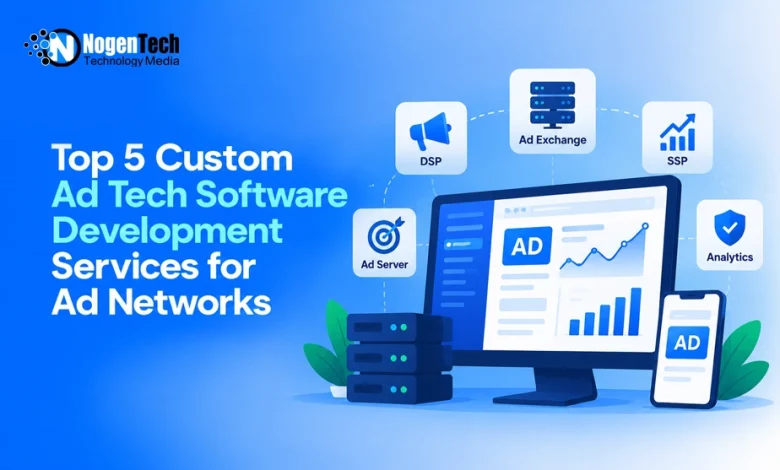
Top 5 Custom Ad Tech Software Development Services for Ad Networks

Running an ad network requires more than connecting advertisers with publishers. Managing real-time bidding, traffic quality, reporting, and demand partners becomes more complicated as your network grows. Ready-made advertising platforms can handle basic operations, but they may not offer the flexibility your business needs.
Custom ad tech software development services help networks build platforms around their specific requirements, including supply-side platforms (SSPs), demand-side platforms (DSPs), ad exchanges, analytics, and fraud detection systems.
Choosing the right development partner depends on your advertising model, technical requirements, and budget. Below are five AdTech development companies, their main services, and what makes each suitable for different projects.
| Company | Best For | What to Consider |
|---|---|---|
| Attekmi | White-label ad exchanges and custom programmatic platforms | White-label vs. fully custom development |
| Oxagile | Video advertising and OTT/CTV monetization | Video-specific integrations |
| Geomotiv | End-to-end AdTech platform development | Project complexity and scope |
| Xenoss | Data-intensive and AI-driven AdTech systems | Data engineering requirements |
| Clearcode | Custom RTB and programmatic platforms | Integrations and ownership terms |
Top 5 Custom Ad Tech Software Development Companies Explained
Start creating Verdict in seconds, and convert more of your visitors into leads.
1. Attekmi
Attekmi provides white-label AdTech infrastructure and custom software development services for ad networks, publishers, agencies, and media businesses.
Its solutions include ad exchanges, SSPs, DSPs, ad servers, and programmatic marketplaces. Businesses can use white-label AdTech infrastructure to launch branded platforms or develop custom components for specific advertising requirements.
Best for: Ad networks launching branded programmatic platforms or developing custom advertising infrastructure.
Key Services:
- White-label ad exchanges and SSPs
- Custom DSP and ad server development
- RTB integrations and auction customization
- Publisher monetization and traffic management
- Analytics and reporting dashboards
- Self-service advertising portals
Attekmi is particularly suitable for networks that want to control demand connections, auction rules, and monetization workflows without building every platform component from scratch.
2. Oxagile
Oxagile develops advertising technology for publishers, AdTech companies, and digital media businesses, with particular experience in video and streaming environments. Its services cover programmatic advertising platforms, video monetization, and integrations for OTT and connected TV.
Best for: Video-focused ad networks, streaming platforms, and OTT publishers.
Key Services:
- SSP and DSP development
- Video advertising platforms
- OTT and CTV monetization
- RTB and header bidding integrations
- Advertising analytics and reporting
Oxagile is worth considering if your network handles video inventory and needs specialized ad delivery, measurement, or streaming integrations.
3. Geomotiv
Geomotiv offers custom AdTech development for businesses building new advertising platforms or improving existing systems. Its services include DSPs, SSPs, ad exchanges, data management platforms, and real-time bidding integrations.
Best for: Ad networks requiring complete platform development or complex system integrations.
Key Services:
- Custom DSPs, SSPs, and ad exchanges
- Ad server development
- OpenRTB integrations
- Data management platforms
- Advertising analytics
- Platform modernization and performance optimization
Geomotiv is a relevant choice for networks developing multiple connected components, such as an SSP with analytics, fraud controls, and partner management tools.
4. Xenoss
Xenoss specializes in custom AdTech software, data engineering, and high-load advertising systems. Its development services include programmatic platforms, real-time data processing, analytics, and AI-supported advertising tools.
Best for: Data-intensive advertising platforms and networks requiring specialized analytics or AI integration.
Key Services:
- SSP, DSP, and ad exchange development
- Real-time bidding engines
- Advertising data pipelines
- AI-driven audience segmentation
- Fraud detection systems
- Attribution and analytics tools
Xenoss is suitable for networks handling large volumes of advertising data or developing advanced targeting and optimization capabilities.
5. Clearcode
Clearcode develops advertising technology, marketing technology, and data platforms for businesses with specialized requirements. Its services include DSPs, SSPs, ad exchanges, and self-service advertising platforms across different advertising channels.
Best for: Ad networks developing custom RTB infrastructure and self-service advertising solutions.
Key Services:
- Custom DSP and SSP development
- Ad exchanges and RTB systems
- Self-service advertising platforms
- Advertising analytics and attribution
- Data platform development
- Cross-channel integrations
Clearcode is worth considering for networks that need custom bidding systems, advertiser-facing tools, or integrations across multiple advertising formats.
Key Features of Effective Ad Tech Software Development Services
Start creating Verdict in seconds, and convert more of your visitors into leads.
Before choosing a development partner, make sure its capabilities match your network’s technical and operational requirements.
Real-Time Bidding Integration
RTB allows advertising inventory to be bought and sold through automated auctions in milliseconds. It plays an important role in programmatic advertising, where automated systems connect advertisers with available inventory.
A development partner should understand OpenRTB standards, auction logic, bidstream processing, and latency requirements. Support for header bidding, server-side bidding, and high query-per-second (QPS) volumes is also important for larger networks.
Advanced Analytics and Reporting
Ad networks need accurate reporting to monitor revenue, traffic, and campaign performance. Useful capabilities include revenue breakdowns, log-level data processing, anomaly detection, and dashboards that compare performance across publishers, placements, and demand partners.
Cross-Platform Compatibility
Advertising networks often manage inventory across desktop, mobile web, apps, and connected TV. A custom platform should support the relevant advertising formats and integrations, including SDKs, ad tags, and video players, without requiring completely separate systems for each channel.
Benefits of Investing in Custom Ad Tech Software Development Services
Start creating Verdict in seconds, and convert more of your visitors into leads.
Custom AdTech platforms can provide several advantages over standard advertising software.
- Performance and Scalability: Platforms can be designed around specific traffic volumes, latency requirements, and infrastructure needs.
- Targeting and Monetization Control: Networks can introduce custom audience segmentation, auction rules, pricing models, and demand integrations.
- Competitive Differentiation: Specialized features and workflows can help networks serve particular advertising markets without relying entirely on standard platform capabilities.
However, custom development also involves higher technical responsibility, ongoing maintenance, and potentially greater upfront costs. These benefits depend on the quality of the platform’s architecture and implementation.
Conclusion: Elevate Your Ad Network with Custom Ad Tech Software Development Services
Start creating Verdict in seconds, and convert more of your visitors into leads.
The right AdTech development partner depends on your network’s business model and technical needs. Attekmi offers white-label and custom programmatic infrastructure, while Oxagile focuses on video and OTT advertising. Geomotiv supports end-to-end platform development, Xenoss specializes in data-intensive systems, and Clearcode provides custom RTB and programmatic solutions.
Before selecting a provider, compare its technical experience, customization capabilities, development costs, and ongoing support. The goal is to choose a platform that meets your current requirements while leaving room for future growth.