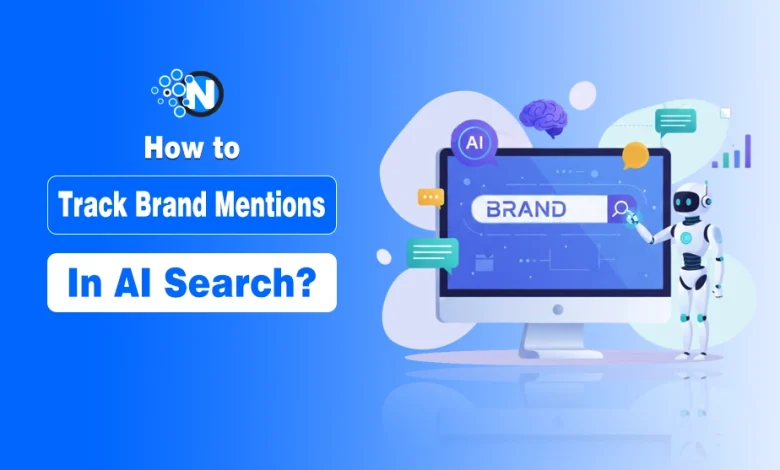
AI-powered search platforms like ChatGPT, Gemini, Perplexity, Claude, and Google AI Overviews have changed how people discover brands online.
Instead of scrolling through traditional Google results, users now trust AI-citations, recommendations, and AI-generated answers while researching products and services.
I personally experienced this yesterday during a lunch break with my team. While searching for pizza places online, one teammate simply checked Google AI Overviews, picked a recommendation, and never scrolled further down the page.
That is exactly why AI search monitoring matters now. If AI search engines recommend your competitors instead of your brand, you are quietly losing visibility, trust, traffic, and potential customers.
Now, I will take you through what AI search monitoring is, how AI brand mentions work, and the best ways to track brand visibility across major AI search platforms.
What is AI Search Monitoring?
AI search monitoring is the process of tracking how Large Language Models (LLMs) and AI-powered answer engines like ChatGPT, Gemini, Perplexity, Claude, and Google AI Overviews mention, cite, and recommend brands online.
As AI-powered search adoption continues growing in the United States, businesses now need to monitor more than just Google rankings. A January 2026 Clutch report states that 65% of users now use AI tools before making a purchase amid rising agentic commerce trends.
AI search monitoring helps brands:
- Track AI-generated brand mentions
- Monitor citations across AI search platforms
- Measure AI visibility and share of voice
- Analyze competitor presence in AI answers
- Improve visibility in conversational and generative search results
How Does AI Search Monitoring Work?
AI search monitoring tools use machine learning and natural language processing (NLP) to track how AI-powered search engines and answer platforms interpret, mention, and recommend brands online.
These tools usually help businesses:
- Scan AI-generated search results across platforms like ChatGPT, Google AI Overviews and more
- Detect brand mentions, even without direct backlinks or citations
- Track how AI systems summarize and interpret website content
- Analyze sentiment, context, and recommendation accuracy
- Monitor competitor visibility in AI-generated answers
- Identify changes in AI search responses over time
This helps marketers, SEO professionals, agencies, and SaaS brands understand how their business appears across conversational search, AI summaries, voice search, and generative search experiences.
Why Use AI Search Monitoring Tools?
AI search monitoring tools are important because AI platforms such as ChatGPT, Gemini, Perplexity, and Claude now generate direct answers using real-time web information; search is no longer limited to blue links and keyword rankings.
This means:
- Fewer users click traditional search results
- Brands mentioned in AI answers gain visibility and trust
- Brands excluded from AI responses lose traffic, even with strong Google rankings
AI search monitoring tools help businesses:
- Track AI-generated brand mentions and citations
- Monitor competitor visibility in AI answers
- Analyze sentiment and recommendation accuracy
- Discover which prompts trigger your brand
- Measure AI visibility and share of voice
- Track whether new content appears in AI search results
- Prove ROI from SEO, content marketing, and digital PR efforts
From my experience, brands that do not monitor AI visibility risk becoming invisible across the fastest-growing AI search platforms over the next few years.
Best Ways to Track Brand Mentions in AI Search
Here are the best ways to track mentions in AI search. This includes methods from the simplest to the time-consuming ones:
1. Manual spot-checks in the major AI chatbots (fastest way to start)
To quickly analyze AI search visibility, test branded and industry-specific queries across platforms like ChatGPT, Claude, Gemini, Perplexity, Grok, and Google AI Overviews.
I regularly monitor how these AI search engines mention brands, surface citations, summarize content, and recommend sources inside AI-generated answers. This helps me:
- Identify visibility gaps
- Competitor positioning
- Citation opportunities
- Sentiment patterns across conversational search results
Some common query patterns include:
- Best [product category] in 2026
- Alternatives to [competitor]
- Reviews of [brand]
- Is [brand] worth it?
- Best [service] in the USA
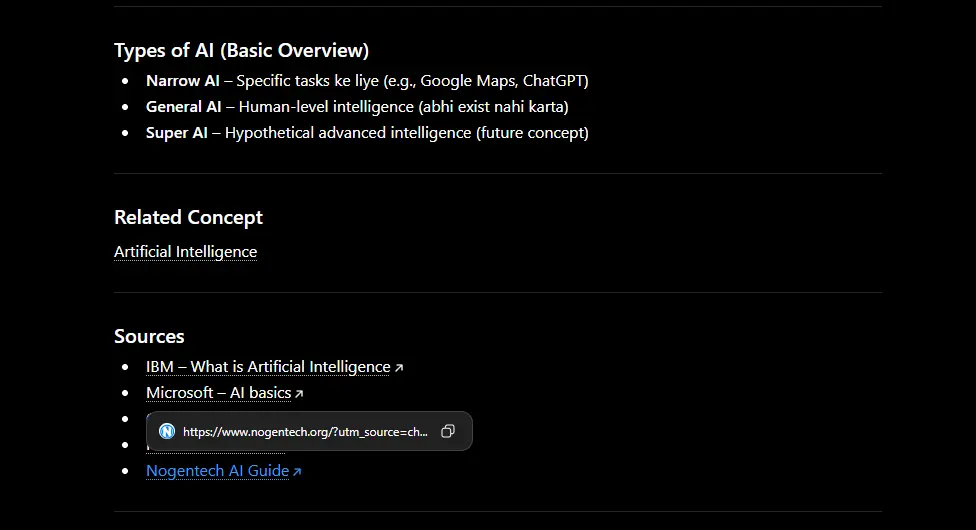
As an example, one of my AI-related articles, such as What is AI was directly cited inside a ChatGPT-generated response while explaining Artificial Intelligence concepts.
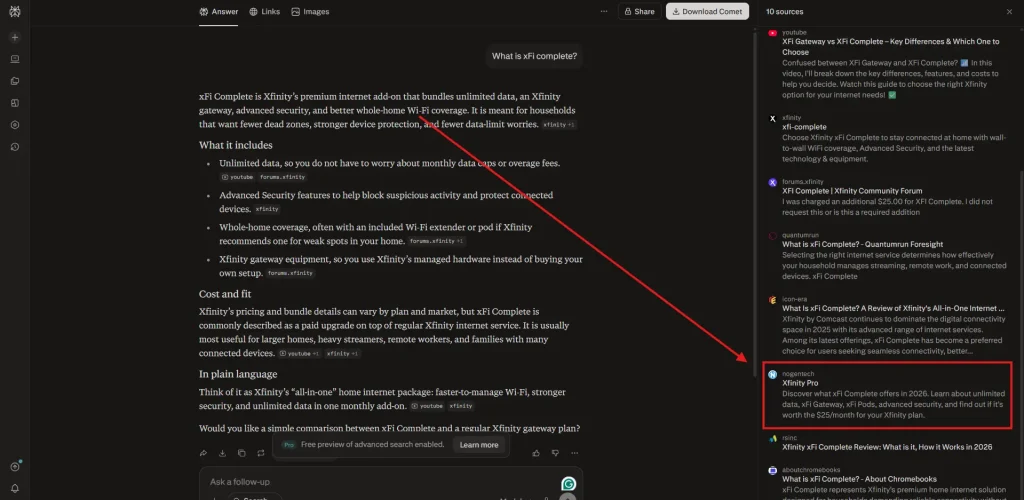
In another example, Perplexity also surfaced NogenTech as a referenced source while answering a branded technology-related query, “What is xFi Complete“.
Even a simple weekly review of AI-generated answers can help businesses track:
- AI search visibility trends over time
- AI-generated brand mentions
- Citation frequency across AI platforms
- Competitor visibility in AI search
- Brand sentiment and recommendation tone
2. Set up branded AI alerts with Google Alerts + brand-name searches
Another effective way to monitor AI search visibility is by tracking branded mentions across Google Search, news sites, Reddit, forums, and review platforms before they start appearing inside AI-generated answers.
My team mate always monitors branded search patterns using Google Alerts and targeted brand-name searches such as:
- “[brand name]”
- “[brand name] review”
- “[brand name] vs competitor”
- “[brand name] better than”
- “[brand name] alternatives”
It is also important to track:
- Product names
- Founder names
- Competitor brands
- Industry keywords
- Branded search variations
This helps identify new mentions across blog posts, Reddit discussions, news articles, forums, and comparison pages, a core part of modern digital PR campaigns designed to build online authority. Many of these sources are later indexed, summarized, and cited by AI platforms and Google AI mode.
While Google Alerts is not a complete AI search monitoring solution, it is still useful for:
- Discovering early brand mentions
- Reputation trends
- Citation opportunities
It can also later influence LLM visibility and AI-generated recommendations.
3. Use Brand Monitoring Tools That Now Track AI Citations
Many traditional brand monitoring platforms now include AI search tracking features that monitor how brands appear across AI-generated answers and conversational search platforms.
Some widely used tools include:
- Brand24: Tracks AI-generated brand mentions across platforms like ChatGPT, Gemini, and Perplexity using its AI listening capabilities.
- Talkwalker: Includes AI search monitoring features that analyze brand mentions, competitor visibility, and AI-generated recommendations.
- Hootsuite Insights: Combines social listening with AI mention tracking and helps identify prompts that trigger brand appearances.
These tools usually help businesses:
- Track AI-generated brand mentions
- Monitor competitor visibility in AI answers
- Identify prompts that trigger brand citations
- Analyze sentiment and recommendation context
- Measure citation frequency and ranking position
- Discover visibility trends across AI search engines
4. Dedicated AI visibility & AEO monitoring tools (Most Accurate 2026 Method)
Dedicated AI visibility and AEO monitoring platforms are currently the most advanced way to track brand mentions across AI search engines and large language models (LLMs).
Once you’ve used them to spot your visibility gaps, you’ll likely want to switch gears into optimization. I have mapped out the best platforms for that in NogenTech’s guide on the Top AI Search Optimization Tools for Small Businesses.
They typically help businesses monitor:
- How often a brand appears in AI-generated answers
- Citation position and ranking order
- Competitor visibility across AI search results
- Sentiment and recommendation tone
- Conversational prompts that trigger brand mentions
- AI share of voice and visibility trends
Some popular AI search monitoring tools include:
- Ahrefs AI Visibility Tracker
- Otterly
- Ryze AI
- Semrush AI Toolkit
- Surfer AI Search Visibility
- Peec.ai
- Glimpse.ai
- Rankscale
Most of these tools cost between $99 and $499 per month, depending on:
- Query volume
- Tracking depth
- Reporting features
5. Build Your Own Lightweight Monitoring Tool
For technical teams, agencies, and advanced marketers, another option is building a lightweight AI search monitoring workflow using APIs and Automation tools.
Many brands now use the OpenAI API, Anthropic API, or Custom LLM Workflows to automatically test branded queries across AI search platforms and conversational search environments.
A simple setup usually includes:
- Running 20–50 branded or competitor-related prompts weekly
- Logging AI-generated answers in Google Sheets or dashboards
- Using Regex or LLM parsing to detect brand mentions and citation positions
- Tracking visibility trends and sentiment changes over time
This approach is especially useful for agencies and SaaS companies that want AI visibility tracking without paying hundreds of dollars monthly for enterprise monitoring platforms.
What I Observed While Testing AI Search Mentions?
While monitoring branded prompts across ChatGPT, Grok, and Perplexity, I noticed that each AI platform handled citations differently.
- ChatGPT usually displayed direct source citations alongside answers
- Perplexity surfaced linked references more aggressively within search results
- Grok blended mentions naturally into conversational responses without always highlighting sources separately
I also noticed that platforms frequently referenced:
- Reddit discussions
- Authoritative blog content
- Recently updated pages
- Well-structured informational content
This shows that AI visibility is no longer only about rankings and backlinks. Content freshness, entity authority, conversational relevance, and citation trust now play a major role in how AI search engines recommend brands online.
What are the Best AI Search Monitoring Tools?
1. Ahrefs AI Visibility Tracker
Best for: SEO agencies and serious e-commerce brands.
Pricing: $129 (lite)
Key features:
- AI Share of Voice (SOV)
- AI Visibility Impressions
- AI Responses Report
- AI Mention & Citation Gaps
- Cited Domains & Pages Reports
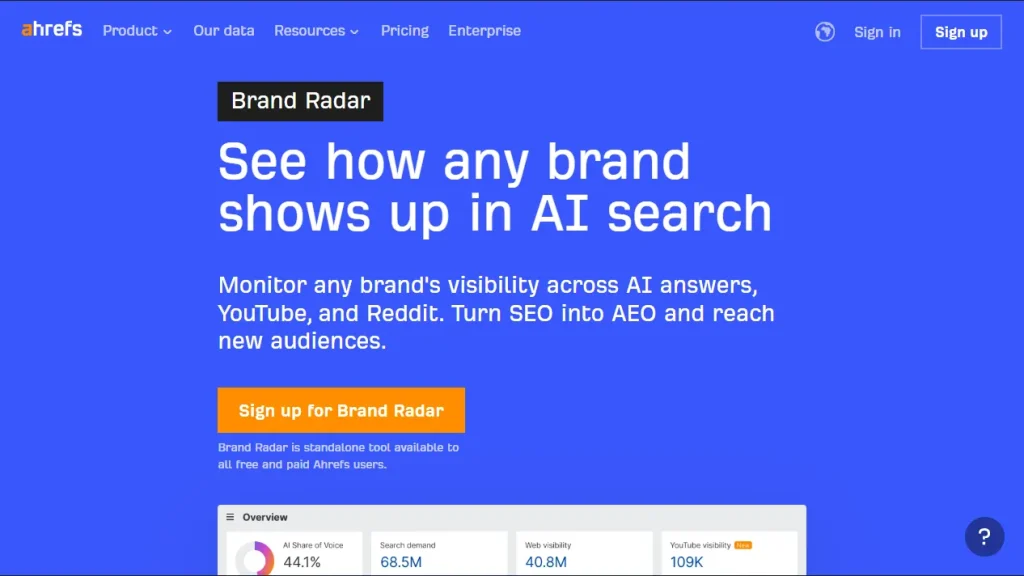
It is one of the earliest and most trusted platforms in AI visibility tracking. Ahref’s Brand Radar, also known as the AI visibility tracker, tracks your brand across major LLMs with thousands of daily queries.
It shows position, prompt triggers, sentiment, and competitor comparison. After that, it integrates with traditional SEO data. SEO agencies and serious e-commerce brands.
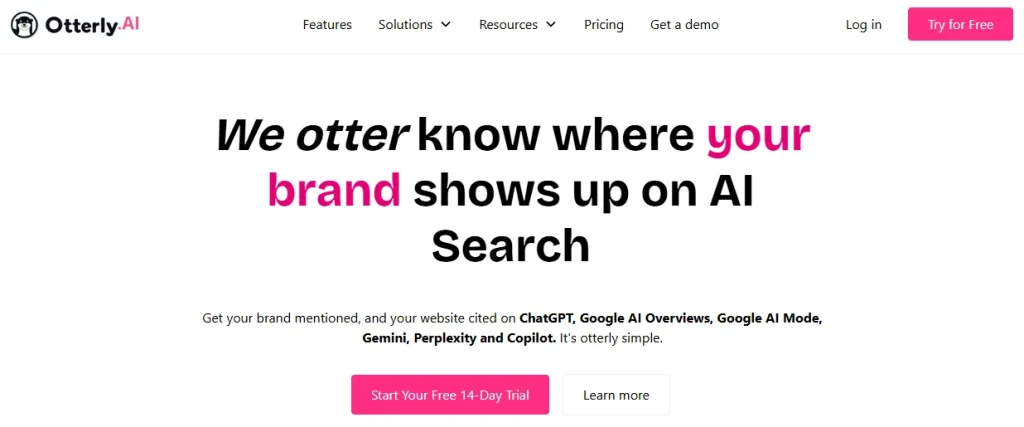
2. OtterlyAI
Best for: Marketing teams and agencies tracking AI visibility across multiple platforms and countries.
Pricing: $29/month (Lite)
Key features:
- Brand Mention and Citation Tracking (6 AI platforms)
- Brand Visibility Index
- Share of Voice
- GEO Audit (Crawlability + Content Readiness)
- AI Keyword Research Tool
- Brand Sentiment Analysis
OtterlyAI analyzes AI-generated answers for brand mentions, competitor visibility, citations, Share of Voice, and average brand position using scheduled prompt tracking.
One of its most useful features is the GEO Audit tool, which checks whether AI crawlers can access your content and evaluates your site’s readiness for AI search. OtterlyAI also includes an AI keyword research feature that converts traditional SEO keywords into conversational AI search prompts.
The platform supports country-based tracking across 50+ regions, making it useful for agencies, SaaS brands, and marketers focused on scalable AI visibility monitoring and AEO optimization.
3. Ryze AI
Best for: Ecommerce and Shopify brands improving AI search visibility without a dedicated SEO team.
Pricing: Starts at $129/month (SEO Autopilot)
Key features:
- AI visibility optimization for ChatGPT and AI agents
- GEO and SEO automation
- AI-generated SEO pages
- Technical SEO improvements
- Competitor content optimization
- MCP integration
Ryze AI combines AI search optimization with SEO automation to help ecommerce brands improve their visibility in AI-generated answers. It creates and optimizes pages, applies technical SEO improvements, and makes websites more accessible to AI crawlers.
Unlike tools that only report AI visibility, Ryze AI focuses on implementation by automating GEO and SEO tasks. It’s a good fit for Shopify stores and ecommerce businesses looking to improve discoverability across AI search platforms.

4. Semrush AI Toolkit
Best for: Full-service marketing teams already using Semrush.
Pricing: $199 /month (Starter)
Key features:
- AI Mentions Tracking
- AI Share of Voice (SOV)
- Brand Performance Dashboard
- Prompt Research Report
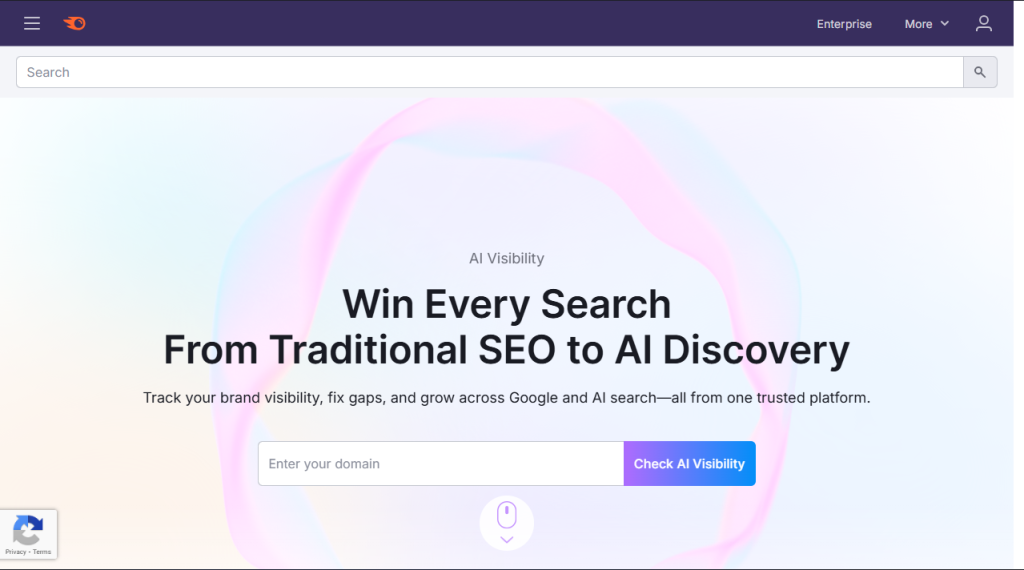
This platform has expanded massively. Semrush AI toolkit tracks your brand mentions in ChatGPT, Gemini, Perplexity, and more.
Other than that, it also shows source links cited, position, and trend graphs. I will personally say that the Semrush AI toolkit is very good for spotting sudden drops after algorithm updates.
5. Surfer AI Search Visibility
Best for: Content-heavy brands and publishers.
Pricing: $52/month for basic tracking.
Key features:
- AI Mention Tracking
- AI Citation Insights
- Mention Gap Analysis
- Sentiment Tracking
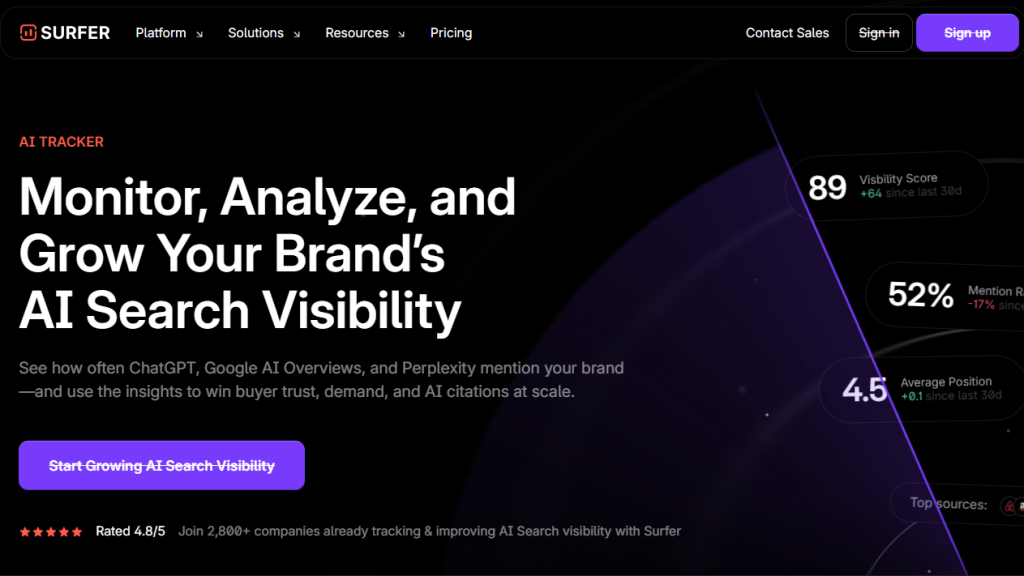
Surfer AI search tracker is very focused on AEO (Answer Engine Optimization). This helps you to track how often you appear in AI answers, which prompts surface, and how your content is summarized.
This platform is a great prompt database for testing. It is also helpful in sentiment tracking about your platform in AI search results.
6. Peec AI
Best for: Mid-size brands wanting affordable but deep AI monitoring.
Pricing: €89 /month (includes 25 prompts and tracking in 3 countries)
Key features:
- AI Visibility Dashboard
- AI Share of Voice
- Suggested Prompts
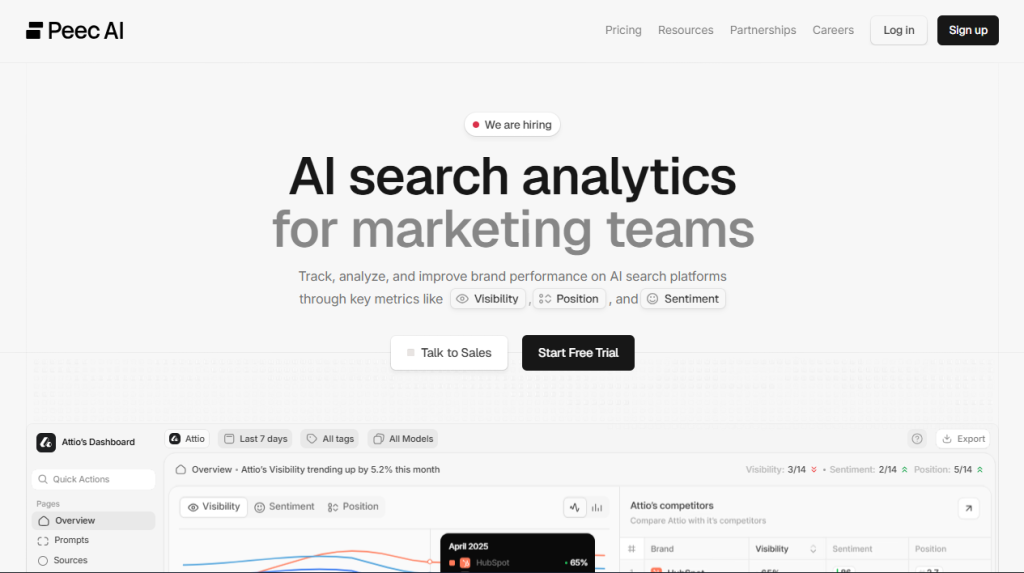
Peec.ai is a fast-growing European tool for tracking AI search visibility. This works best for mid-sized brands that require AI tracking, but it is an affordable option.
It is excellent at showing exact prompts with answer pairs. This also helps in tracking strong competitor benchmarking and sentiment analysis.
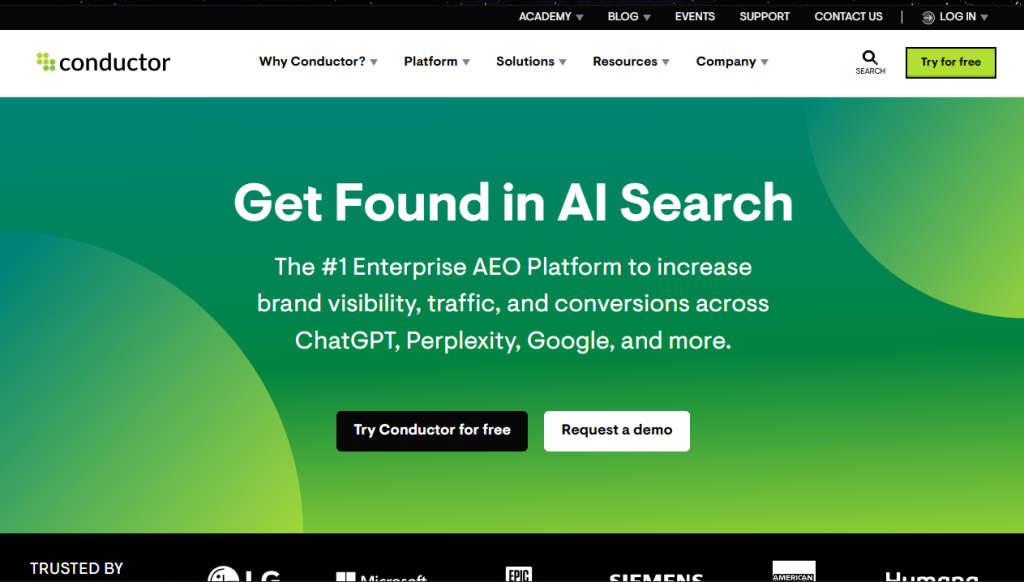
7. Conductor AI
Best for: Executive-friendly AI visibility reports
Pricing: Depends on your website (Not fixed tiers)
Key features:
- AI Overview Tracking
- Answer Engine Optimization (AEO) Dashboard
- Sentiment and Brand Perception Analysis
- Citation Tracking
Conductor has featured a new AEO tracking tool in the market. It specializes in real-time monitoring of how brands appear across ChatGPT, Claude, Perplexity, Gemini, and Grok.
This provides you with prompt-level insights, citation position tracking, and automated weekly competitor reports.
7-Day Action Plan for AI Search Monitoring
Here is a quick 7-day plan that you should definitely try to analyze whether your brand appears in AI searches:
- Day 1: Run manual searches in ChatGPT, Claude, Gemini, and Perplexity using 10 of your most important customer questions. Screenshot every mention or absence that you track.
- Day 2: Pick one monitoring tool from the list above and sign up for a trial.
- Day 3–4: Set up branded queries and let them run for a couple of days.
- Day 5: Look at the first report. Note your brand’s position, sentiment, and top competitors.
- Day 6: Share the report with your team or boss. Decide on one improvement to test, such as new content, better link-building, press push, etc.
- Day 7: Run the same 10 manual searches again and compare.
This will give you real baseline data of your brand’s one-week performance and a clear next step.
People Also Ask
What is the difference between AI search visibility and traditional SEO?
Traditional SEO focuses on rankings and clicks, while AI search visibility focuses on how often AI systems mention, summarize, cite, and recommend your brand in generated answers.
Do Reddit and forums influence AI citations?
Yes. Platforms like Reddit, Quora, forums, and community discussions are frequently used by AI search engines for contextual understanding and answer generation.
What are AI citations?
AI citations are the websites, sources, or references AI search engines use while generating answers, summaries, and recommendations.
Can I track competitor mentions in AI search?
Yes. Most AI visibility tools and manual monitoring workflows allow businesses to track competitor appearances, citations, and recommendation frequency across AI platforms.
What is GEO optimization in AI search?
GEO (Generative Engine Optimization) is the process of optimizing content so AI-powered search engines and answer platforms can better understand, cite, and recommend your brand.
What is AEO in SEO?
AEO (Answer Engine Optimization) focuses on optimizing content for AI-generated answers, featured snippets, conversational search, and answer engines like ChatGPT and Google AI Overviews.
How do AI monitoring tools detect brand mentions without backlinks?
Most AI visibility tools use NLP, entity recognition, and prompt analysis to detect brand mentions, even when AI platforms do not provide direct links.
Are AI Overviews affecting website traffic?
Yes. Google AI Overviews can reduce clicks to traditional search listings because users often get direct answers without visiting websites.
What is LLM visibility?
LLM visibility refers to how often large language models like ChatGPT, Claude, Gemini, and Perplexity mention or cite your brand in generated responses.
Final Thoughts on Tracking Brand Mentions in AI Search
Now you know how to track brand mentions in AI search using practical methods and reliable tools. In 2026, AI search is as essential as Google. If your brand is not showing up in answers from ChatGPT, Gemini, Claude, Perplexity, and other AI tools, you are quietly losing visibility, trust, and revenue.
Start with the basics, such as running manual checks, setting up alerts, and testing at least one AI search monitoring tool. I use these approaches for the NogenTech brand, and they deliver real insights. Take action this week and make sure AI is highlighting your brand, not overlooking it.