The tools you choose today can determine how efficiently your business grows tomorrow.
Every growing business reaches a point where spreadsheets, emails, and disconnected tools start slowing operations. From my experience, the biggest difference between companies that scale and those that struggle is often the software they choose. In fact, choosing the right software partners can also empower businesses in multiple ways.
The best B2B SaaS companies help businesses:
- Provide automation tools
- Strengthen customer relationships
- Improve team collaboration
- Manage projects
- Simplify payroll
- Make data-driven decisions
To make your decision easier, I’ve researched and shortlisted the top B2B SaaS companies trusted by businesses worldwide. Whether you’re launching a startup or scaling an established company, this will help you understand what each platform offers, where it excels, and who it’s best suited for.
What Is a B2B SaaS Company?
A B2B SaaS company provides cloud-based software that helps businesses automate operations, improve productivity, and scale through subscription-based services.
Unlike B2C SaaS, which targets individual consumers, B2B SaaS companies build software for businesses. Their solutions support functions like CRM, project management, payroll, communication, accounting, and workflow automation without requiring on-premise installation.
Popular B2B SaaS companies include Salesforce, Shopify, Slack, Atlassian, and Dropbox, serving startups, SMBs, and enterprises across the United States and worldwide.
Key characteristics of B2B SaaS companies
- Cloud-based software accessible through a web browser
- Subscription pricing with monthly or annual plans
- Scalable solutions for growing businesses
- Automatic updates and maintenance
- Third-party integrations with business applications
- Enterprise-grade security and compliance
Top 10 B2B SaaS Companies to Grow Your Business in 2026
Below are the top B2B SaaS companies trusted by startups, SMBs, and enterprises to improve productivity, automate workflows, and scale efficiently.
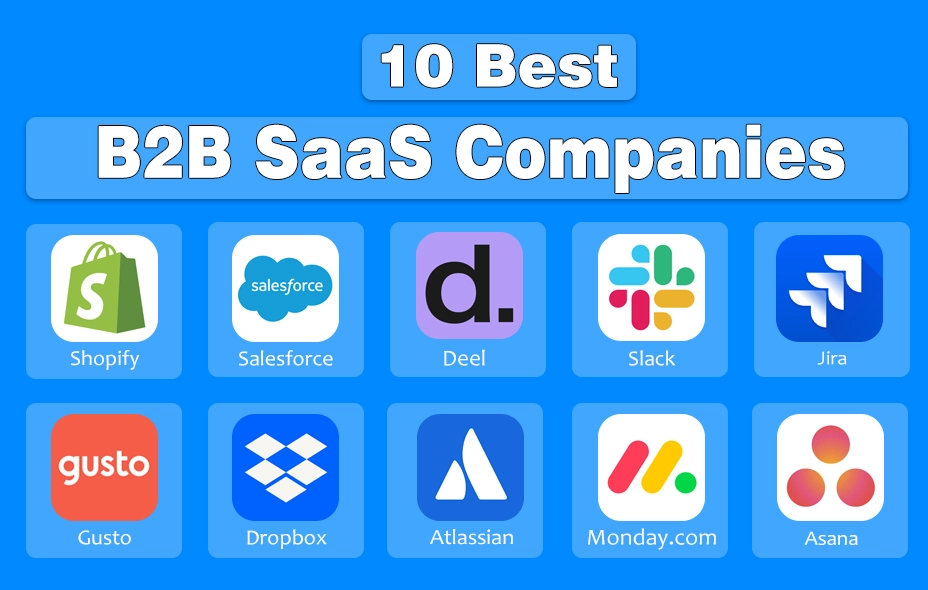
- Shopify – Best for B2B eCommerce and omnichannel selling
- Salesforce – Best for customer relationship management (CRM)
- Deel – Best for global hiring and payroll
- Slack – Best for team communication and collaboration
- Jira – Best for agile project management
- Gusto – Best for payroll and HR management
- Dropbox – Best for cloud storage and file sharing
- Atlassian – Best for team productivity and collaboration
- Monday.com – Best for workflow and work management
- Asana – Best for task and project management
1. Shopify
Shopify is a leading B2B SaaS company that enables businesses to sell online, manage operations, and scale through a cloud-based commerce platform.
This helps businesses manage online and offline sales from a single platform. It supports websites, mobile apps, social media, marketplaces, and retail stores while simplifying inventory, orders, payments, and customer management.
Its ecosystem includes Shopify Payments, built-in analytics, marketing automation, thousands of app integrations, and Shopify Plus for wholesale selling, custom storefronts, and advanced B2B capabilities.
Best for: B2B wholesalers, eCommerce brands, retailers, and enterprises looking for an all-in-one commerce platform.
Key Features
- Omnichannel selling
- Inventory and order management
- Secure payment processing
- Marketing automation and analytics
- Third-party app integrations
- Shopify Plus for enterprise B2B commerce

Startups, growing businesses, and established companies that want to scale online sales without managing hosting or complex technical infrastructure.
2. Salesforce
Salesforce is another SaaS company that helps businesses manage customer relationships, automate sales, and analyze data through cloud-based CRM software.
It centralizes customer data, leads, sales pipelines, marketing, customer support, and commerce in one platform. Its products, including Sales Cloud, Marketing Cloud, Service Cloud, and Einstein AI, help businesses automate workflows, personalize customer interactions, and make data-driven decisions.
Best for: B2B businesses, sales teams, and enterprises managing customer relationships at scale.
Key Features
- Lead and customer management
- Sales pipeline automation
- AI-powered analytics with Einstein AI
- Marketing and customer service automation
- Custom workflows and third-party integrations
- Real-time dashboards and reporting
Startups, growing businesses, and enterprises that need a scalable CRM for sales, marketing, customer support, and business operations.
3. Deel
Deel enables businesses to hire, pay, and manage international teams without setting up local legal entities.
Expanding into global markets often means navigating different employment laws, tax regulations, and compliance requirements. Deel removes these barriers by giving businesses a centralized platform to build and manage an international workforce, making global expansion faster, simpler, and less risky.
Best for: Remote-first companies, global startups, and enterprises hiring international talent.
Key Features
- Global payroll across 150+ countries
- Employer of Record (EOR) services
- Contractor onboarding and management
- Automated tax and compliance management
- Localized employee benefits
- Multi-currency payments and invoicing
Businesses planning to expand globally or manage employees and contractors across multiple countries without increasing administrative complexity.
4. Slack
Slack centralizes team communication, making it easier to collaborate, share information, and keep work organized in one place.
As businesses grow, scattered emails and disconnected conversations slow decision-making. Slack replaces traditional communication with organized channels, helping teams collaborate in real time while keeping discussions, files, and updates searchable and accessible from a single workspace.
Best for: Startups, remote teams, agencies, and enterprises that rely on real-time collaboration.
Key Features
- Channel-based team communication
- Audio and video huddles
- File sharing and searchable message history
- Workflow Builder for task automation
- Integrations with thousands of business apps
- Slack Connect for collaborating with external partners
Businesses looking to reduce email, improve team communication, and keep projects, conversations, and resources organized across departments.
5. Jira
Jira helps teams plan, track, and deliver projects with agile workflows and issue management tools.
Developed by Atlassian, Jira gives software and product teams complete visibility into every stage of development. It simplifies sprint planning, task tracking, and issue resolution, enabling teams to collaborate efficiently, meet deadlines, and deliver high-quality software faster.
Best for: Software development teams, IT departments, and agile organizations.
Key Features
- Scrum and Kanban boards
- Backlog and sprint management
- Bug and issue tracking
- Custom workflows and automation
- Roadmaps and release planning
- Reports and performance dashboards
Businesses and development teams that need a structured platform to manage projects, track issues, and streamline agile software delivery.
6. Gusto
Gusto simplifies payroll, benefits, and HR, helping businesses manage employees from a single platform.
Managing payroll and HR manually can be time-consuming and error-prone. Gusto streamlines people operations in small and mid-sized businesses by reducing administrative work, improving compliance, and giving businesses an easier way to support employees throughout their lifecycle.
Best for: Small and mid-sized businesses, startups, and growing teams.
Key Features
- Automated payroll processing
- Tax filing and compliance
- Employee onboarding
- Health insurance and benefits administration
- Time tracking and PTO management
- Retirement plans and HR tools
Businesses that want to automate payroll, simplify HR processes, and manage employee benefits without investing in complex HR software.
7. Dropbox
Dropbox makes it easy for businesses to store, access, and collaborate on files securely from anywhere.
As teams become more distributed, secure file access and seamless collaboration are essential. Dropbox provides a centralized workspace where businesses can organize documents, share large files, and collaborate without worrying about version conflicts or device limitations.
Best for: Remote teams, agencies, creative professionals, and businesses managing shared documents.
Key Features
- Cloud storage and file synchronization
- Secure file sharing with access controls
- Dropbox Sign for electronic signatures
- File recovery and version history
- Third-party app integrations
- Admin controls and security features
Businesses that need secure cloud storage, simple file sharing, and collaborative document management across multiple devices and teams.
8. Atlassian
Atlassian helps businesses connect teams, manage knowledge, and streamline work with an integrated suite of productivity tools.
Rather than relying on a single application, Atlassian offers a connected ecosystem that improves collaboration across software development, IT, operations, and business teams. Its products work together to centralize documentation, simplify knowledge sharing, and keep projects aligned from planning to delivery.
Best for: Software companies, IT teams, and enterprises managing cross-functional collaboration.
Key Features
- Jira for project and issue tracking
- Confluence for documentation and knowledge management
- Trello for visual task management
- Jira Service Management for IT support
- Cross-product integrations
- Automation for repetitive workflows
Organizations that need an integrated workspace to connect projects, documentation, service management, and team collaboration in one ecosystem.
9. Monday.com
Monday.com helps businesses organize projects, workflows, and team operations through a highly customizable work management platform.
Every team manages work differently, and Monday.com adapts to those processes instead of forcing a fixed workflow. Its visual interface allows organizations to coordinate projects, sales, marketing, operations, and client work from a centralized workspace, improving visibility and accountability across teams.
Best for: Growing businesses, agencies, marketing teams, and organizations managing multiple workflows.
Key Features
- Customizable workflow boards
- Project and task management
- Workflow automation
- Real-time dashboards and reporting
- CRM, marketing, and business templates
- Integrations with popular business applications

Businesses that need a flexible platform to organize projects, automate repetitive work, and track progress across departments.
10. Asana
Asana helps teams turn business goals into organized tasks, projects, and measurable outcomes from a single workspace.
Keeping projects on schedule requires more than assigning tasks. Asana helps teams prioritize work, coordinate responsibilities, and monitor progress, ensuring everyone stays aligned with business objectives and deadlines.
Best for: Project managers, marketing teams, operations teams, and growing businesses.
Key Features
- Task and project management
- Timeline and calendar views
- Workload management
- Task dependencies and milestones
- Goals and progress tracking
- Automation and third-party integrations
Organizations that need a structured platform to coordinate projects, improve accountability, and keep teams aligned with strategic goals.
How Do You Choose the Right B2B SaaS Company?
Choose a B2B SaaS company based on your business needs, scalability, integrations, security, pricing, and customer support.
Not every B2B SaaS company is built for the same purpose. While Shopify excels in eCommerce, Salesforce focuses on CRM, Slack improves communication, and Deel simplifies global hiring. Evaluating your requirements before investing helps you select software that supports long-term growth.
Consider these factors before choosing a platform:
- Business needs: Identify the problem you want to solve.
- Scalability: Choose software that grows with your business.
- Integrations: Ensure compatibility with your existing tools.
- Ease of use: Look for an intuitive interface and minimal learning curve.
- Security and compliance: Verify data protection and industry certifications.
- Pricing: Compare plans based on your budget and required features.
- Customer support: Check the availability of documentation, training, and live support.
Selecting the right platform isn’t about choosing the most popular software; it’s about finding the solution that best fits your business goals and workflows.
What People Also Ask About B2B Companies
Which Is the Largest B2B SaaS Company?
Salesforce is widely considered the largest B2B SaaS company due to its global leadership in CRM, enterprise customer base, and annual recurring revenue.
Other major B2B SaaS companies include Shopify, Atlassian, Dropbox, and Slack, each serving different business needs.
What Is the Difference Between B2B SaaS and Enterprise SaaS?
B2B SaaS serves businesses of all sizes, while enterprise SaaS is designed specifically for large organizations with complex operational needs.
Platforms like Shopify and Monday.com support both SMBs and enterprises, whereas enterprise editions such as Salesforce Enterprise and Shopify Plus provide advanced customization, security, and scalability.
What Are Some Examples of B2B SaaS Products?
Popular B2B SaaS products include Salesforce CRM, Shopify Plus, Slack, Jira, Asana, Dropbox, Gusto, and Deel.
These cloud-based applications help businesses manage sales, communication, HR, payroll, collaboration, project management, and document storage through subscription-based services.
What Industries Use B2B SaaS Software?
B2B SaaS software is used across eCommerce, healthcare, finance, manufacturing, education, marketing, IT, logistics, and professional services.
Companies choose platforms like Salesforce, Jira, Slack, and Dropbox to improve collaboration, automate workflows, and increase operational efficiency.
Can Small Businesses Benefit From B2B SaaS Companies?
Yes, B2B SaaS companies help small businesses access enterprise-grade software without high upfront costs or IT infrastructure.
Platforms like Shopify, Gusto, Monday.com, and Asana offer scalable pricing, allowing startups and SMBs to grow without switching systems as their business expands.
My Final Take on the Best B2B SaaS Companies
Choosing the right B2B SaaS company isn’t about picking the biggest name—it’s about finding a platform that solves your business challenges and supports long-term growth.
Whether you need Shopify for eCommerce, Salesforce for CRM, Deel for global hiring, Slack for collaboration, or Asana for project management, each solution serves a different purpose.
After researching the best B2B SaaS companies, my biggest takeaway is that businesses succeed when they invest in software that fits their workflows, scales with their goals, and integrates seamlessly with the tools they already use. A well-chosen SaaS platform is a long-term business asset, not just another subscription.