Your smartphone knows what you want before you say a word.
It suggests the next video you will watch, finishes your sentences, flags spam emails, and even helps your camera take better photos. None of this is magic. It is machine learning at work.
I remember the first time this genuinely hit me. I was scrolling through my phone, and YouTube recommended a video so precisely aligned with what I had been thinking about that it felt almost unsettling. I had not searched for it. The algorithm just knew.
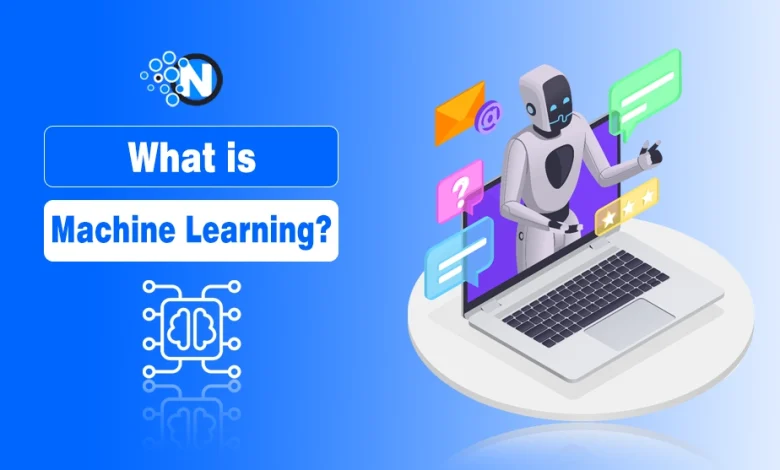
Machine learning is the technology that allows computers to learn from experience instead of following fixed instructions. Rather than being programmed step by step, machines study data, recognize patterns, and improve their decisions over time.
In this guide, you will explore what machine learning really means using simple language and everyday examples you already interact with. No technical overload, no confusing theories.
What is Machine Learning in Today's Context?
Machine learning is a branch of artificial intelligence that enables computers to learn from data and improve their performance without being explicitly programmed.
Instead of following fixed rules written by humans, machines analyze patterns, learn from experience, and make decisions on their own.
Think of it like teaching a child. You do not give them a rulebook for every situation. You show examples, correct mistakes, and over time, they get better.
When I first encountered this definition in my data science program, I nodded along without truly understanding it. It only became real when I built a digit recognition system that identifies handwritten numbers through a webcam.

I never wrote a single rule describing what the number 7 looks like. I showed the model 60,000 labeled examples, and it worked out the patterns on its own. That is when supervised learning stopped being a definition and became something I actually understood.
Core Types of Machine Learning Explained Simply
Machine learning is usually divided into four main types, based on how the system learns from data and experience. Each type solves different kinds of problems and is used in everyday technologies you already interact with.
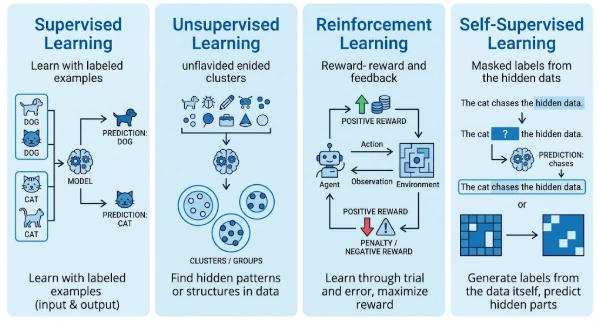
The above image, by Gemini, shows the core types of machine learning based on their learning approach. Note that self-supervised learning, which powers modern LLMs like ChatGPT and Gemini, has emerged as a fourth major type not always shown in traditional diagrams.
1. Supervised Learning
Supervised learning is the most common form of machine learning. In this approach, the model is trained using labeled data, which means the correct answers are already known. Especially generative engines.
For example, if you want a system to recognize animals, you feed it thousands of images labeled “cat” or “dog.” Over time, the model learns which visual features belong to each category and can correctly classify new images it has never seen before.
When I built my ASL sign language detection system, I collected images of hand gestures and labeled each one with the corresponding letter.
I then trained a YOLOv11 model to recognize them in real time through a webcam. Every labeled image was a lesson. The model learned from those lessons the same way a student learns from solved examples before an exam.
Supervised learning is widely used for:
- Email spam detection
- Credit score evaluation
- Medical diagnosis
- Image and speech recognition
Because the system learns from clear examples, supervised learning is highly accurate when quality data is available.
2. Unsupervised Learning
Unsupervised learning works differently. Here, the model is given unlabeled data, which means it does not know the correct answers in advance. Instead, it explores the data on its own and looks for hidden patterns, similarities, or groupings.
A simple way to understand this is customer behavior analysis. An unsupervised model can analyze shopping habits and automatically group customers with similar interests, even if no categories were defined beforehand.
I worked with this concept when building my job recommender system. The model had to find relationships between user skills and job roles without being told which skills belong to which career. Nobody labeled Python as belonging to data science. The model discovered those connections on its own by measuring how close different skill sets were to each other mathematically.
Unsupervised learning is commonly used for:
- Customer segmentation
- Market research
- Trend discovery
- Fraud and anomaly detection
This type of learning is especially useful when dealing with massive datasets where manually labeling data would be impractical or impossible.
3. Reinforcement Learning
Reinforcement learning is inspired by how humans and animals learn through experience. Instead of learning from labeled data, the system learns by trial and error.
The model takes actions in an environment and receives feedback in the form of rewards or penalties. Actions that lead to positive outcomes are encouraged, while poor decisions are discouraged. Over time, the system learns the best strategy to maximize rewards.
Think about how you learned to ride a bicycle. Nobody gave you a manual with exact instructions for every balance correction. You tried, fell, adjusted, and improved. Reinforcement learning works the same way but faster and at a scale no human could manage manually.
Reinforcement learning is used in:
- Game-playing AI
- Robotics and automation
- Self-driving systems
- Recommendation optimization
This learning method is powerful because it allows machines to adapt, improve, and make decisions in dynamic real-world environments.
4. Self-Supervised Learning
Self-supervised learning is the fourth type and arguably the most important for understanding how modern AI actually works.
Unlike supervised learning, it does not need human-labeled data. Unlike unsupervised learning, it still creates a learning signal. The model generates its own labels from the raw data itself and learns by predicting missing or hidden parts of that data.
A simple example: take a sentence and hide one word. The model must predict what that word is based on the surrounding context. Do this billions of times across billions of sentences, and the model develops a deep understanding of language structure, meaning, and relationships without a single human ever labeling anything.
This is exactly how ChatGPT, Gemini, Perplexity, Claude, and virtually every modern large language model is trained. They learned language not from labeled datasets but from predicting text across the entire internet.
Self-supervised learning is widely used for:
- Training large language models (LLMs)
- Speech recognition systems
- Image representation learning
- Video understanding models
- Foundation models across all modalities
What makes this type genuinely different is scale. Supervised learning is limited by how much labeled data humans can produce. Self-supervised learning removes that ceiling entirely. A model can learn from any raw text, image, or audio without anyone manually annotating it first. That scalability is why it powers the largest and most capable AI systems in existence today.
How Does Machine Learning Work? Core 3 Steps Discussed
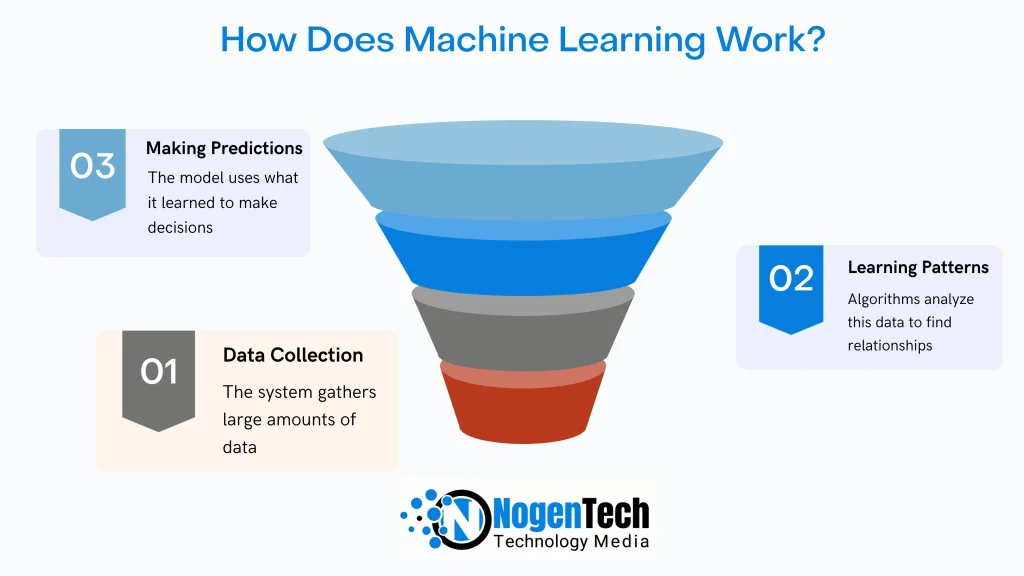
Machine learning works the same way as a child learns new things over time, but with data instead of life lessons. At a basic level, Machine learning works the same way a student learns over time, but with data instead of life lessons. At a basic level, machine learning follows three core steps:
- Data collection: The system gathers large amounts of data, such as images, text, numbers, or user behavior.
- Learning patterns: Machine learning algorithms analyze this data to find relationships, trends, and patterns.
- Making predictions: The model uses what it learned to make decisions or predictions on new data.
The more quality data the system receives, the better its predictions become. This is why modern machine learning systems constantly improve over time. Advanced systems use retrieval-augmented generation to improve accuracy beyond the training data.
As someone who has trained models from scratch, I would say the data step is where almost all the real work happens. Before my sign language model could detect a single gesture correctly, I spent days collecting images, organizing folders, cleaning mislabeled examples, and verifying every annotation.
The training itself ran in a few hours. The data preparation took far longer. No textbook communicates that ratio clearly until you experience it yourself. In machine learning, quality data is everything.
Everyday Examples of Machine Learning You Already Use
Machine learning is not something you only encounter through complex software or advanced technology. It is quietly embedded into tools you rely on daily, often without you even noticing.
These systems continuously learn from your behavior to deliver faster, smarter, and more personalized experiences.
1. Personalized Streaming Recommendations
When a streaming platform suggests a movie or series that feels perfectly aligned with your taste, that is machine learning at work. Services like Netflix analyze what you watch, how long you watch it, what you skip, and even when you stop watching.
Based on this data, the system builds a detailed preference profile and compares it with similar users. This allows it to recommend content that matches your interests rather than showing the same list to everyone.
I noticed this clearly one evening when I spent an hour watching documentaries about artificial intelligence. The next morning, my entire homepage had shifted toward technology, science, and innovation content. I had changed no settings. The system simply observed my session and adapted overnight.
2. Smarter Search Results and Voice Assistants
Search engines use machine learning and natural language processing to train their large language models and to understand user intent, not just keywords. This is why searching for short or vague phrases still produces accurate results.
Voice assistants take this further by learning how you speak, what you usually ask for, and when you need information. The more you interact with them, the better they become at predicting your needs.
3. Email Spam Filtering and Smart Inbox Sorting
Machine learning plays a critical role in keeping your inbox clean. Email services like Gmail study patterns such as sender behavior, message structure, and user interactions to identify spam, phishing attempts, and promotional emails.
Each time you mark an email as spam or safe, the system learns and improves while protecting millions of inboxes simultaneously. You are training the model every time you interact with it, even if you never think of it that way.
4. Online Shopping and Product Recommendations
E-commerce platforms use machine learning to understand buying behavior and suggest relevant products. If you browse a product and later see related recommendations across different platforms, it is because these systems have learned from your activity and built a profile around your interests.
Companies like Amazon rely heavily on machine learning to personalize product listings, optimize pricing dynamically, and manage inventory based on demand predictions.
5. Smartphone Cameras and Photo Enhancements
Modern smartphone cameras are powered by machine learning models that recognize faces, objects, lighting conditions, and motion. These systems automatically adjust brightness, sharpness, and color balance to produce high-quality images with minimal effort.
This is why portrait mode blurs backgrounds accurately and night mode captures clear photos in low light. The camera is not just capturing what it sees. It is making intelligent decisions about how to present it.
Machine Learning vs Traditional Programs? What's the Difference
Traditional programming and machine learning solve problems in fundamentally different ways.
Machine Learning vs Traditional Programming (Comparison Table)
Start creating Verdict in seconds, and convert more of your visitors into leads.
What You May Also Get Interested in About Knowing Machine Learning
1. What is quantum machine learning?
Quantum machine learning combines machine learning with quantum computing to solve certain complex problems more efficiently.
2. What is a machine learning engineer?
A machine learning engineer builds, trains, and deploys machine learning models for real-world applications.
3. What is a machine learning engineer’s salary?
A machine learning engineer’s salary depends on experience, location, skills, and company, with experienced engineers generally earning more.
4. What jobs can you get in machine learning?
Machine learning skills can lead to jobs such as machine learning engineer, data scientist, AI engineer, research scientist, and MLOps engineer.
8. How does machine learning optimize farming?
Machine learning can optimize farming by predicting crop yields, detecting plant diseases, and improving irrigation and resource management.
9. How to use Raspberry Pi for machine learning?
You can use a Raspberry Pi to run lightweight machine learning models for projects involving sensors, cameras, image recognition, and data processing.
10. Why is Python used for machine learning?
Python is used for machine learning because it is easy to learn and provides powerful libraries such as NumPy, pandas, scikit-learn, TensorFlow, and PyTorch.
11. What does WAE stand for in machine learning?
WAE stands for Wasserstein Autoencoders, a type of generative model used for learning useful data representations.
12. What is regularization in machine learning?
Regularization reduces overfitting by adding a penalty that prevents a machine learning model from becoming unnecessarily complex.