
How to Build Computer Vision Systems That Work in the Real World? From Prototype to Production
Build reliable computer vision systems by testing with real-world data, adapting models to operating conditions, and addressing failures before deployment.

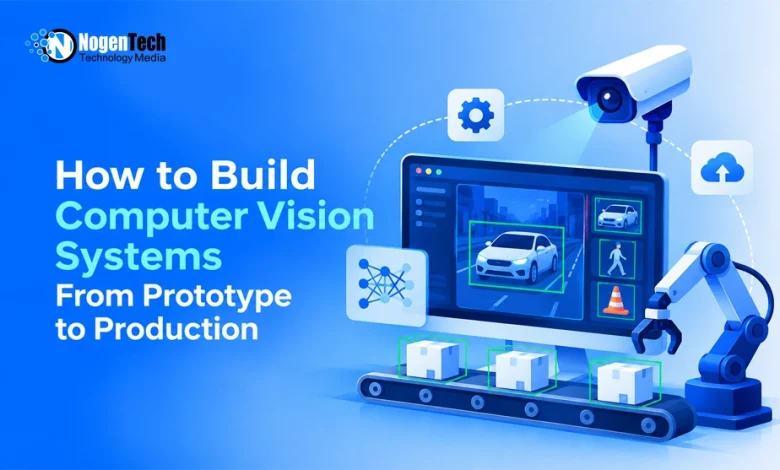
A computer vision system that works during a demo can still fail when exposed to changing light, unexpected objects, or inconsistent conditions on a production floor.
These failures can lead to missed defects, costly downtime, and automation that requires more human supervision than expected.
In this regard, custom computer vision software development services help businesses address these challenges by adapting models to the environments they will actually operate in.
The key is to account for real-world conditions early, before a promising prototype becomes an expensive production problem.
Start With the Business Problem, Not the Model
A common mistake is starting with a technology, say the latest neural network, instead of a measurable outcome.
In fact, a RAND Corporation study on AI project failures shows that over 80% fail in production, most often because teams misunderstand the business problem or lack quality data.
Therefore, before any code is written, a good project team should help you answer a few questions:
- What decision should the system make or support?
- What does a wrong decision cost: a missed defect, a false alarm, or a safety risk?
- What accuracy is actually required, and how will it be verified?
- Where will the system run, and who will use its output?
These answers shape every later choice. A system that flags suspicious items for human review can tolerate more false positives than one that automatically rejects products or controls a robot arm.
Why Off-the-Shelf Models Often Fall Short
Real business tasks rarely look like public benchmarks. Pre-trained models and cloud APIs can recognize everyday objects, read printed text, and detect faces with decent accuracy.
But a model trained on random internet photos has never seen your specific product, your lighting, or your camera angle. It does not know that a hairline scratch on a metal part is a defect while a smudge of oil is not.
Generic tools also struggle with:
- Unusual image types, such as thermal, X-ray, hyperspectral, or microscopy data
- Strict latency requirements, where decisions must happen in milliseconds
- Limited hardware, such as embedded boards or edge devices without a stable internet connection
- Domain-specific rules that determine what counts as “correct”
When accuracy, speed, or cost matter, a tailored solution usually outperforms a generic one.
Data Is the Real Foundation
Model architecture usually gets the attention, but data quality actually determines the result. Teams should plan for data from day one.
- Collection. Images should reflect real operating conditions: different shifts, seasons, lighting, camera positions, and equipment wear. A dataset gathered in one afternoon rarely covers this variety.
- Annotation. Labels must be consistent. If two annotators disagree on what counts as a defect, the model learns confusion. Clear labeling guidelines and periodic quality checks save weeks of rework.
- Rare events. In many industries, the interesting cases, such as defects, anomalies, and failures, are very rare. Techniques like synthetic data generation, augmentation, and anomaly detection approaches that learn from “normal” examples can help when real failure images are scarce.
- Ongoing updates. Products change, cameras get replaced, and environments drift. A data pipeline that makes it easy to add and relabel new samples keeps the system accurate over time.
The Right Approach and Deployment Strategy
The right strategy involves two decisions: selecting a vision method suited to the task and choosing a deployment setup that meets operational demands.
Which Computer Vision Approach Fits the Task?
There is no single best method. The right approach depends on the task:
- Classification answers “what is this?” and suits sorting or grading.
- Object detection finds and locates items, useful for counting, inventory, and safety monitoring.
- Segmentation outlines exact shapes, which matters for measuring areas, tracking surface damage, or guiding robots.
- Tracking and video analysis follow objects across frames for traffic, sports, or behavior analysis.
- 3D vision and depth sensing support robotics, volumetric measurement, and AR applications.
Cloud or Edge Deployment: Which Fits Your Needs?
Cloud processing offers scalability and easy updates, but it adds latency and depends on connectivity.
Edge deployment runs inference directly on a camera, a GPU module, or a mobile device. It reduces delay and bandwidth use and keeps sensitive footage on-site.
Many production systems combine both, handling fast inference at the edge and heavier model training in the cloud.
Model optimization, such as quantization, pruning, and conversion to efficient runtimes, can make the difference between a model that needs an expensive server and one that fits on a small, affordable device.
How to Measure Success
Overall accuracy is a weak metric on its own. If only 1% of items on a line are defective, a model that simply marks every item as good will score 99% “accuracy” while failing to catch a single flaw.
Better practice is to track precision, recall, and the confusion between specific classes, and to convert these into business terms like reduced manual inspection hours, fewer returns, faster throughput, or improved safety.
Testing on a held-out set collected independently from the training data, and ideally in a pilot at the real site, gives the most honest picture.
This approach aligns with NIST guidance on AI system evaluation, which calls for testing under conditions similar to deployment and monitoring performance after launch.
What to Look for in a Development Partner
To build a production-grade computer vision system, look for a team with a balanced mix of skills across machine learning research, data engineering, embedded and mobile development, and deep industry domain knowledge.
When evaluating a team, consider whether they:
- Ask detailed questions about your process before proposing a solution
- Have a track record of taking projects all the way to deployment, not just prototypes
- Can work across platforms, from servers and cloud to mobile and edge hardware
- Provide clear documentation, test results, and a plan for maintenance and retraining
- Communicate honestly about risks, feasibility, and trade-offs
A short proof-of-concept phase is a practical way to reduce uncertainty. It lets both sides validate the data, estimate achievable accuracy, and agree on realistic goals before a full-scale investment.
Common Pitfalls to Avoid
Experienced teams know where projects tend to go wrong. Watch out for these:
- Testing on data that is too similar to training data. This produces inflated accuracy numbers that collapse in the field.
- Ignoring the hardware setup. Better lighting, lenses, or camera placement can improve results more than any algorithm change.
- Skipping edge cases. Reflections, motion blur, dirt on the lens, and partial occlusion are everyday realities.
- No monitoring after launch. Without tracking confidence scores and error rates, performance can quietly degrade.
- Underestimating integration. The model must connect to existing software, databases, PLCs, or mobile apps, and that work takes time.