Every time you ask your phone a question, something has to decide where the thinking happens. Either the request travels to a data center hundreds of kilometers away, gets processed, and comes back, or the device figures it out right there in your hand.
That second option is Edge AI. And once you understand it, you start noticing it everywhere.
I came to this topic from an unusual angle. A few months ago, I built a computer vision system that detects the sign language alphabet in real time using a webcam. At the time, I thought of it purely as a machine learning project: train a model, get good accuracy, done.
It was only later, reading about Edge AI, that I realized I had accidentally built one. The model ran entirely on my laptop. No internet, no API calls, and no cloud. Just a camera, a trained model, and a prediction happening in milliseconds.
That reframing changed how I understood the whole field. So let me walk you through it.
Edge AI, Defined
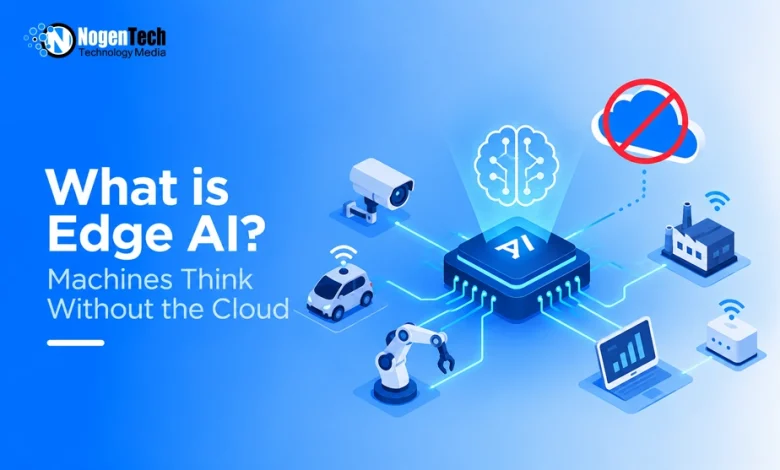
Edge AI is the practice of running artificial intelligence models directly on the device where data is generated, rather than sending it elsewhere for processing.
The “edge” here means the outer boundary of a network: the phone, the camera, the sensor, the car, the factory machine. The place where the real world meets the digital one.
Traditional AI deployment looks like this: a device collects data, sends it over the internet to a server, the server runs the model, and the result comes back. Edge AI removes the middle two steps. The model lives on the device itself.
That’s the entire concept. Everything else is a consequence of that one architectural decision.
Why Edge AI Now?
Edge AI isn’t a new idea. The reason it’s exploding now comes down to three things converging at once.
- Models got smaller. Quantization, pruning, and knowledge distillation let engineers shrink models dramatically without destroying accuracy. A model that needed a server-grade GPU five years ago can now run on a Raspberry Pi.
- Hardware got better. Chips designed specifically for AI inference, such as NPUs, TPUs, and dedicated accelerators, now ship inside phones, cameras, and microcontrollers as standard, not premium features.
- The numbers back this up. The global Edge AI market was valued at $30.0 billion in 2026, and industry forecasts project it crossing $118.7 billion within the next decade, growing at a compound annual growth rate of 21.7% as per Grand View Research.
When I was building my sign language project, I didn’t set out to avoid the cloud. I just didn’t want to deal with API latency for something that needed to respond frame by frame. The architecture chose itself, which is exactly how most real Edge AI adoption happens.
How Does Edge AI Actually Work?
The above by Gemini shows the entire process of building and using an Edge AI application. There’s a distinction people miss: training and inference are separate.
Almost all Edge AI systems are trained in the cloud and deployed to the edge. Training needs massive compute and large datasets. Inference is actually using the trained model to make a prediction. The typical flow:
- Step 1: Train in the cloud. For my project, this meant training a model on Google Colab with GPU access.
- Step 2: Optimize the model. This is the step that makes edge deployment possible. Convert to a lightweight format (TensorFlow Lite, ONNX), reduce precision from 32-bit to 8-bit integers, and strip unnecessary layers. A model can shrink by 75% or more with minimal accuracy loss.
- Step 3: Deploy to the device. Package the optimized model and load it onto the target hardware.
- Step 4: Run inference locally. The device captures data, feeds it to the model, and produces a result, with no network involved.
- Step 5: Optionally, send results back. Not the raw data. Just the outcome. A camera doesn’t upload video; it uploads “person detected at 14:32.“
That last point is where a lot of the value lives. Edge AI doesn’t eliminate the cloud. It changes what gets sent to it.
Edge AI vs Cloud AI vs Distributed AI
These get conflated constantly, so here’s a direct comparison.
| Cloud AI | Edge AI | Distributed AI | |
| Where computation happens | Remote data centers | On the local device | Split across multiple coordinating nodes |
| Latency | Higher (network round trip) | Near-instant | Varies by node coordination |
| Internet dependency | Required | Not required | Partially required |
| Compute power available | Very high | Limited by hardware | Pooled across nodes |
| Data privacy | Data leaves the device | Data can stay local | Depends on architecture |
| Best suited for | Large models, heavy analysis | Real-time, offline-capable tasks | Collaborative learning, large-scale coordination |
| Example | ChatGPT running on OpenAI’s servers | Face unlock on your phone | Federated learning across hospital networks |
The important thing is that these aren’t competitors. Most serious systems are hybrids. A smart camera might run detection at the edge, then send flagged events to the cloud for deeper analysis and long-term storage. Think of it less as choosing a side and more as deciding, for each task, where that task belongs.
Components of an Edge AI System
The following are the four components that work together and end up building an edge AI system.
- The edge device: It is the physical hardware that ranges from microcontrollers with kilobytes of RAM to single-board computers, industrial gateways, smartphones, and cars.
- The AI accelerator: The specialized silicon that makes inference fast and power-efficient. NPUs, TPUs, VPUs. Increasingly standard: smartphones alone account for over 80.5% of edge AI hardware volume as of 2024.
- The optimized model: This one is the compressed, quantized version of the trained model, converted into an edge-compatible runtime format.
- The inference runtime: The software layer that executes the model on the hardware. TensorFlow Lite, ONNX Runtime, PyTorch Mobile, or vendor-specific SDKs.
Above these sits the data pipeline: capturing input, preprocessing it consistently, handling the output. In my project, this was OpenCV grabbing webcam frames, resizing and normalizing them, then passing them to the model.
Benefits of Edge AI
- Latency drops: No round trip means responses in milliseconds instead of hundreds of milliseconds. For real-time applications like autonomous vehicles, industrial safety systems, and live video analysis, this is not a choice; it’s non-negotiable.
- Structural privacy improvement: Data that never leaves the device can’t be intercepted in transit or leaked from a server. This is an architectural guarantee, not a policy promise.
- Offline working: Remote agricultural sensors, offshore equipment, rural clinics, and underground mining sites are the places where connectivity is unreliable. Edge AI functions here regardless of the internet connection.
- Bandwidth and cost go down: A camera streaming 24/7 video to the cloud is expensive. A camera processing locally and sending occasional event alerts costs almost nothing to run.
- Reliability increases. No dependency on network uptime or third-party API availability.
Limitations of Edge AI
I want to be honest here, because most articles skip this part. The following are some limitations of Edge AI that need to be fixed.
- Computation Cost: You cannot run a large language model on a microcontroller. Cloud AI will always be capable of more. But if you use a pre-trained model, then it’s not a big deal.
- Accuracy Change: Quantization and pruning trade precision for size. Often the loss is negligible. Sometimes it isn’t. You have to measure it, not assume it.
- Model Updating: Pushing a new model version to a million field devices is an infrastructure problem in a way updating a server isn’t.
- Training vs Testing: Sometimes the model performed well on training data, but when real-world data is fed to the model during inference. It completely crashes or decreases its accuracy. This is what I learned personally.
My sign language model performed well in testing. Then I ran it on live webcam input and accuracy collapsed. The problem wasn’t the model; it was that my training data and my real-world input looked nothing alike: different lighting, different backgrounds, different camera angles.
That gap is worse in Edge AI than in cloud deployments, because edge devices sit in genuinely uncontrolled environments. A factory camera deals with changing light across the day. A car’s sensors deal with rain, fog, and glare. Your clean training dataset has none of that.
Fixing it meant rebuilding my preprocessing and adding heavy data augmentation like brightness variation, contrast shifts, rotation, and color inversion. So the model learned to recognize the pattern rather than the conditions.
The lesson generalized far beyond that one project is that in Edge AI, your deployment environment is part of your problem definition, not an afterthought.
Edge AI Use Cases Across Industries
- Manufacturing: It has applications in visual defect detection on production lines, predictive maintenance from vibration and thermal sensors, and worker safety monitoring.
- Automotive: Edge AI has a major use case in Self-driving systems that process camera, lidar, and radar data continuously. Sending that to the cloud and waiting for a response isn’t physically survivable at highway speed.
- Retail: Edge AI in checkout-free stores, shelf inventory monitoring, foot traffic analysis, avoiding both the bandwidth cost and privacy concerns of uploading customer footage.
- Agriculture: Crop disease detection from drone imagery, livestock monitoring, irrigation control, often in fields with no reliable connectivity at all.
- Energy and utilities: ID monitoring, equipment fault detection, and anomaly detection in remote, frequently unmanned infrastructure are some areas in energy and utilities where Edge AI technology plays a role well.
- Consumer devices: Some daily-life use cases of Edge AI are face unlock, on-device voice recognition, and real-time camera effects.
A pattern worth noticing: Edge AI tends to win where the cost of latency is high, connectivity is unreliable, or the data itself is sensitive. That’s a useful filter when evaluating whether a problem is genuinely an edge problem.
How to Choose an Edge AI Device
- Start with the model, not the hardware. Figure out what your model needs in memory and compute. This eliminates most options immediately.
- Then check power. Identify whether the device is plugged into a wall (unlimited power), or running on a battery that must last months? Different design problems entirely.
- Consider the environment. Temperature, humidity, dust, and vibration are some factors that you have to consider before selecting an Edge AI device. Industrial and outdoor deployments need hardware rated for conditions that would destroy a consumer device.
- Check latency requirements. This determines whether you need a dedicated accelerator or if a general-purpose CPU is enough.
- Evaluate the software ecosystem. A slightly slower device with excellent tooling often beats a faster one with poor support.
- Factor in scale economics. Ten devices and ten thousand devices are different financial calculations.
For a prototype, a Raspberry Pi or a laptop is usually enough. My project ran on a standard laptop, with no specialized hardware at all. Optimizing hardware before you’ve validated the model is premature.
The Edge AI Lifecycle and Edge MLOps
Deploying a model once is a project. Keeping it working over years across a fleet of devices is a discipline, and that’s Edge MLOps.
- Collect data from the actual target environment, not a clean lab. This matters more in edge deployments than almost anywhere else.
- Train and validate in the cloud, where compute is cheap and abundant.
- Optimize and convert for the target hardware, then re-validate that accuracy survived.
- Deploy to devices, ideally through an automated pipeline rather than manual installation.
- Monitor in production. Track inference performance, error rates, and resource usage. Devices in the field behave differently from devices on your desk.
- Detect drift. Real-world conditions shift over time,ase lighting changes, equipment ages, and behavior evolves.
- Retrain and redeploy over the air, without physically touching devices.
The hard part isn’t the modeling. It’s the operations, version management across heterogeneous hardware, safe rollbacks when an update fails, monitoring systems you can’t easily SSH (Secure Shell) into.
The Future of Edge AI
- Models will keep shrinking. Small language models already run on phones. The gap between “needs a data center” and “fits on a device” narrows every year.
- Hardware will keep specializing. AI accelerators are becoming standard, not premium. TinyML, neural networks on microcontroller-class devices, is maturing rapidly.
- Federated learning will grow. Training collaboratively across devices without centralizing raw data solves the privacy problem and the data-access problem at once.
- Hybrid becomes the default architecture. Not edge versus cloud, but intelligent routing, meaning lightweight decisions locally, heavy reasoning remotely, coordinated automatically.
- Regulation will push it forward. New frameworks like the EU’s Cyber Resilience Act, adding compliance obligations from late 2026 onward, increasingly favor architectures where sensitive data never leaves the device.
Final Thoughts
The thing I keep returning to is how ordinary Edge AI feels once you understand it. It’s not a new type of AI. It’s the same models, deployed in a different place. This single change cascades into different trade-offs, different constraints, different engineering problems.
Building that sign language detector taught me something no article had: the difference between a model that works and a model that works where it has to work. In cloud deployment, you control the environment. At the edge, you don’t and that’s the entire challenge.
If you’re learning this field, build something small that runs locally. Watch it fail on real input. Fix it. The gap between your training data and your deployment reality will teach you more about Edge AI than any amount of reading. That gap is where the actual engineering lives.