Which Internet Type Is Best for Your Location and Needs? 8 Options Compared
The best internet connection depends on your location and needs, with fiber and 5G offering the fastest speeds, while DSL, cable, satellite, and wireless options serve wider or remote areas.

Still dealing with slow internet? Your Wi-Fi may not always be the problem; the type of internet connection you use can also affect your experience.
Choosing the right internet connection is no longer just about availability. You must focus on the different types of internet available in the market and how each one fits your needs, such as streaming, enhancing remote job setup, or a safe browsing experience.
From fiber-optic and cable to DSL, satellite, and 5G, every option offers different speeds, reliability, and performance. Yet many users still struggle with slow connections or overpay simply because they don’t know their options.
Now, as you read further, you will explore the 8 most popular internet types, how they work, and which one is best based on speed, usage, and availability.
Here’s a simple way to decide which type of internet is right for you:
| Internet Type | Speed Range | Latency | Best For | Availability in the U.S. |
|---|---|---|---|---|
| Dial-Up | Up to 56 kbps | Very High | Emergency or legacy use only | Rare/near obsolete |
| DSL | 1 – 100 Mbps | Medium (30–60ms) | Budget users, basic browsing, legacy infrastructure areas | High availability but gradually declining |
| Cable | 100 Mbps – 2 Gbps | Low (15–35ms) | Family households, streaming, multiple devices | Widely available across most U.S. cities |
| Fiber-Optic | 300 Mbps – 8 Gbps | Ultra-Low (<15ms) | Professional gaming, 8K streaming, cloud work | Limited (~50%+ urban/suburban coverage) |
| Satellite Internet | 25 – 220 Mbps | Medium (25–60ms) | Rural and remote areas (such as Starlink users) | Nationwide coverage |
| 5G Home Internet | 100 – 400 Mbps | Low–Medium (20–40ms) | Renters, cord-cutters, wireless home internet users | Expanding rapidly in U.S. cities & suburbs |
| Fixed Wireless | 10 – 1,000 Mbps | Medium (30–50ms) | Rural/suburban homes without fiber or cable | Regional, provider-dependent |
| Mobile Hotspot | 10 – 100 Mbps | Medium (30–50ms) | Travel, backup internet, temporary access | Dependence on carrier coverage |
8 Types of the Internet To Select for Your Own Use
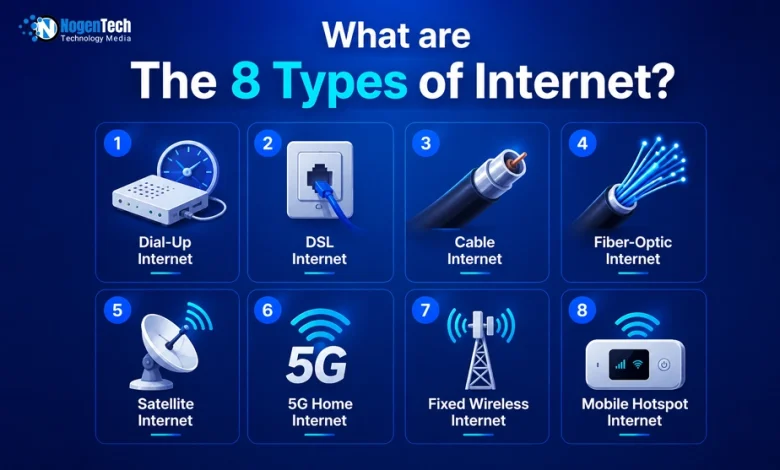
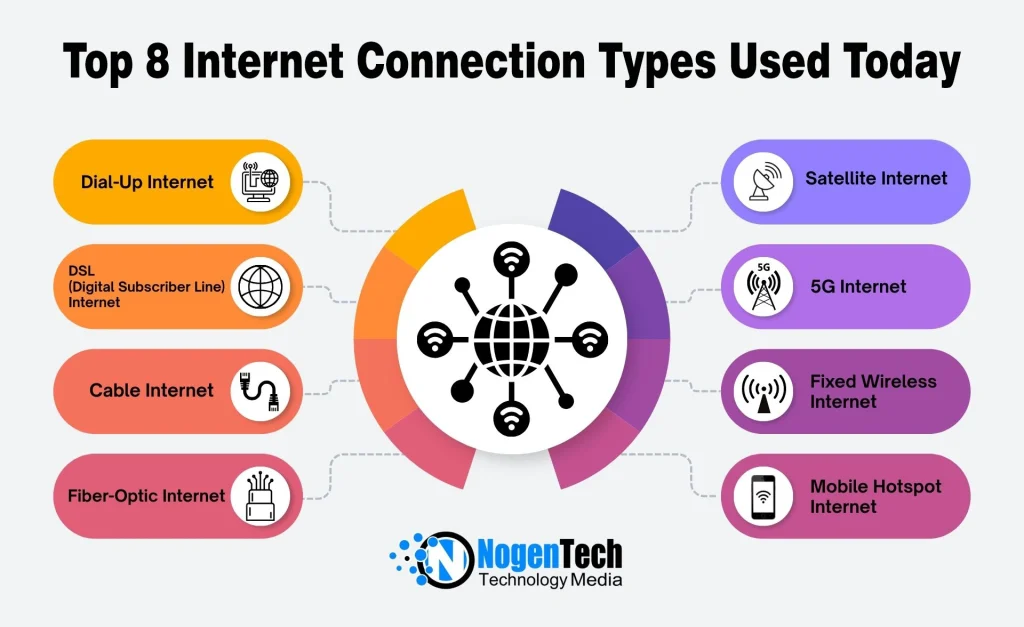
The list of the 8 types of the Internet is:
- Dial-Up Internet
- DSL (Digital Subscriber Line) Internet
- Cable Internet
- Fiber-Optic Internet
- Satellite Internet
- 5G Home Internet
- Fixed Wireless Internet
- Mobile Hotspot Internet
1. Dial-Up Internet
Dial-up internet is among the oldest types of internet connections. It uses a telephone line and modem to connect your device to an Internet Service Provider (ISP).
It can reach speeds of up to 56 kbps, which is extremely slow by today’s standards. Because the connection uses the phone line, you generally can’t make a phone call and use dial-up internet at the same time.
Although largely replaced by broadband, dial-up may still be an option in some remote areas where modern internet infrastructure is limited.
Best For
- Users in extremely remote areas with no access to broadband internet
- Basic text-based browsing or emergency use
Pros
- Very low cost
- Available in areas without modern infrastructure
Cons
- Extremely slow speeds
- Cannot use the phone and the internet at the same time
Which Companies Offer Dial-Up Internet?
NetZero, Juno, and Dialup 4 Less offer dial-up internet services, primarily in North America. These providers offer varied pricing options, ranging from free, limited plans to paid, accelerated services, allowing users to choose a plan that best fits their budget and usage needs.
2. Digital Subscriber Line (DSL) Internet
Digital Subscriber Line (DSL) is an internet connection that works through traditional telephone lines. It uses a different frequency for data, so you can use the internet and make phone calls at the same time.
It is commonly found in places where newer options such as cable or fiber may be limited. Depending on the provider, DSL technology, and your distance from the provider’s equipment, speeds can vary considerably.
Best For
- Budget-conscious users needing basic internet access
- Households in rural or suburban areas without fiber or cable
- Light browsing, emails, and standard-definition streaming
Pros
- Affordable entry-level broadband option
- Supports basic internet usage needs
Cons
- Slower speeds compared to cable and fiber
- Performance decreases with distance from the provider
Which Companies Offer Digital Subscriber Line (DSL) Internet?
Companies like CenturyLink, Kinetic by Windstream, and Verizon are still offering the DSL internet connection to users.
3. Cable Internet
Cable internet uses coaxial cables, which are also commonly used for cable TV services. It is a popular home internet option in many urban and suburban areas.
Depending on the provider and internet plan, cable connections can offer speeds from around 100 Mbps to 1 Gbps. Some providers also offer additional features or service packages, such as Xfinity’s xFi Complete for eligible legacy users.
One thing to keep in mind is that cable bandwidth is typically shared among nearby users. As a result, you may notice slower speeds during busy hours when more people in your area are online.
Best For
- Families needing reliable home internet
- Gamers and streamers require stable broadband
- Remote workers and households with multiple devices
Pros
- Faster than DSL
- Supports HD/4K streaming and online gaming
- Stable and reliable for everyday use
Cons
- Shared bandwidth can cause slower speeds during peak hours
- Slightly more expensive than DSL plans
4. Fiber-Optic Internet
Fiber-optic internet sends data through thin strands of glass or plastic using light signals. This allows it to deliver fast and reliable internet speeds, typically ranging from 300 Mbps to 8 Gbps, depending on the provider and plan.
Fiber is less affected by distance and network congestion than DSL or cable, but availability is still limited in some parts of the U.S., particularly rural areas where fiber infrastructure is still being expanded.
Recent 2026 broadband comparisons also rank fiber ahead of cable and DSL for maximum speed and high-bandwidth households.
Best For
- Gamers and streamers need ultra-low-latency internet
- Large households with multiple smart home-connected devices
- Remote professionals using cloud-based and high-bandwidth tools
Pros
- Ultra-fast speeds (up to multi-gigabit performance)
- Extremely low latency and high reliability
- No slowdowns during peak usage hours
Cons
- More expensive than DSL and cable in some regions
- Limited availability in rural and underserved areas
Fiber-optic internet delivers multi-gigabit performance with ultra-low latency, making it the top choice for modern home setups—especially if you’re hosting local media servers or building a robust IPTV network infrastructure to handle multiple 4K/8K TV streams simultaneously.
Which Companies Offer Fiber-Optic Internet?
AT&T, Google Fiber, and Frontier are the major fiber-optic internet providers in the United States.
5. Satellite Internet
Satellite Internet is designed for users in rural and remote areas where traditional broadband options like fiber, cable, or DSL are not available. It works by transmitting data between satellites in orbit and a satellite dish installed at the user’s home.
Modern satellite providers such as Starlink have significantly improved speeds and reliability. It can deliver speeds up to 200 Mbps or more, but it typically has higher latency because data must travel long distances between Earth and space.
Below is a quick comparison of Starlink with other traditional Satellite Internet providers.
| Feature | Traditional Satellite | Starlink |
|---|---|---|
| Speed | Lower | Higher |
| Latency | Very High | Much Lower |
| Gaming | Poor | Better |
Best For
- Users in rural or remote locations with no wired broadband access
- Basic internet usage, such as browsing, emails, and light streaming
- Backup internet in areas with unreliable connectivity
Pros
- Available almost anywhere in the U.S. (nationwide coverage)
- No need for physical cable infrastructure
- Improved modern speeds compared to older satellite systems
Cons
- Higher latency compared to fiber, cable, and 5G internet
- Often comes with a higher cost and data limitations
Which Companies Offer Satellite Internet?
In 2026, the main satellite internet providers in the USA are Starlink, Viasat, and Hughesnet.
6. 5G Internet
5G Internet is the latest generation of wireless broadband technology, offering ultra-fast speeds and very low latency without the need for traditional wired connections.
Major U.S. telecom providers such as Verizon and T-Mobile are leading the rollout of 5G home internet services. It can deliver speeds ranging from 100 Mbps to 400 Mbps, depending on network strength and location.
Best For
- Gamers, streamers, and workers need low-latency wireless internet and cloud-based tools
- Users looking for high-speed home internet without cables
- Renters and cord-cutters in urban or suburban areas
Pros
- Ultra-fast speeds with very low latency
- No wired installation required
- Easy setup and portability
Cons
- Availability is still limited in some regions
- Performance depends on network coverage and signal strength
- Requires a compatible 5G device or router
Which Companies Offer 5G Internet?
Verizon, T-Mobile, and Starry Internet are the major companies that are offering 5G internet connectivity in the US.
7. Fixed Wireless Internet
Fixed Wireless Internet is a type of broadband connection that delivers internet service using radio signals transmitted from a nearby tower to a receiver installed at the user’s home.
Speeds for fixed wireless internet typically range from 10 Mbps to 1 Gbps, depending on signal strength, provider, and location. Performance can vary based on distance from the tower and environmental conditions.
Best For
- Rural and suburban users without fiber or cable access
- Households needing a wireless alternative to DSL
- Areas with a strong line of sight to local towers
Pros
- No physical cable installation required
- Faster than DSL in many rural regions
- Good alternative where wired broadband is limited
Cons
- Performance depends on distance and signal quality
- Can be affected by weather and physical obstructions
- Requires a clear line of sight to the tower
Which Companies Offer Fixed Wireless Internet?
Rise Broadband and Internet Air are the key names in the United States when it comes to offering Fixed Wireless Internet.
8. Mobile Hotspot Internet
Mobile hotspot internet is a type of wireless internet connection that allows users to share their smartphone’s cellular data connection with other devices, such as laptops, tablets, or smart TVs.
It effectively turns your phone into a portable Wi-Fi router, providing internet access wherever mobile network coverage is available.
Mobile hotspot speeds depend on your carrier, location, and network type (4G or 5G). While it can be fast in strong coverage areas, performance is limited by data plans and network congestion.
Best For
- Travelers needing internet access anywhere in the U.S.
- Remote workers and students requiring portable connectivity
- Backup internet when fixed broadband is unavailable
Pros
- Highly portable and easy to use
- Works anywhere with mobile network coverage
- Quick setup without installation
- Useful as a backup internet option
Cons
- Data limits can make it expensive for heavy usage
- Not as stable as fiber or cable internet
Which Companies Offer Mobile Hotspot Internet?
To use mobile hotspot internet, you can use almost all carriers available in the United States of America.
What is the Difference Between Wired and Wireless Internet Connections?
The Wired Internet Connections are:
- Fiber
- Cable
- DSL
- Dial-up
The Wireless Internet Connections are:
- Satellite
- Fixed Wireless
- 5G
- Hotspots
| Features | Wired Internet | Wireless Internet |
|---|---|---|
| Connection Method | Uses physical cables | Uses radio signals |
| Speed | Generally faster | Can vary by signal strength |
| Reliability | More stable | More prone to interference |
| Latency | Lower | Usually higher |
Wired internet uses physical cables, often through an Ethernet connection, which provides stable and low-latency performance compared to wireless methods.
How to Find Internet Providers in Your Area?
After comparing the different types of internet, you may be wondering, “What internet can I get at my address?” The FCC’s National Broadband Map lets you check which internet providers report service at a specific location, along with available connection technologies and maximum advertised speeds.
Here is how to do it:
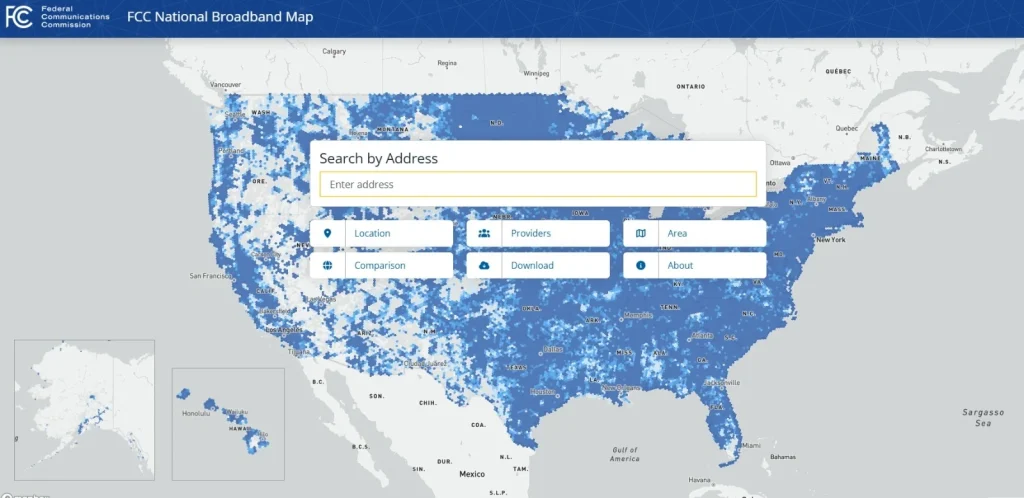
- Enter your home address.
- Check which internet providers serve your location.
- Compare the available connection types and speeds.
- Visit the providers to compare plans, pricing, and contract terms.
People Also Ask
What is the fastest type of internet in 2026?
The fastest types of internet are fiber-optic and 5G home internet, offering speeds up to multi-gigabit levels. Fiber is the most stable, while 5G provides fast wireless connectivity in supported areas.
Which type of internet is best for home use?
For most U.S. households, fiber-optic internet is the best option due to its high speed and stability. Cable internet is also a strong alternative where fiber is not available.
What is the cheapest type of internet?
The cheapest internet type is usually DSL, followed by basic cable plans. However, pricing depends on providers and location across the United States.
Is 5G home internet better than cable internet?
5G home internet offers flexibility, but cable internet is usually more consistent and reliable for heavy usage.
What internet type has the lowest latency?
Fiber-optic internet has the lowest latency, making it ideal for gaming and real-time applications.
Is fiber worth paying extra for?
Yes, fiber is worth the extra cost if you want the fastest speeds, highest reliability, and best overall performance.
Final Thoughts on Internet Types
Choosing the right internet type in 2026 depends on your speed needs, budget, and location. From fiber-optic and cable to 5G home internet, satellite, and DSL, each option serves different users.
If you need top performance, fiber services from providers like AT&T Fiber or Verizon Fios are the best choice, while satellite, like Starlink, helps rural users.
Personally, fiber is the best overall internet type for speed, stability, and future-proof connectivity in modern homes.