Keyword research is the foundation of every successful SEO campaign. I’ve spent more than 14 years working as an SEO strategist, optimizing websites for global readership and consistently growing organic traffic for platforms like NogenTech.
Over the years, I’ve experimented with hundreds of methods, keyword research tools, and frameworks. But through all those experiences, I developed a simple, predictable, and extremely effective keyword research system that works (at least for me) across every niche.
I’ve compiled this guide that tells my complete keyword research workflow, exactly how I do it today, using a combination of tools. If you want a modern keyword research process that supports AI Overviews (AEO), Featured Snippets, and People Also Ask coverage, this guide is for you.
Why Keyword Research Matters More Than Ever
Before jumping into the process, it’s important to understand why keyword research has advanced so drastically.
Search engines no longer reward keywords, but they reward: context, search intent, depth, semantics, relevance, topic authority, expertise, and experience.
Gone are the days when you could simply target a keyword with decent volume and write a 1,000-word blog post. Today’s SEO relies heavily on:
- User behavior signals
- AI-driven SERPs
- Zero-click searches
- Voice search queries
- Conversational intent
- Search journeys instead of single queries
This is why my keyword research process is built around:
- Real-time data
- Predictive analysis
- Semantic expansion
- User-generated queries
- Cluster building
- Intent mapping
This ensures the content we produce doesn’t just rank, it matches user intent and earns visibility on all major SERP placements, including PAA, featured snippets, and AI Overviews.
My Complete Keyword Research Workflow
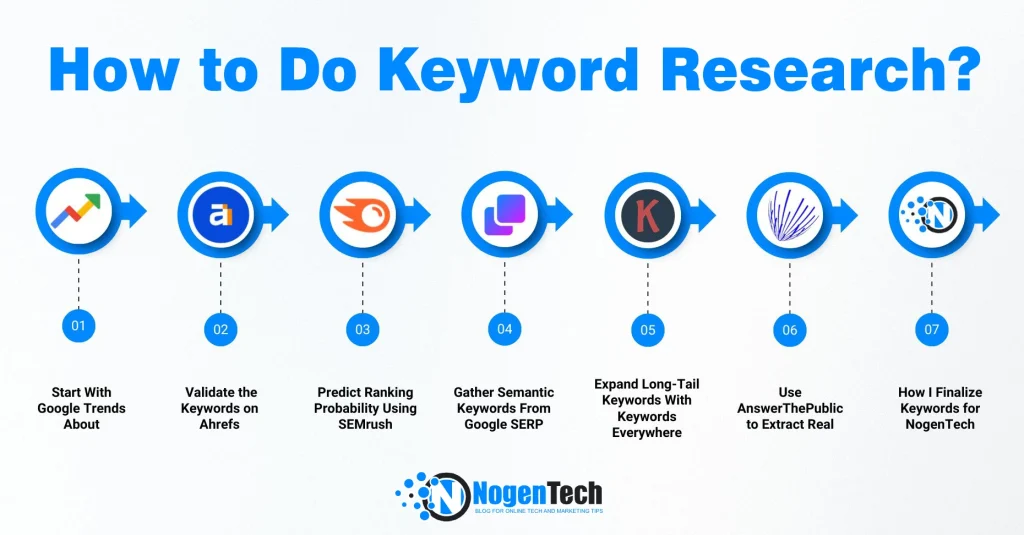
Here’s the full breakdown of my process:
- Google Trends → Find trending topics
- Ahrefs → Validate keyword difficulty & traffic
- SEMrush → Predict ranking and analyze SERP features
- Google SERP + SERP Help → Extract semantic and intent-based queries
- Keywords Everywhere → Expand long-tail and low-competition keywords
- AnswerThePublic → Gather real human questions for AEO
- 4-Factor Scoring System → Finalize the best keywords for NogenTech
This method blends: real-time trends, predictive analytics, SERP semantics, user psychology, topic clustering, and experience-driven insights. This is why it consistently wins rankings across dozens of niches.
How to Do Keyword Research: A Step-by-Step Guide
Step 1: Start With Google Trends
Most SEOs start with Ahrefs or SEMrush, but I always begin with Google Trends, and I recommend every SEO do the same. Why? Because Google Trends helps me understand:
- What’s rising
- What’s declining
- What people are asking today
- Seasonal content patterns
- Regional search behaviors
- Topic momentum
👉 Pro Tip: Keyword research without trend analysis is like sailing without a compass. That’s why always go for trends before searching for a keyword.
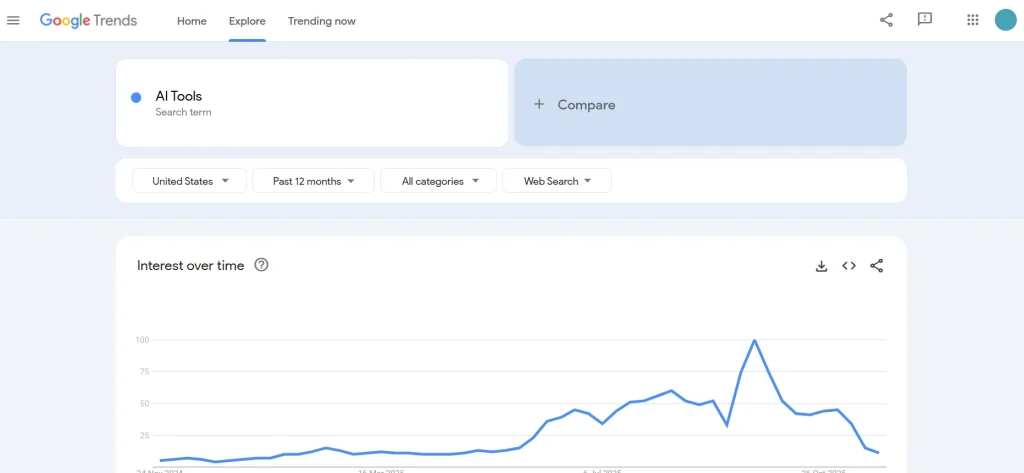
Here’s how I use Google Trends for NogenTech:
1. Enter the seed keyword
If I’m researching “AI tools,” I’ll start with that term.
2. Compare related keywords
For example:
This shows me which topics are trending faster.
3. Explore “Related Queries”
This helps me find trending keywords with breakout potential with low competition.
4. Check popularity by region
For NogenTech, I often assess trends in the US, UK, and Asia.
5. Identify seasonal trends
Some topics peak at certain times. For instance:
- “Laptops for students” spikes in July–September
- “Best smartphones” spikes in November–December
This gives us opportunities for time-sensitive content planning.
What I learn from Google Trends becomes my starting point.
It tells me where user interest is headed before tools even update their search volume.
Step 2: Validate the Keywords on Ahrefs
Once I’ve identified trending terms, I move to Ahrefs because no other tool matches Ahrefs’ depth and accuracy for keyword research.
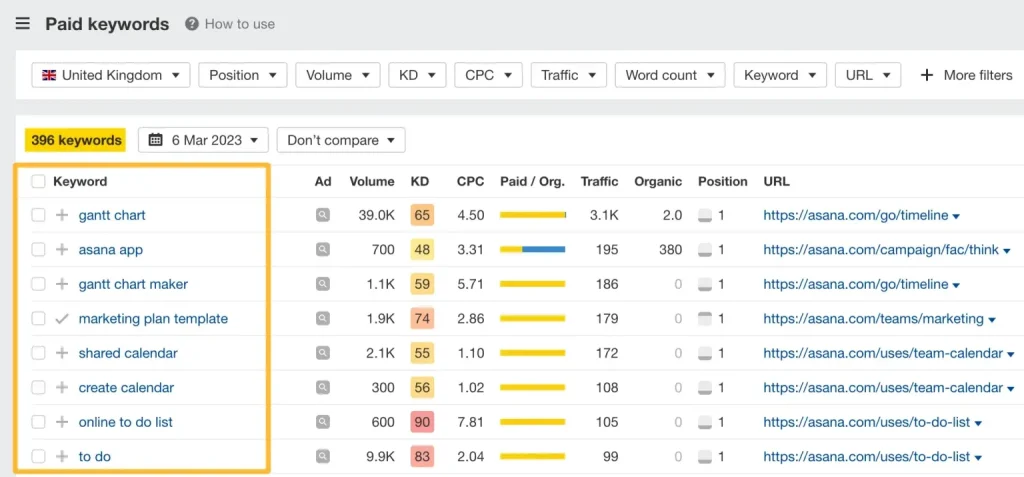
In Ahrefs, I check:
- Keyword Difficulty (KD): This shows how hard it will be to rank.
- Search Volume: To understand demand, but I never rely on volume alone.
- Clicks vs. Searches: Some keywords have high impressions but few clicks (especially zero-click searches).
- Traffic Potential: The parent topic drives more traffic than the keyword the user entered.
- SERP Overview: What type of content is ranking, whether I need a blog, guide, listicle, or video, if SERP is dominated by authority sites, and if my domain can compete.
- Keyword Variations & Questions: These help me plan clusters and subtopics.
- Competing Pages: Word count, heading structure, backlinks, page authority, and content depth.
After analyzing all of this, I separate keywords into:
- Primary keyword candidates
- Secondary semantic keywords
- Long-tail variations
- Supporting keyword clusters
Step 3: Predict Ranking Probability Using SEMrush
Ahrefs shows me the data. SEMrush shows me the future. That’s why I always cross-check my keywords on both tools.
In SEMrush, I analyze:
- Keyword Intent Classification: Semrush’s intent labels (Informational, Commercial, Transactional, Navigational) help me understand how the content should be structured.
- Keyword Difficulty Forecast: Semrush often gives a different perspective from Ahrefs.
- Traffic Trend Over Time: To understand whether the keyword is stable or volatile.
- SERP Features: Semrush shows if the keyword triggers: Featured snippets, Knowledge panels, People Also Ask, Videos, AI Overviews, and Local packs.
- Competitive Positioning Map: Useful for seeing if Nogentech can compete with top-ranking domains.
- Topic Clusters: SEMrush clusters help me plan entire topic ecosystems, not just single articles.

Did You Know? Together, Ahrefs and Semrush give me a 360-degree view of a keyword’s potential, and they can do the same for you, too.
Step 4: Gather Semantic Keywords From Google SERP
The most powerful keyword insights aren’t always in tools, but they’re in Google SERP itself. Google uses real-time data to understand what people want, and analyzing SERP gives me: search intent signals, suggested keywords, PAA questions, related searches, autocomplete patterns, and competitor outlines.
But instead of manually copying all this, I use:
SERP Help (Chrome Extension)
This is one of the best Chrome extensions for SEOs that extracts:
- Semantic keywords
- What people are searching for frequently
- Related searches
- Featured snippet patterns
This saves me hours and ensures I extract every semantic angle Google is pushing.
I use SERP data to understand:
- What questions must the content answer
- What structure does Google prefer
- Which keywords belong in H2s and H3s
- What gaps competitors are missing
Semantic keyword clustering is the key to modern SEO, and Google SERP is the best teacher.

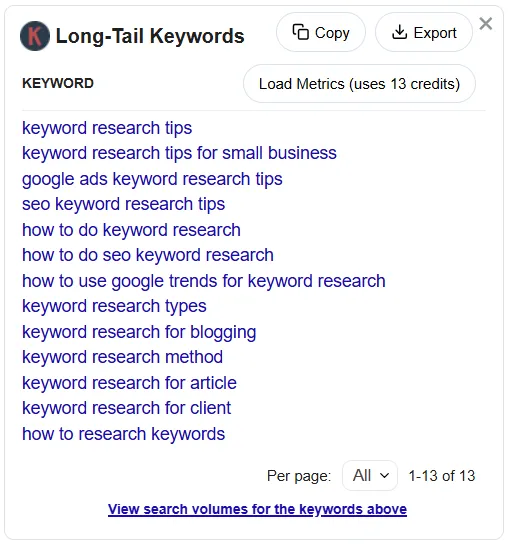
Step 5: Expand Long-Tail Keywords With Keywords Everywhere
Long-tail keywords are the secret weapon for ranking fast, especially in competitive niches. That’s why I rely on Keywords Everywhere. It helps me uncover:
- Long-tail Questions: Instead of “AI tools,” it reveals “AI tools for project managers” or “AI tools for students.”
- People Also Search For keywords: This often reveals new content ideas.
- Trend Graphs: Useful for finding rising long-tails.
- CPC Insights: A high CPC keyword indicates commercial value.
- Competitiveness Scores: Great for finding easy-to-rank opportunities.
These long-tails help NogenTech capture:
- High-intent users
- Quick wins
- Topic authority
- Niche audiences
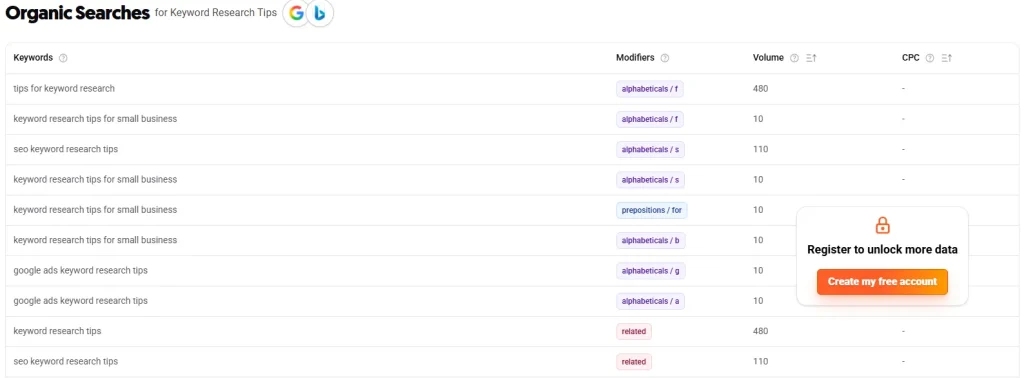
This tool alone often gives me 20–30 extra keywords that tools like Ahrefs miss.
Step 6: Use AnswerThePublic to Extract Real Queries
AI Overviews and People Also Ask boxes love natural language questions, exactly the format AnswerThePublic specializes in.
I use AnswerThePublic to generate:
- “How-to” queries
- “Why” queries
- “What is” queries
- Pain points
- Misconceptions
- Comparison questions
- Problems users are trying to solve
These questions help me understand:
- What people really want to know
- What confuses them
- What they struggle with
- What they expect us to explain
- What answers does Google want us to provide
Why this matters for AEO:
AI Overviews prefer pages that are structured, helpful, direct, question-focused, and fact-based. AnswerThePublic provides ideal queries for:
- FAQ sections
- Snippet-friendly answers
- AEO-ready content
- Informational authority
- NLP-friendly writing
This step is essential for modern SEO success.
Step 7: How I Finalize Keywords for NogenTech
After gathering hundreds of keywords, I finalize them using a scoring system I’ve developed over 14+ years.
1. Search Intent Match (30 Points)
If the keyword doesn’t match what Nogentech’s audience wants, I discard it.
2. Ranking Feasibility (30 Points)
I decide ranking feasibility based on competitors, KD, domain authority, and content depth.
3. Traffic Potential (20 Points)
Even low-volume keywords can bring high traffic if their parent topics rank well.
4. Topical Relevance & Authority Building (20 Points)
I only choose keywords that strengthen NogenTech’s authority in:
Any keyword scoring below 70/100 is removed.
This ensures our final list is:
- Relevant
- Rankable
- High-intent
- Future-proof
- Cluster-friendly
Final Thoughts on Keyword Research
Keyword research isn’t simply about finding keywords anymore, but it’s about understanding: what people need, what they’re searching for, what problems they want solved, how Google interprets intent, what SERP features they prefer, and how AI Overviews summarize content.
The process I’ve shared is the same workflow I use every week for NogenTech and other clients. It’s the product of 14+ years of learning, testing, failing, innovating, and adapting.
People Also Ask
What is keyword research in SEO?
Keyword research is the process of identifying the words and phrases people search for on Google so you can create content that matches their intent.
How does Google Trends help in keyword research?
Google Trends shows search interest over time, helping you identify trending topics, seasonal keywords, and rising queries.
What is the difference between short-tail and long-tail keywords?
- Short-tail keywords: 1–2 words, high search volume, high competition.
- Long-tail keywords: 3+ words, lower volume, easier to rank, higher intent.
Long-tails bring more targeted, conversion-ready traffic.
How many keywords should I target in one article?
Target one main keyword, plus 10–30 semantic keywords and long-tail variations. Google now ranks pages based on topical relevance, so clusters and semantic depth matter more than repeating a single keyword.
What are semantic keywords in SEO?
Semantic keywords are related phrases, variations, questions, and concepts that help Google understand the topic’s context. They improve rankings, boost topical authority, and help you appear in AI Overviews and Featured Snippets.
How often should I update my keyword research?
For competitive niches like tech and AI, update keyword research every 1–2 months. For evergreen industries, review every 3–6 months.