Your Topics Multiple Stories: SEO Hub-and-Spoke Strategy for 2026
Modern content writing isn’t just about keywords—it’s about Your Topics Multiple Stories. With the Hub‑and‑Spoke model, one core “Sun Topic” branches into multiple stories that capture different search intents, boost SEO through interlinking, and keep readers engaged.

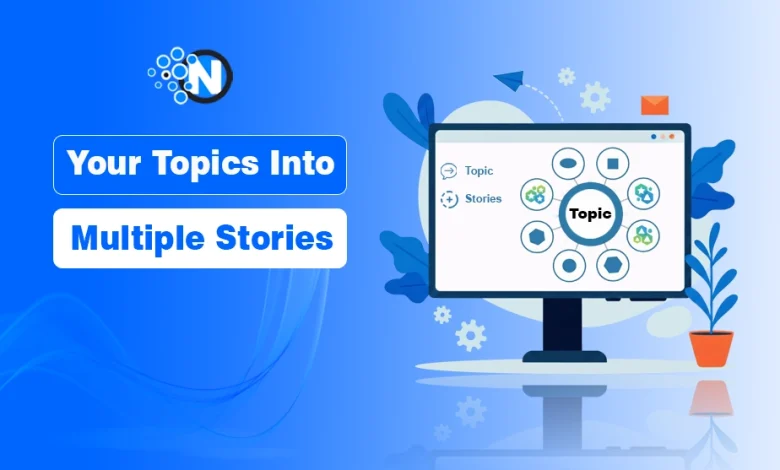
Creating one piece of content for a topic is no longer enough. To dominate search results, you need to turn your topics into multiple stories—a strategy that builds topical authority, prevents keyword cannibalization, and maximizes organic reach. This approach, often called the Hub-and-Spoke SEO model, allows you to expand one idea into several angles, each targeting unique search intents.
In this blog post, you will learn how to take your core topics and break them down into multiple compelling stories that satisfy different user intents, capture a wider audience, and signal to search engines that you are the ultimate expert.
Importance of Your Topics Multiple Stories Structure
Before we dive into the “how,” we must understand the “why.” Why should you invest time creating your topics multiple stories instead of just jumping to the next keyword?
1. Satisfying Different Search Intents
Imagine your core topic is “Remote Work.”
- User A searches: “Is remote work effective?” (They want data/opinion).
- User B searches: “Best tools for remote work.” (They want a listicle).
- User C searches: “How to manage a remote team.” (They want a guide).
If you write one giant guide called “Everything About Remote Work,” you might rank okay for general terms. But by splitting this topic into multiple stories, you can specifically target User A with an opinion piece, User B with a review, and User C with a tutorial. You capture the entire funnel.
2. Building Topical Authority
Google uses semantic search. It looks at the relationships between pages. If your site has 20 interlinked articles about “Search Engine Optimization,” Google sees a web of relevance. You become a trusted entity. If you only have one article, you are just a passerby.
3. The “Binge-Read” Effect
Just like on social media, readers on blogs want to go down a rabbit hole. If a reader finishes an article about “Coffee Beans,” they are likely to click a link to “Best Coffee Grinders” or “History of Espresso.” By offering your topics multiple stories, you keep readers on your site longer, reducing your bounce rate.
Your Topics Multiple Stories Guide for SEO
The Core Strategy – Identifying Your “Sun” Topics
To start, you need to identify your “Sun” topics—the massive, gravitational subjects your brand revolves around.
Do not start with “Multiple Stories.” Start with the Topic.
The “Is It Big Enough to Write about?”
To determine if a topic is worthy of the “multiple stories” approach, ask these three questions:
- Can I write 2,000 words on this without fluff?
- Are there at least 5 different questions people ask about this on Google? (Use “People Also Ask” to check).
- Does this directly relate to what I do or sell?
Example:
- Too Small: “Meta description length.” (Hard to write 10 stories about this).
- Just Right: “SEO Content Strategy.” (You can write about keyword clustering, topical authority, link building, content calendars, on-page optimization, etc.)
Once you have your “Sun” Topic, it’s time to create the planets that orbit it.
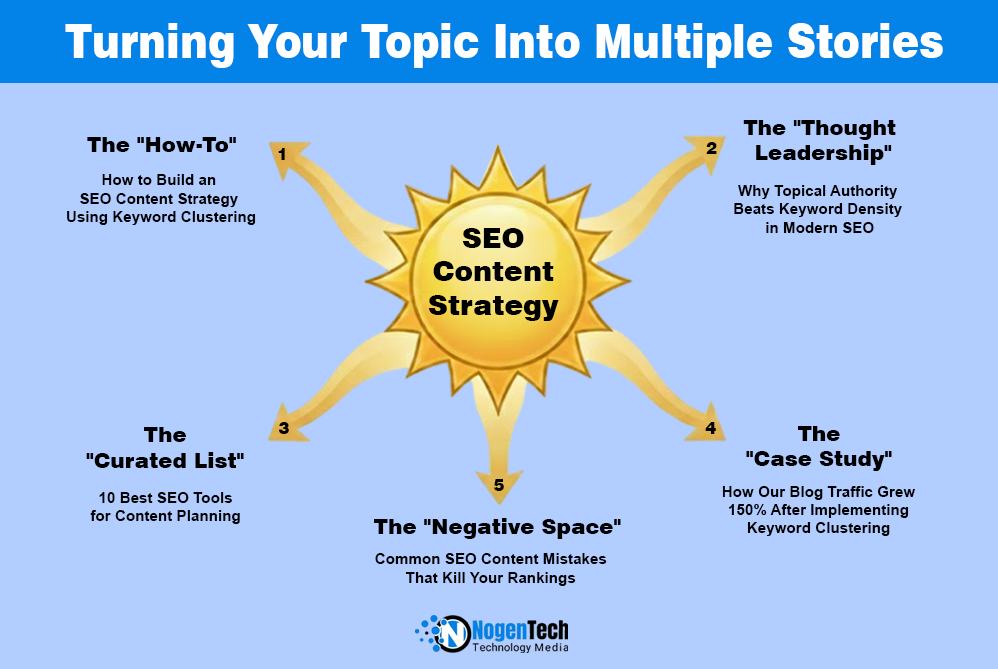
The 5 Angles – How to Spin One Topic into Five Stories
This is the practical execution of your topic’s multiple stories. You don’t need to invent new ideas; you just need to shift your lens. Here are five standard angles to apply to any core topic.
1: The “How-To” (The Teacher)
- Focus: Actionable steps, tutorials, and implementation.
- Tone: Instructive and clear.
- Example for “SEO Content Strategy”: “How to Build an SEO Content Strategy Using Keyword Clustering.”
2: The “Thought Leadership” (The Philosopher)
- Focus: Trends, predictions, and “Why” it matters. This is where you challenge the status quo.
- Tone: Opinionated and authoritative.
- Example for “SEO Content Strategy”: “Why Topical Authority Beats Keyword Density in Modern SEO.”
3: The “Curated List” (The Librarian)
- Focus: Tools, books, resources, or examples. People love lists because they are easy to scan.
- Tone: Helpful and unbiased.
- Example for “SEO Content Strategy”: “10 Best SEO Tools for Content Planning in 2026.”
4: The “Case Study” (The Scientist)
- Focus: Proof. Show the topic in action. Use real data and real results.
- Tone: Analytical and evidence-based.
- Example for “SEO Content Strategy”: “How Our Blog Traffic Grew 150% After Implementing Keyword Clustering.”
5: The “Negative Space” (The Skeptic)
- Focus: Mistakes to avoid, myths, and what not to do. Fear of failure is a powerful click driver.
- Tone: Cautionary and protective.
- Example for “SEO Content Strategy”: “5 Common SEO Content Mistakes That Kill Your Rankings.”
By using this framework, you’ve instantly generated five unique headlines from one single SEO topic. You are effectively covering your “Sun Topic” with multiple stories without repeating a single paragraph.
Interlinking – Creating the Web
Writing the content is only half the battle. To make this strategy work for SEO, you must connect the pieces.
Imagine your content as a wheel.
- The Hub: This is your “Ultimate Guide” (e.g., “The Complete Guide to SEO Content Strategy”).
- The Spokes: These are your multiple stories (The How-To, The Case Study, The List).
The Golden Rule of Interlinking
Every single “Spoke” article must link back to the “Hub.” And the “Hub” must link out to every “Spoke.”
When a search engine crawler lands on your “Case Study,” it follows the link to the “Hub,” realizes that these pages are related, and boosts the authority of both.
Anchor Text Strategy:
Don’t just say “Click here.” Use descriptive anchor text.
- Bad: “Read our other post about mistakes here.”
- Good: “To learn more about what to avoid, read our guide on common SEO Content Mistakes.”
Repurposing – One Story, Multiple Formats
The concept of your topics multiple stories extends beyond just blog posts. Once you have written the article, you have the script for every other platform.
This is where your content efficiency skyrockets.
- The Newsletter: Take your “Thought Leadership” article, shorten it, and send it as an email.
- The Twitter/X Thread: Take your “Listicle” article and turn every H2 header into a tweet.
- The LinkedIn Post: Take your “Case Study” and write a story about the struggle and success.
- The TikTok/Reel: Take your “How-To” article and film yourself doing the steps.
You are not creating new content; you are translating your topics multiple stories into different languages for different platforms.
How to Manage Cannibalization in your Topics Multiple Stories Approach
A common fear when writing multiple stories about one topic is Keyword Cannibalization. This happens when Google gets confused because two of your pages look too similar, so it ranks neither of them.
How to Avoid It
- Distinct Primary Keywords: Ensure every story targets a slightly different long-tail keyword.
- Story 1 Target: “SEO Content Strategy“
- Story 2 Target: “SEO Writing Tools“
- Story 3 Target: “SEO content writing Examples”
- Distinct Search Intent: As discussed in Part 1, ensure the goal of the user is different for each page. If Story A and Story B both answer “What is SEO Content Strategy?”, merge them.
- Canonical Tags: If you have two pages that are unavoidably similar (e.g., a product page and a blog post about the product), use a canonical tag to tell Google which one is the “master” version.
The Content Calendar for Topics
How do you schedule this? Do you publish all 5 stories at once?
There are two schools of thought here.
Approach A: The “Netflix Drop” (All at Once)
- Strategy: You write the Hub and all 5 Spokes, then publish them on the same day.
- Benefit: Immediate topical authority. Great for launching a new blog section.
Approach B: The “Serial” (Weekly Episodes)
- Strategy: Month 1 is dedicated to Topic A. Week 1 is the Hub. Weeks 2-5 are the Spokes.
- Benefit: Keeps your audience engaged and coming back. It signals consistent updates to Google.
For most content teams, Approach B is more sustainable. It allows you to deeply focus on one theme per month, ensuring that by the end of the year, you have built massive authority on 12 core topics.
Optimize for EEAT
- Expertise: Cite authoritative sources (Google Search Central, Moz, Ahrefs).
- Experience: Share real Nogentech examples.
- Authority: Link internally to related guides.
- Trust: Add author bio with credentials and SEO achievements.
Stop Writing Randomly – Turn your topics multiple stories
The internet is filled with noise. To stand out, you don’t need to be louder; you need to be deeper.
By adopting the philosophy of your topics multiple stories, you move away from the hamster wheel of chasing trending keywords. You start building a library of interconnected knowledge.
This strategy serves the reader, who gets a comprehensive education. It serves the search engine, which gets a clear map of your expertise. And most importantly, it serves you, the writer, by providing a never-ending well of content ideas.
Look at your content calendar today. Pick one topic. Now, tell five different stories about it. That is how you win.
FAQs
Use clear keyword mapping and internal linking to differentiate intent
Topic clustering organizes keywords; multiple stories are the content execution of those clusters.
Yes—by exploring different formats (guides, lists, case studies, thought leadership)