Back in 2021, I turned to Semrush while managing multiple SEO projects and struggling with too many separate tools for research, tracking, and audits.
Fast-forward to 2026, and Semrush has evolved far beyond traditional SEO workflows. Today, it combines search intelligence, competitor research, content optimization, PPC insights, and AI visibility features, but the bigger question remains: does it still deliver enough value for the price?
In this Semrush review, I’ll look at:
- What Semrush does well and where it falls short
- Whether its pricing is justified
- How it compares with Ahrefs, Moz, and other alternatives
- Who should use it and who should consider other options
This is a practical look at what Semrush offers today and whether it is worth adding to your marketing stack in 2026.
What Is Semrush?
Semrush is an all-in-one digital marketing platform that helps businesses, marketers, and SEO professionals improve their online visibility through SEO, keyword research, competitor analysis, backlink analysis, content marketing, PPC, and social media management.
Instead of switching between multiple tools, you can manage these tasks from a single dashboard with unified reporting and insights.
Founded in 2008 by Oleg Shchegolev and Dmitri Melnikov, Semrush started as an SEO toolkit and has evolved into a comprehensive marketing platform. In 2026, Semrush became part of Adobe, combining Semrush’s search intelligence and visibility data with Adobe’s customer experience and marketing technologies.
Today, Semrush serves more than 10 million users worldwide and is used by 35% of Fortune 500 companies. It has also received 21 international awards and maintains one of the industry’s largest marketing databases, including 28.7 billion keywords, 43 trillion backlinks, and 808 million domain profiles.
What Is Semrush Rank?
Semrush Rank (SR) is Semrush’s proprietary metric that measures a website’s relative online visibility based on estimated traffic and other performance signals. A lower SR indicates stronger online visibility, making it useful for benchmarking your website against competitors over time.
How accurate is Semrush?
Semrush is generally accurate for SEO research and competitive analysis, but its metrics are estimates rather than Google’s actual data. Keyword volumes, traffic, and rankings are calculated using Semrush’s own data and algorithms, so they may differ from Google Search Console or Google Analytics.
How Does Semrush Work?
Semrush works by collecting and analyzing large amounts of search, competitor, and website data to provide insights about keywords, rankings, backlinks, traffic trends, and digital marketing performance.
When you enter a domain, keyword, or competitor into Semrush, the platform processes available data from its databases and presents reports that help users understand search visibility and identify growth opportunities.
Semrush works through several core processes:
- Keyword & ranking analysis: Tracks keywords, positions, and visibility changes.
- Competitor analysis: Shows competitors’ keywords, traffic insights, and strategies.
- Backlink analysis: Evaluates backlinks and link-building opportunities.
- Website auditing: Identifies technical SEO issues affecting performance.
- Performance tracking: Monitors rankings, visibility, and campaign progress.
After analyzing the data, Semrush organizes the information into dashboards and reports, making it easier for marketers and SEO professionals to make data-driven decisions.
The platform also adapts to changes in search technology. In September 2025, Semrush adjusted its data collection processes after Google removed the n=100 SERP parameter, a change that affected SEO data providers across the industry.
Our blog also has basic informational guides about other market-dominant SEO tools to consider to fuel your marketing strategies. You can also read about those below,
- Ahrefs
- MOZ SEO
- Ubersuggest
- Yoast SEO
Why are rankings different on Semrush than Ahrefs?
Semrush and Ahrefs use different crawlers, databases, and algorithms, so their rankings and SEO metrics often vary. These differences are normal, and both platforms are better suited for identifying trends and benchmarking performance than providing identical data.
Why are Semrush and SimilarWeb different?
Semrush and SimilarWeb estimate website traffic using different methodologies, so their traffic figures rarely match. Semrush primarily estimates traffic from search data, while Similarweb combines multiple data sources, including user panels and other proprietary signals.
Which is Better for Backlink Analysis, Ahrefs or Semrush?
Ahrefs is generally better for backlink analysis because it has one of the largest and most frequently updated backlink databases, making it excellent for link discovery, competitor backlink research, and link profile analysis.
Semrush is a stronger all-in-one SEO platform, combining backlink analysis with keyword research, site audits, rank tracking, and content marketing tools.
Semrush Pricing: How Much Does Semrush Cost?
Semrush pricing starts at $139.95 per month for the Pro plan, with higher tiers available for teams, agencies, and enterprises that need more projects, reports, users, and advanced features.
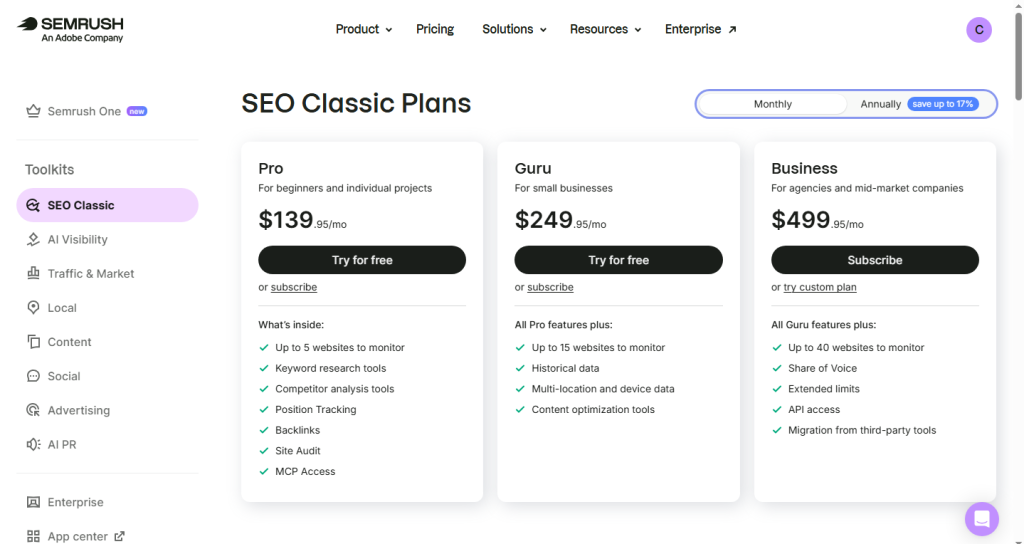
The best plan depends on your workflow, team size, and the number of websites or campaigns you manage.
Semrush Pricing Plans
| Plan | Monthly Price | Annual Price (per month) | Best For |
|---|---|---|---|
| Pro | $139.95 | $117.33 | Freelancers and small teams |
| Guru | $249.95 | $208.33 | Agencies and growing businesses |
| Business | $499.95 | $416.66 | Large agencies and enterprises |
| Enterprise | Custom pricing | Custom pricing | Organizations with specific requirements |
Annual billing can reduce the monthly cost compared with month-to-month subscriptions, with discounts of up to 17% depending on the plan.
Semrush Plan Breakdown
- Pro: Includes essential SEO tools such as keyword research, position tracking, and site auditing. It supports up to 5 projects and tracks up to 500 keywords.
- Guru: Adds features such as historical data and content marketing tools, with higher limits including up to 1,500 tracked keywords.
- Business: Designed for larger teams, offering advanced capabilities such as white-label reporting, API access, and higher usage limits, including up to 5,000 tracked keywords.
- Enterprise: Provides customized solutions for organizations that need tailored features, premium support, account management, training, and additional customization options.
Additional Semrush Costs to Consider
Semrush plans generally include one user account. Teams that need additional users must purchase extra user seats, which can increase the overall subscription cost.
Semrush also introduced Semrush One, a bundled offering that combines the core SEO Toolkit with the AI Visibility Toolkit. It is designed for businesses that want to monitor and improve visibility across traditional search results and AI-powered search experiences.
Is Semrush Free? Free Plan and Trial Options
Semrush offers limited free access and a free trial, allowing users to test its SEO tools before upgrading. The free plan provides restricted access to features such as keyword research, domain analysis, and site audits.
Apply filters to narrow your results, identify high-value opportunities, and save relevant keywords for your SEO or content strategy.
While free users can access the Keyword Magic Tool with limited searches, including up to 10 keyword searches per day. This is useful for exploring the platform, but regular SEO workflows usually require a paid plan.
The free trial provides temporary access to paid features, allowing users to evaluate Semrush tools before choosing a subscription.
Furthermore, it helps users to extract the best keywords for PPC campaigns to achieve better outcomes without breaking the bank.
What Are the Key Features of Semrush?
Semrush combines SEO, content marketing, advertising, competitor research, and AI search visibility into a unified platform, helping businesses manage their entire digital marketing strategy from one place.
The following are the compelling features and associated advantages of utilizing the potential of the SEMrush tool.
1 – Comprehensive Keyword Research
Discover keyword opportunities with Keyword Magic Tool, Keyword Gap, search intent analysis, keyword difficulty, and SERP insights.
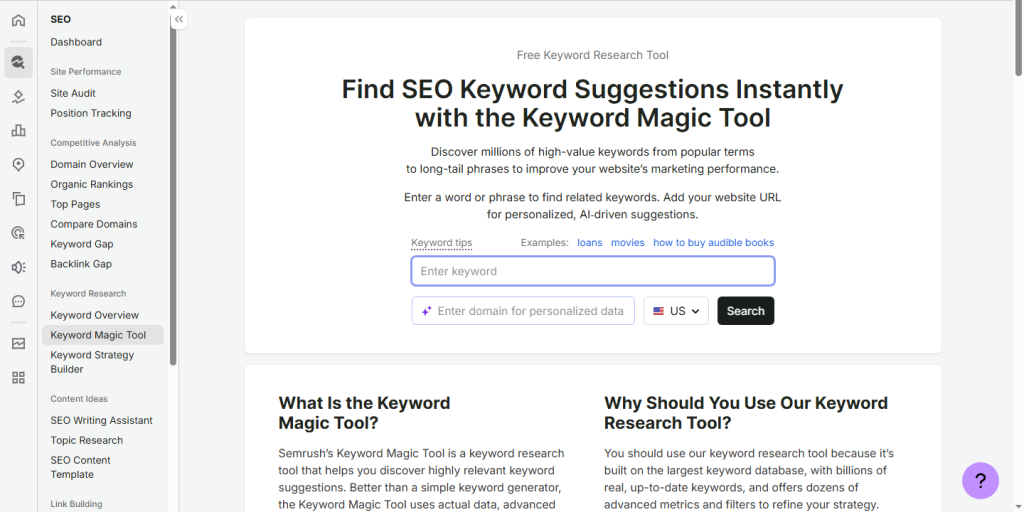
Also, it helps you unlock new opportunities by measuring trends, search volume, and relevant keywords to improve your content strategy.
2 – Competitor Analysis
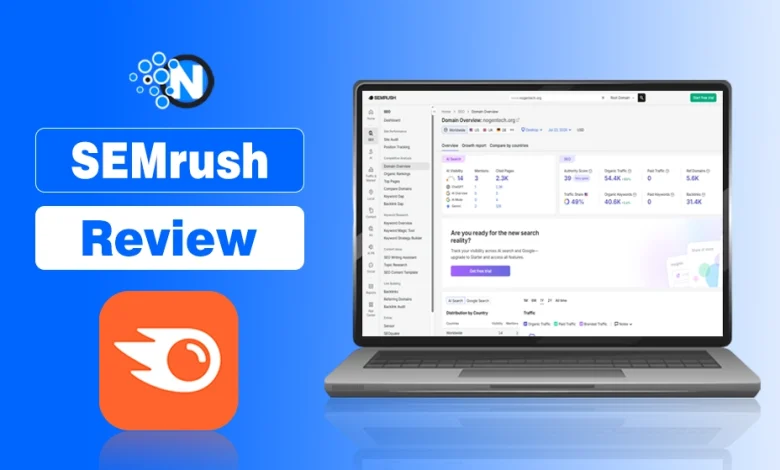
Analyze competitors’ keywords, traffic, backlinks, paid campaigns, and overall search performance using Domain Overview, one of Semrush’s most popular tools for researching any website.
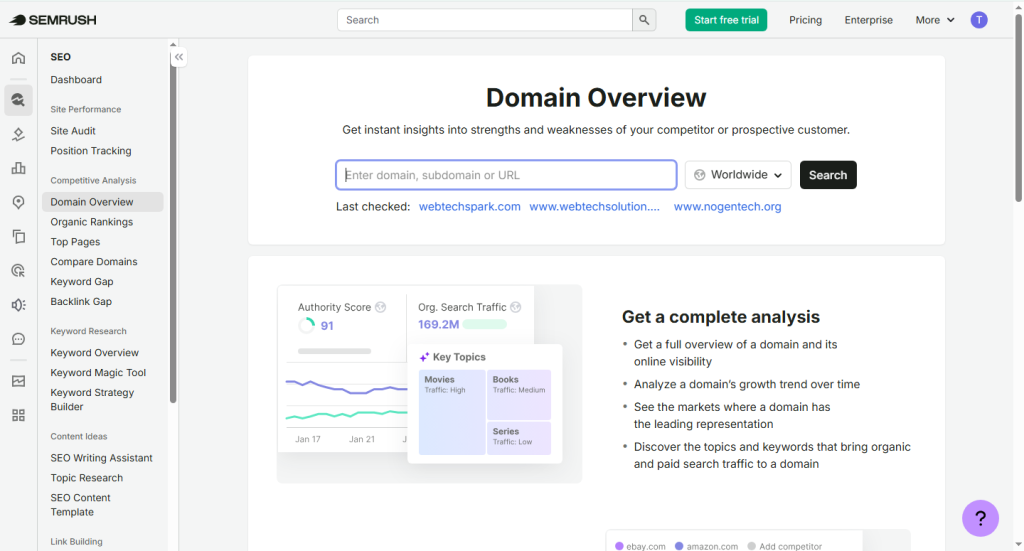
Similarly, analyzing the backlink profiles lets you learn about the tactics of creating more backlinks and the strategic placement of advertisements to boost audience numbers.
3 – Site Audit and SEO Recommendations
Site audits and SEO recommendations are other key benefits of adopting SEMrush, as they analyze websites for technical SEO issues. With this tool, you can identify broken links, missing meta tags, and other on-page SEO factors.
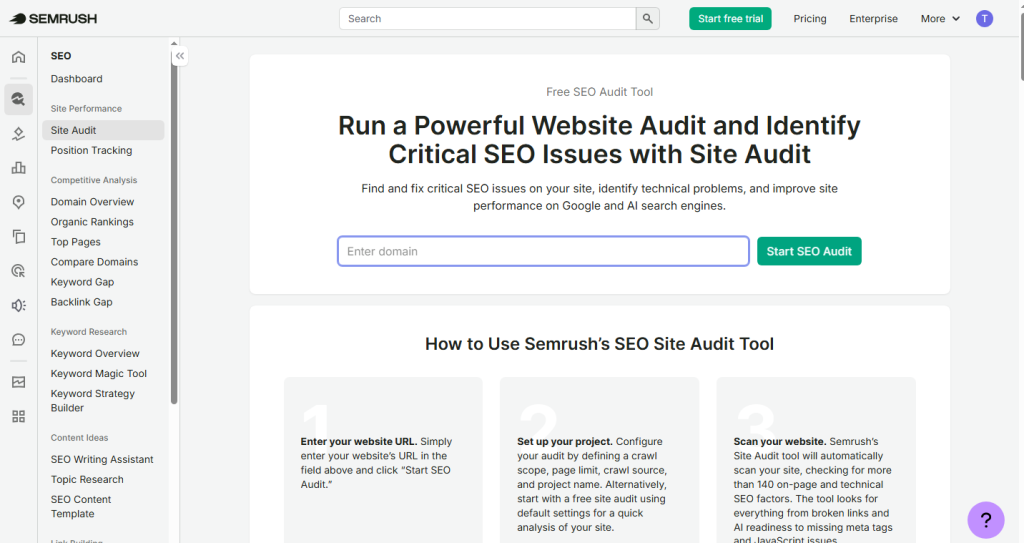
In this way, you can build a comprehensive SEO strategy. Further, you can take your site growth to the next level by receiving actionable recommendations.
4 – Backlink Analysis
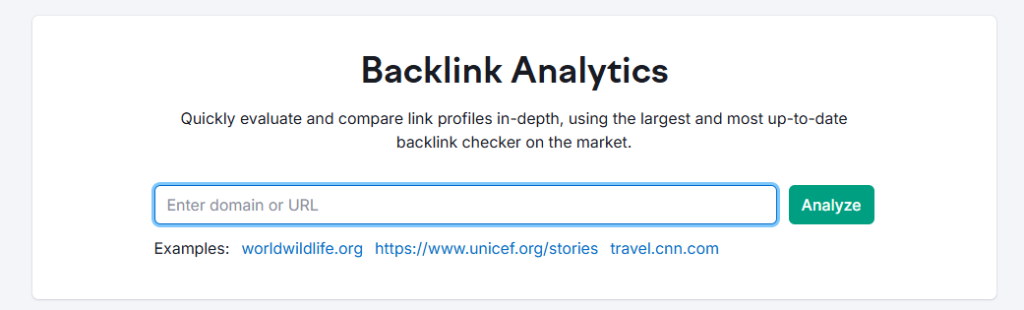
Backlinks play a crucial role in taking the website to the top of the search engine results pages. Therefore, it is necessary to maintain the quality and quantity of backlinks to prevent adverse outcomes. SEMrush allows you to monitor your backlink profile to identify spammy and broken links.
You can monitor backlink profiles of your site, referring domains, toxic links, and link-building opportunities using one of the industry’s largest backlink databases.
After getting the insights, you can work properly and strategically to overcome them. Above all, SEMrush helps you find and create more backlinks by unlocking new opportunities.
5 – PPC Advertising Insights
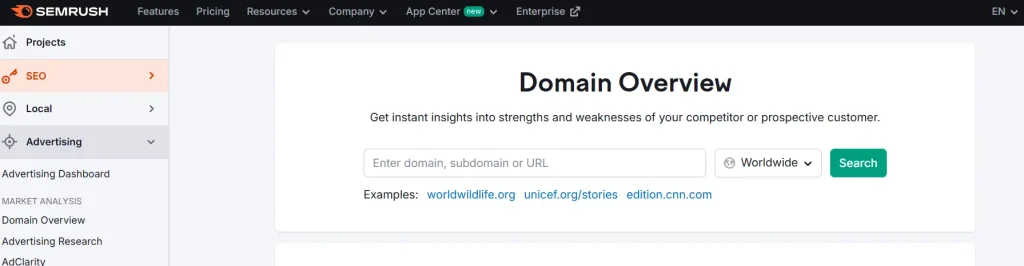
Research competitors’ Google Ads, keywords, landing pages, and advertising strategies to improve paid search campaigns.
Users can analyze competitors’ ad strategies to optimize their own campaigns. Also, the integrated research tool maximizes the effectiveness of your paid advertising efforts.
6 – Position Tracking
You can track keyword rankings by country, city, device, and search engine with daily performance updates.
As a result, you can direct your efforts to optimize your existing content strategies as well as create new ones to enhance the rank of other content.
7- Content Marketing
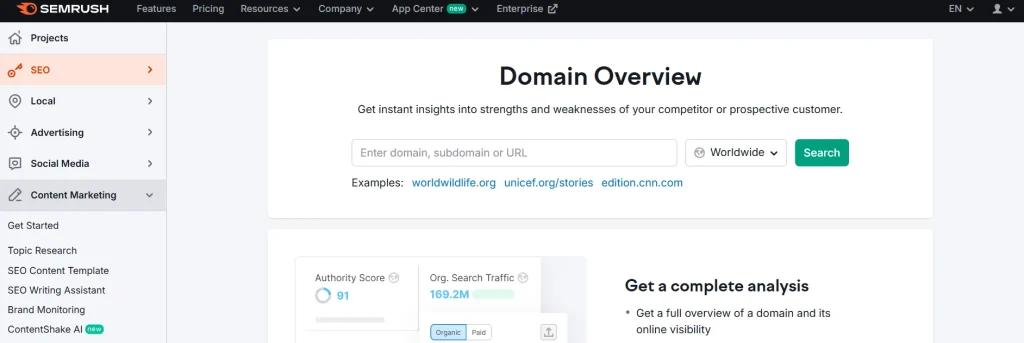
The content marketing feature of this tool helps users search for keywords and get creative content ideas to stand out among competitors. This is a helpful tool for businesses that know which keywords they want to target but don’t have content ideas to work on.
Most people consider SEMrush to be dedicated only to search engine optimization. However, this is not true, as it features built-in features for PPC advertisements.
In this way, they can go through different web pages to see how they have covered the given keyword and do something unique and creative.
8- Advertising
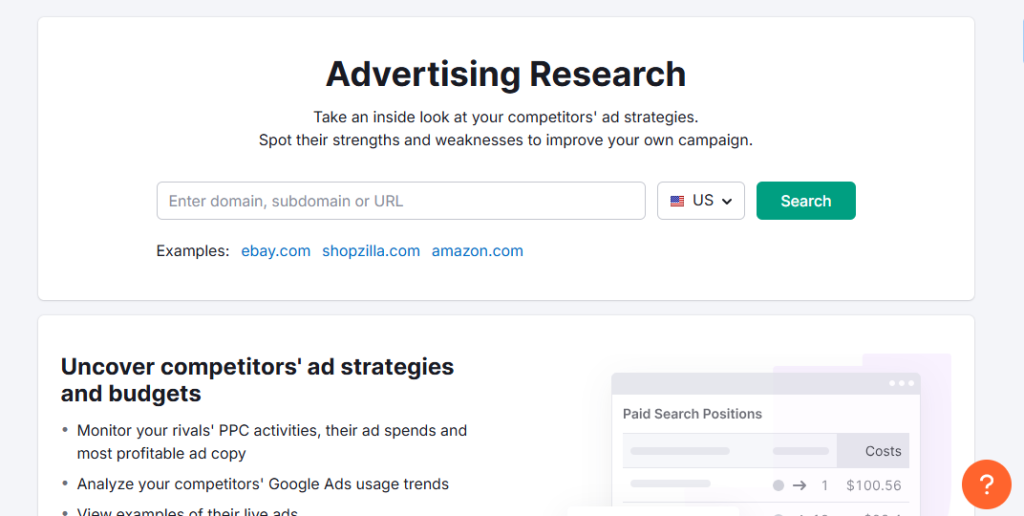
The advertising section of Semrush has a range of features to help brands spy on their competitors to steal ideas and do something better. It generates reports for paid traffic coming from sources like Facebook ads or Google ads.
9- Local SEO
Manage business listings, track local rankings, monitor Map Pack performance, and optimize your Google Business Profile from a single dashboard.
What's New in Semrush (2026)?
Semrush continues to expand beyond traditional SEO by adding AI search intelligence, integrated workflows, and new tools for optimizing brand visibility across AI-powered search platforms.
- Semrush One: Unifies SEO, content marketing, advertising, competitor research, and AI visibility in a single platform.
- Expanded AI Visibility Toolkit: Tracks brand visibility, prompts, and citations across Google AI Overviews, ChatGPT, Gemini, Perplexity, and other AI search platforms.
- LLM Gap Analyzer: Reveals why AI models cite or overlook your content and identifies opportunities to improve visibility.
- Perplexity MCP Connector: Brings Semrush search intelligence directly into Perplexity through the Model Context Protocol (MCP).
- AI-Cited Media & Journalist Discovery: Identifies the publications and authors most frequently cited by AI models to support AI-focused digital PR.
Together, these updates position Semrush as more than a traditional SEO platform, extending its capabilities to support visibility across both search engines and AI-driven discovery experiences.
How to Use Semrush for Keyword Research
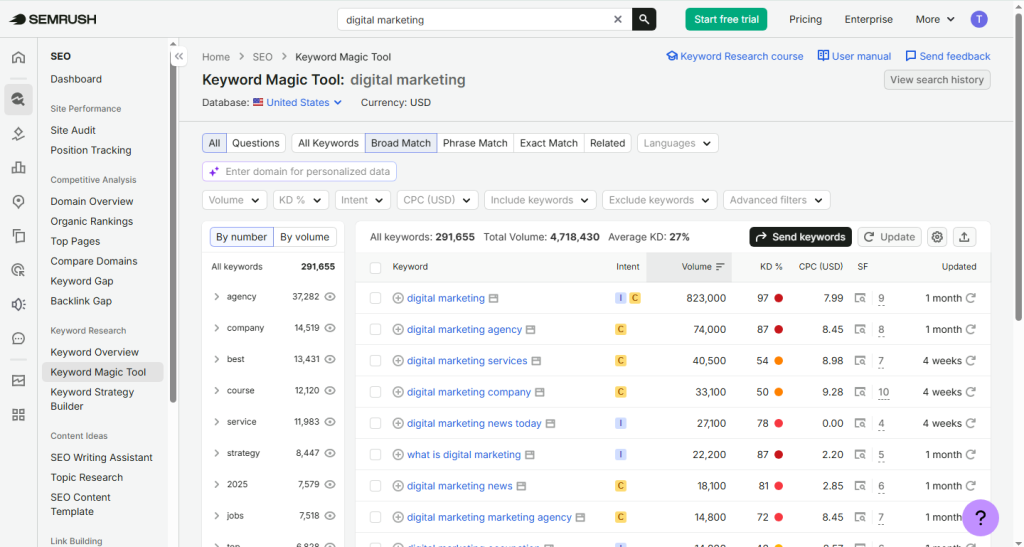
To use Semrush for keyword research, enter a seed keyword into the Keyword Magic Tool to discover related keywords, search volume, keyword difficulty, search intent, CPC, and SERP features. Then, use filters to find the most relevant opportunities and save the best keywords for your SEO or content strategy.
Step 1: Open the Keyword Magic Tool
Search for Keyword Magic Tool on Google and click on the Semrush website showing in the SERP. Log in to Semrush and navigate to the Keyword Magic Tool from the left-hand menu under SEO → Keyword Research.
Step 2: Enter a Seed Keyword
Type a broad keyword related to your topic (for example, “digital marketing”) into the search bar and click Search.
Step 3: Review Keyword Suggestions
Semrush generates thousands of related keyword ideas along with important SEO metrics, including:
- Monthly search volume
- Keyword Difficulty (KD%)
- Search intent
- Cost per click (CPC)
- Competition level
- SERP features
- Trend data
Then use the available filters to narrow the keyword list based on your goals. You can also filter by selecting the search volume:
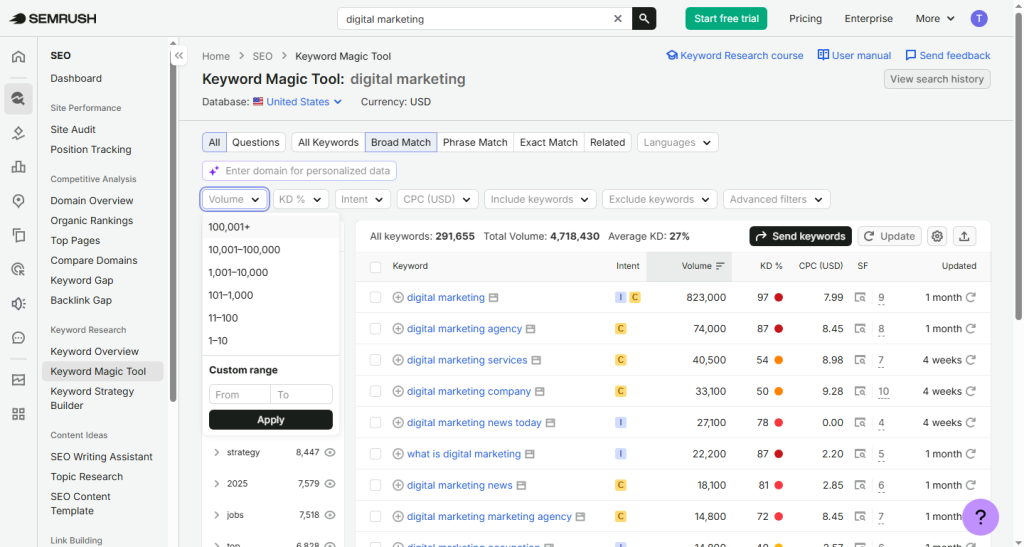
- Search volume
- Keyword Difficulty
- Search intent
- CPC
- Word count
- Include or exclude specific terms
- SERP features
This helps you focus on keywords that match your SEO strategy.
Step 5: Analyze Keyword Opportunities
Compare keywords based on their traffic potential, ranking difficulty, and user intent. Prioritize keywords that balance search volume with achievable competition and align with your target audience. Select the KD filter with start from zero and then find the opportunity.
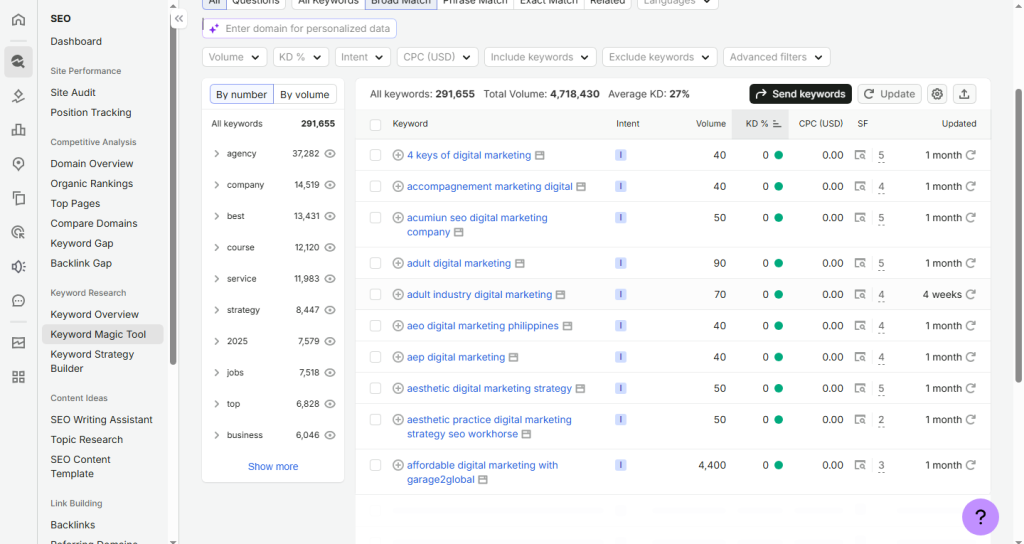
Step 6: Save Your Selected Keywords
Add promising keywords to the Keyword Strategy Builder, Keyword Manager, or export them to a CSV or Excel file for future planning.
Group related keywords into topical clusters or content categories. This makes it easier to plan articles, landing pages, and supporting content that target multiple relevant search queries.
Incorporate your selected keywords into your content plan, optimize existing pages, and monitor their performance over time to improve search rankings and organic traffic.
SE Ranking vs. Semrush: Which Should You Choose?
Semrush is better suited for users who need a comprehensive digital marketing platform, while SE Ranking is a more affordable alternative for businesses focused on SEO and search visibility.
Both platforms offer keyword research, rank tracking, site audits, competitor analysis, and AI visibility features. Semrush provides a broader toolkit with PPC research, content marketing, social media management, and advanced competitive intelligence, while SE Ranking focuses on delivering core SEO capabilities with growing AI search visibility tools.
Choose SE Ranking if you want an affordable SEO platform. Choose Semrush if you need a wider range of marketing and search intelligence tools.
What Are the Best Semrush Alternatives?
If Semrush doesn’t fit your budget or workflow, several SEO platforms offer strong alternatives depending on your needs.
- Ahrefs: Best for backlink analysis, keyword research, and organic SEO.
- SE Ranking: Best for affordable SEO, rank tracking, and AI search visibility.
- Mangools: Best for beginners looking for a simple, easy-to-use SEO toolkit.
- SpyFu: Best for competitor analysis and PPC research.
- Moz Pro: Best for beginners, website optimization, and AI visibility tools.
Each platform has its strengths, but Semrush remains the most comprehensive option for users who need SEO, PPC, content marketing, competitive research, social media management, and AI visibility in one platform.
What Are the Pros and Cons of Semrush?
Semrush offers one of the most comprehensive digital marketing platforms available, but its pricing and learning curve may not suit every user.
Pros of Semrush
- Comprehensive SEO, PPC, content marketing, social media, and AI visibility tools.
- Extensive keyword, backlink, and competitor research databases.
- Powerful site audits, rank tracking, and reporting features.
- AI-powered tools for content optimization and search visibility.
- Free trial available for new users.
Cons of Semrush
- Higher starting price than many competitors.
- Only one user seat is included with most plans.
- Large feature set can be overwhelming for beginners.
- Lower-tier plans have project and keyword tracking limits.
How Can You Cancel a Semrush Subscription?
You can cancel your Semrush subscription from your account settings, but the cancellation is only completed after you confirm it by email.
To cancel your subscription:
- Log in to your Semrush account.
- Go to Subscription Info in your account settings.
- Select your active subscription and follow the cancellation prompts.
- Complete the required feedback steps and choose Continue to Cancel.
- Open the confirmation email from Semrush and click the verification link within 72 hours to finalize your cancellation.
Your subscription remains active until the end of the current billing period unless stated otherwise. Before canceling, review Semrush’s latest cancellation and refund policy, or consider switching to the free plan if you want to keep your account and project history.
What People Want More About Semrush?
Does Neil Patel recommend Semrush or Ahrefs?
Neil Patel has recommended both Semrush and Ahrefs for professional SEO. He also promotes Ubersuggest as a more affordable alternative for beginners and small businesses.
What tool is better, Semrush or Ahrefs?
Semrush is better for all-in-one SEO, including keyword research, site audits, and rank tracking, while Ahrefs is better for backlink analysis and link research. Choose the tool that best matches your SEO priorities.
Is Semrush good for beginners?
Yes, Semrush is suitable for beginners, but its extensive feature set comes with a learning curve. The platform also provides tutorials, templates, and guided workflows to help new users get started.
Which search engines does Semrush support?
Semrush primarily tracks Google Search but also supports keyword and rank tracking for Bing in selected tools and regions. Features may vary depending on the tool and location.
Can Semrush track local SEO rankings?
Yes, Semrush can track local keyword rankings by country, state, city, ZIP code, and device. It also includes tools for managing business listings and monitoring local search performance.
Does Semrush offer API access?
Yes, Semrush offers API access on selected plans for integrating SEO, keyword, and analytics data into custom applications and dashboards.
Can Semrush help with AI search optimization?
Yes, Semrush includes AI visibility tools that help monitor brand presence across AI-powered search experiences such as Google AI Overviews, ChatGPT, Gemini, and Perplexity.
Is Semrush the Right SEO Tool for You?
Semrush is a strong choice for businesses, agencies, and marketers who need advanced SEO and digital marketing insights in one platform.
Its wide range of tools makes it valuable for users managing multiple campaigns, websites, or marketing channels.
Semrush is a good fit if you:
- Manage SEO for multiple clients or websites.
- Need SEO, PPC, content, and competitor research in one tool.
- Want deeper insights into rankings, competitors, and AI search visibility.
- Run an e-commerce, affiliate, or content-focused business.
Semrush may not be the best fit if you:
- Only need basic SEO tools or have a limited budget.
- Need only backlink analysis instead of a full marketing platform.
- Are just starting with SEO and prefer a simpler interface.