What if your restaurant could identify costly mistakes before they hurt your profits?
Artificial intelligence (AI) is quietly transforming restaurant design and management beyond self-order kiosks and robotic servers. Behind the scenes, restaurants use data from POS systems, reservations, inventory, kitchens, and customer interactions to make smarter decisions.
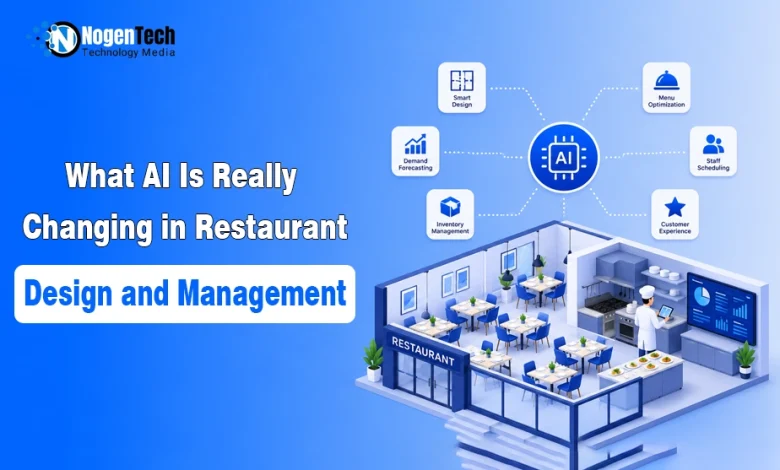
- Optimize dining room layouts and commercial kitchen design
- Forecast demand, schedule staff, and manage inventory
- Reduce food waste and improve customer experiences
Major brands like McDonald’s and Dine Brands are already using AI, while independent restaurants are adopting practical tools to improve efficiency and profitability.
Rather than replacing chefs, designers, or managers, AI supports better decision-making with real-time insights.
Moving forward, you will explore how AI is reshaping restaurant operations, its benefits and challenges, and why the future of restaurants is smarter, not staffless.
How Is AI Changing Restaurant Operations?
AI helps restaurants analyze data from POS systems, reservations, inventory, and kitchen operations to improve layouts, staffing, forecasting, and customer service.
Global brands like McDonald’s and Dine Brands use AI to reduce costs, improve operational efficiency, and support data-driven restaurant management across multiple locations.
Restaurants generate operational data from multiple sources every day, including:
- POS transactions
- Online reservations
- Delivery orders
- Inventory records
- Kitchen Display Systems (KDS)
- Employee schedules
- Customer loyalty programs
Instead of reviewing these datasets separately, Generative AI combines them to identify operational patterns, such as peak demand, inefficient workflows, inventory shortages, and staffing requirements.
This enables restaurant operators to:
- Optimize restaurant layouts
- Improve commercial kitchen design
- Forecast customer demand
- Reduce food waste
- Schedule staff more efficiently
- Improve customer experiences
Rather than replacing restaurant professionals, AI provides data-backed insights that help designers, chefs, and managers make faster, more accurate decisions.
For example, McDonald’s has announced broad technology upgrades that may even influence the placement of a restaurant booth for better customer flow.
How Is AI Transforming Restaurant Design and Management?
AI helps restaurants worldwide use POS systems, reservations, inventory, and customer data to optimize design, kitchen operations, staffing, and management, improving efficiency, profitability, and guest experiences.
It connects operational data from multiple systems to improve how restaurants are designed, managed, and operated.
Instead of relying on assumptions, businesses use data to optimize space, workflows, labor, and resources.
How Does AI Improve Restaurant Design?
AI enables data-driven restaurant design by analyzing customer behavior, occupancy trends, and operational data before construction or renovation.
In this regard, understanding the role of AI in floor plan generation helps designers automatically calculate traffic flow, seat density, and spatial efficiency.
It helps operators:
- Optimize seating capacity
- Improve customer and staff movement
- Position service stations efficiently
- Allocate space for dine-in, takeaway, and delivery
- Identify underutilized areas
By analyzing floor space, AI can help designers determine the ideal layout for a restaurant booth configuration to maximize comfort and capacity.
Using POS data, reservations, and occupancy patterns, restaurants can evaluate multiple layouts before investing in physical changes. Designers then combine these insights with accessibility, customer comfort, and brand identity.
How Is AI Transforming the Restaurant Dining Room?
AI improves dining room operations by predicting reservations, party sizes, and table availability to increase seating efficiency and reduce wait times.
Restaurants use AI to:
- Optimize table assignments
- Balance server workloads
- Reduce wait times
- Improve table turnover
- Personalize digital menus
AI also adjusts lighting, HVAC, and music based on occupancy while digital menus promote items using demand, inventory, and customer preferences.
How Does AI Improve Commercial Kitchen Design and Operations?
AI improves commercial kitchens by optimizing workflows, forecasting demand, reducing food waste, and monitoring connected equipment.
Restaurants use AI to:
- Optimize workstation layouts
- Forecast ingredient demand
- Reduce food waste
- Monitor equipment health
- Improve preparation efficiency
By combining POS data, weather, seasonality, and local events, AI improves preparation planning and inventory usage while predictive maintenance reduces unexpected equipment failures.
How Is AI Improving Restaurant Management?
AI helps restaurant managers forecast demand, optimize staffing, manage inventory, improve purchasing, and analyze business performance using operational data.
Key management applications include:
- Demand forecasting
- Employee scheduling
- Inventory management
- Supplier optimization
- Menu engineering
- AI-powered reporting
Instead of reacting to problems, managers receive data-backed recommendations that support faster operational and financial decisions.
How Is AI Changing Restaurant Staff and Customer Experience?
AI supports restaurant staff by automating routine tasks while improving customer service through personalization, faster communication, and operational assistance.
Restaurants use AI to:
- Assist hosts with seating
- Support employee training
- Automate reservations and phone inquiries
- Personalize menu recommendations using the top AI marketing tools available
- Provide multilingual support
While AI improves efficiency, human staff remain essential for hospitality, customer relationships, and decision-making. Restaurants must also protect customer data through responsible privacy and security practices.
What Challenges Do Restaurants Face When Adopting AI?
Restaurants worldwide face AI adoption challenges including poor POS data, system integration, implementation costs, cybersecurity, employee training, and data privacy.
Common challenges include:
- Poor Data Quality: Inaccurate POS, inventory, or sales data reduces AI accuracy.
- System Integration: AI must connect with reservation, payment, inventory, and delivery systems.
- Implementation Costs: Investment extends beyond software to equipment, training, maintenance, and security.
- Employee Adoption: Staff needs training to use AI tools effectively.
- Privacy & Cybersecurity: Customer and business data must be protected and managed in compliance with privacy regulations.
Successful AI adoption depends on reliable data, connected systems, trained employees, and strong security practices.
What Is the Future of AI in Restaurant Design and Management?
AI will help restaurants worldwide improve design, operations, and decision-making through predictive analytics, automation, and data-driven management while keeping human expertise central.
Future AI adoption will focus on practical business improvements rather than full automation.
- Enterprise Restaurants: Brands like McDonald’s will continue expanding AI across operations and multiple locations.
- Independent Restaurants: Small businesses will adopt affordable AI tools for scheduling, inventory, reservations, and forecasting.
- Smarter Decisions: AI will improve layouts, labor planning, inventory, maintenance, and customer experiences using real-time data.
- Human Expertise: Designers, chefs, and managers will continue making strategic decisions while AI provides recommendations.
- Phased Adoption: Restaurants will achieve better results by solving one operational challenge at a time instead of adopting multiple AI systems simultaneously.
Many large restaurant chains also collaborate with the best agentic AI development companies to create custom, autonomous workflows for supply chain management and labor scheduling.
The future of restaurant design and management is AI-assisted, data-driven, and human-led, not fully automated.
Frequently Asked Questions About AI in Restaurant Design and Management
What are the benefits of AI in restaurant design?
AI improves restaurant design by analyzing POS, reservation, and customer data to optimize layouts, seating, workflows, and space utilization for restaurants worldwide.
Can AI replace restaurant staff?
No. AI automates repetitive tasks, but chefs, designers, managers, and service staff remain essential for hospitality, creativity, and business decisions in restaurants globally.
How does AI reduce food waste in restaurants?
AI reduces restaurant food waste by forecasting demand, optimizing inventory, monitoring ingredient usage, and improving preparation planning using operational data.
Is AI suitable for small restaurants?
Yes. Small restaurants worldwide can use affordable AI tools for reservations, inventory, scheduling, forecasting, and customer engagement without fully automating operations.
How does AI improve customer experience in restaurants?
AI improves restaurant customer experiences through personalized menus, faster reservations, shorter wait times, multilingual support, and data-driven service improvements.
What data does AI use in restaurant management?
AI analyzes POS, reservations, inventory, loyalty programs, delivery orders, kitchen systems, and employee schedules to improve restaurant operations globally.
Final Thoughts: Building Smarter Restaurants with AI
AI is changing restaurant design and management by helping businesses replace assumptions with data-driven decisions.
From optimizing commercial kitchen design and dining room layouts to improving inventory, staffing, and customer experiences, AI delivers measurable operational value.
However, technology performs best when combined with experienced designers, chefs, and managers. In my view, restaurants that use AI to support human expertise, not replace it, will build more efficient, profitable, and customer-focused businesses in the years ahead.