
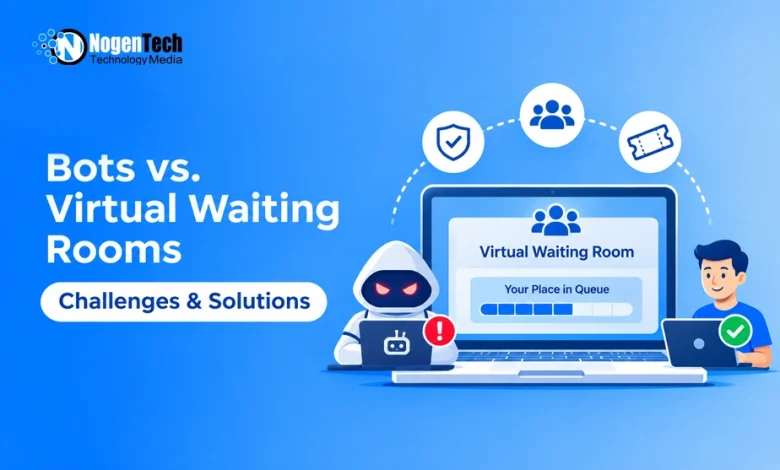
A product drop or ticket sale used to be a predictable traffic spike. Today, AI shopping agents can monitor prices, track inventory, and react to availability around the clock. A virtual waiting room helps businesses handle the resulting demand, but it does not necessarily keep automated buyers out.
DataDome’s Q3 2026 AI Traffic Report recorded nearly 25 billion AI agent requests across its network, a 41.5% increase from the previous quarter. Help Net Security reported these findings on October 19, 2026.
For retailers and ticketing platforms, the challenge is no longer just keeping websites online. It is making sure real customers get a fair opportunity to buy.
What Was a Virtual Waiting Room Built to Do?
A virtual waiting room was originally designed to manage demand, not identify sophisticated attackers. It protects websites from sudden traffic surges by holding visitors in a queue and releasing them gradually as server capacity becomes available.
This works well when thousands of genuine customers arrive simultaneously.
For example, a retailer launching limited-edition sneakers might receive more visitors in five minutes than its website normally handles in an entire day. An online queue management system prevents the server from becoming overwhelmed.
Visitors receive a queue position, wait for admission, and eventually reach the store.
The weakness is that a queue position does not prove someone is a genuine customer. Traditional systems can admit automated sessions alongside humans, leaving businesses with a stable website but an unfair purchasing process.
Why Do Virtual Waiting Rooms Fail Against Bots?
Virtual waiting rooms often fail because they make an initial trust decision when visitors enter the queue and do not continuously reassess their behavior. Sophisticated bots can imitate normal browsing during that initial check, obtain a valid session, and automate purchases later.
There are four common ways attackers exploit this weakness.
1. Bots imitate human behavior at the entrance.
Modern bots can execute JavaScript, reproduce mouse movements, vary browsing intervals, and use residential proxies.
They can also imitate browser fingerprints that older detection systems rely on.
A bot may therefore pass a short entry evaluation without raising obvious alarms.
2. Dormant bots wait for the right moment.
Some bots deliberately behave like ordinary visitors after entering the queue.
They browse slowly, maintain normal session activity, and avoid triggering suspicious traffic patterns.
The moment inventory becomes available, they switch to automated purchasing. Add-to-cart requests, checkout submissions, and payment attempts can happen much faster than a human could perform them.
3. Fake sessions inflate the queue.
Scalper bots do not always need to reach checkout immediately.
Filling a virtual queue with thousands of fake visitors increases waiting times for genuine customers. Some shoppers eventually abandon the purchase before reaching the website.
Even when bots do not complete transactions, they can still damage the customer experience.
4. AI agents complicate detection.
Not all automated traffic is malicious. An authorized AI shopping agent may legitimately purchase something on behalf of a customer.
Legacy systems often struggle to distinguish these agents from scalper bots. Blocking all automation can reject legitimate buyers, while allowing it all creates opportunities for abuse.
The broader challenge of identifying and stopping bot traffic is becoming increasingly important as automated tools become more sophisticated.
The scale of the problem is growing. DataDome’s 2026 State of Bot & Agent Security Report found that scalping activity increased 290.7% year over year, with median daily volume nearly quadrupling. SiliconANGLE covered the findings on September 22, 2026.
The issue is not simply more traffic. It is increasingly sophisticated automation competing for limited inventory.
How Do Bots Get Through a Virtual Queue? A Real-World Example
A queue can look healthy on the dashboard while a significant portion of its visitors are automated. This is particularly concerning during ticket sales, where a few seconds can determine who gets access to limited seats.
DataDome reported one striking example from a midnight ticket sale for a major sporting event. Its detection systems identified 2.4 million bot requests out of 7.8 million total queue requests.
That means 31% of the observed queue traffic was bots, according to DataDome’s May 20, 2026 Priority Protect announcement.
The problem also has a legal dimension. The United States introduced the Better Online Ticket Sales (BOTS) Act in 2016 to prohibit circumventing ticket-purchase limits through automated software.
In January 2021, the FTC announced its first enforcement actions under the law. The cases involved brokers accused of using bots and other technical methods to acquire tickets for resale. The FTC’s announcement illustrates that automated ticket purchasing is not merely a customer-experience issue.
What Actually Works Against Scalper Bots?
The most effective approach combines queue management with continuous traffic validation. Instead of trusting a visitor after one successful entry check, businesses should reassess every request throughout the session.
This means looking at several signals together:
- Human behavior: Does the visitor’s activity match normal browsing and purchasing patterns?
- Agent identity: Is an AI agent authorized to act on behalf of a real customer?
- Request intent: Is the visitor browsing, purchasing, scraping, or attempting to manipulate inventory?
- Behavioral changes: Does a previously normal session suddenly begin making automated purchase attempts?
DataDome addresses this through Priority Protect, its virtual waiting room within its bot and agent trust management platform.
The solution classifies humans, AI agents, and bots on every request. It continuously reassesses sessions and can challenge or remove visitors whose behavior changes after entering the queue.
It also supports priority lanes for trusted users and authorized agents. Businesses can apply different access policies rather than treating every automated visitor as either legitimate or malicious.
Other providers offer relevant approaches as well.
Queue-it combines virtual waiting rooms with bot and abuse management capabilities. Its Traffic Access Rules can challenge, block, or allow visitor segments. It also supports visitor identification, signed queue tokens, and additional validation before transactions. Its approach is particularly relevant for scheduled ticket sales and high-demand product launches.
Cloudflare offers Waiting Room for managing traffic surges and Bot Management for identifying automated requests. Its Enterprise Bot Management assigns request-level bot scores that businesses can use in custom security rules. This allows organizations to apply different actions depending on the traffic risk.
These approaches address different parts of the problem. Businesses should evaluate how well each vendor combines queue management, automated traffic detection, and enforcement across the entire purchasing journey.
What Should You Look for in Virtual Waiting Room Software?
Choosing virtual waiting room software requires more than comparing queue capacity and estimated waiting times. Security teams should understand how the platform handles automated visitors and what happens after someone enters the queue.
Here are four questions worth asking any vendor:
- When does the system recheck visitor trust? A single entry check may leave dormant bots undetected until checkout.
- How does it handle authorized AI agents? Blocking every automated visitor may also exclude legitimate customers using shopping assistants.
- Does it operate on your own domain and infrastructure? Understand how traffic is routed and whether the provider introduces additional dependencies.
- How quickly do policy changes take effect? During a live product launch, security teams need to respond without lengthy deployment processes.
The right solution should protect infrastructure without making genuine customers jump through unnecessary hoops.
A waiting room should make a high-demand sale more orderly, not turn purchasing into a frustrating experience.
As AI-driven shopping continues to grow, businesses need to rethink how they manage automated traffic. For a broader look at how AI is shaping the future of technology, it is worth considering how the growth of AI agents will affect online commerce and security.
DataDome, named a Leader in The Forrester Wave™: Bot and Agent Trust Management Software, Q2 2026, is one provider addressing this shift through continuous validation and agent-aware queue management.
Ultimately, keeping a website online is only half the job. The other half is making sure the people and authorized agents who deserve access actually get through.