How Do AI Detectors Work? What They Measure and Where They Fail
AI detectors analyze text predictability, sentence structure, and statistical writing patterns to estimate whether content was generated by AI.

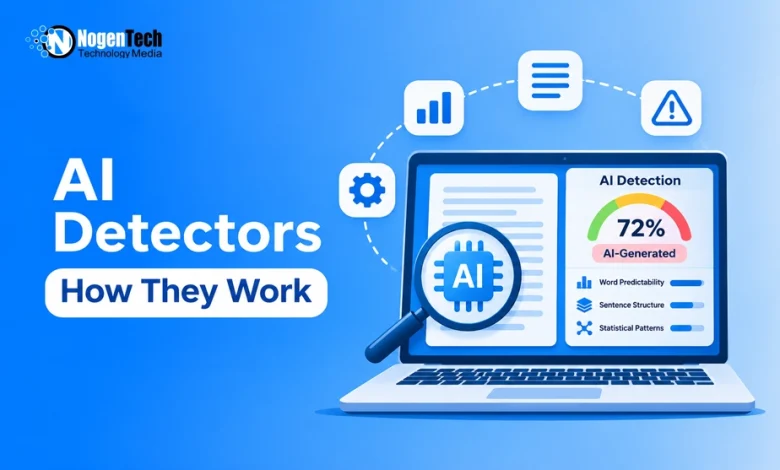
AI detectors analyze writing patterns to estimate whether text was generated by artificial intelligence. They examine whether a passage resembles content produced by large language models (LLMs) such as ChatGPT, Claude, or Gemini, rather than identifying its actual author.
These tools examine several signals:
- Word predictability: How predictable the word choices are.
- Sentence structure: Variations in sentence length and phrasing.
- Statistical patterns: Features associated with AI-generated text.
- Trained classifiers: Models that distinguish patterns in human and AI writing.
However, predictable writing doesn’t necessarily mean AI-generated content, as human writing can show similar patterns. The real challenge is knowing what detection scores actually mean, why false positives occur, and when these tools can be trusted.
Why Does Text Predictability Matter in AI Detection?
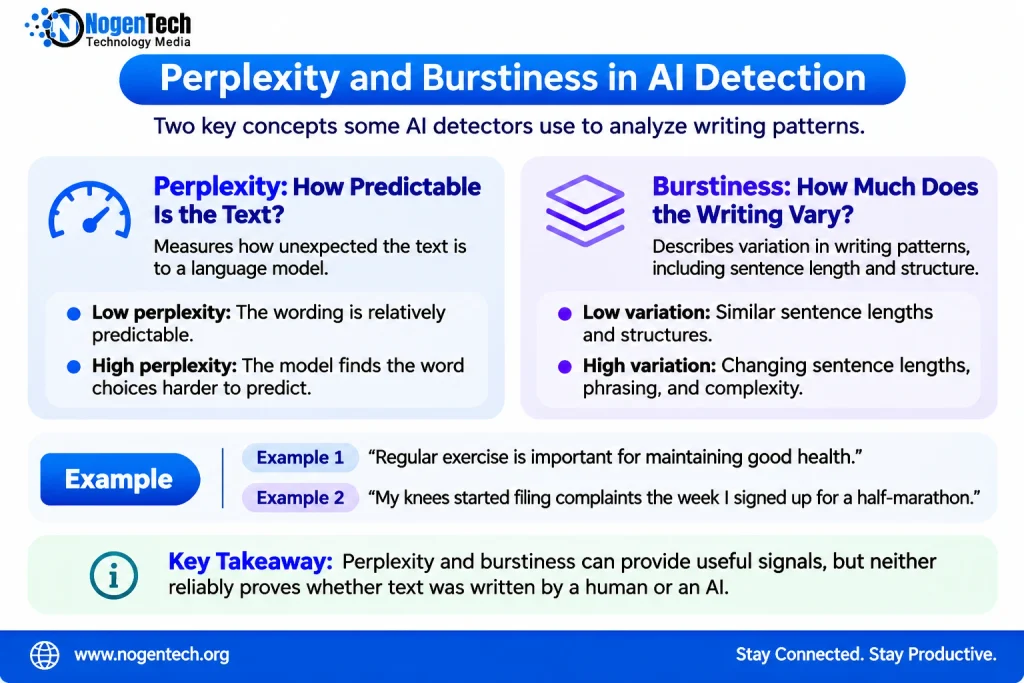
Large language models generate text by predicting tokens based on the preceding context. This can produce fluent, grammatically consistent writing. Some detectors analyze these patterns using two concepts: perplexity and burstiness.
1. Perplexity: How Predictable Is the Text?
Perplexity measures how unexpected text is to a language model.
- Low perplexity: The wording is relatively predictable.
- High perplexity: The model finds the word choices harder to predict.
Consider these examples:
- Example 1: “Regular exercise is important for maintaining good health.”
- Example 2: “My knees started filing complaints the week I signed up for a half-marathon.”
The first sentence uses common wording, while the second includes an unusual expression that may be less predictable. However, low perplexity alone doesn’t indicate AI writing. Technical documentation, academic content, and straightforward explanations can also be predictable.
2. Burstiness: How Much Does the Writing Vary?
Burstiness describes variation in writing patterns, including sentence length, structure, and predictability. Human writing may alternate between long explanations and short statements. AI-generated content can sometimes maintain more consistent patterns.
- Low variation: Similar sentence lengths and structures.
- High variation: Changing sentence lengths, phrasing, and complexity.
Some detectors examine burstiness alongside perplexity, but not every system uses these measures. Neither reliably proves authorship.
3 Methods AI Detectors Use to Identify AI-Generated Text
AI detectors use different techniques, sometimes combining multiple approaches.
| Detection Method | How It Works | Main Limitation |
| Statistical analysis | Examines predictability and writing patterns | May misclassify simple human writing |
| Trained classifiers | Learns patterns from human and AI text | Depends on training data |
| Watermarking | Checks hidden patterns added during AI generation | Requires a compatible watermark |
1. Statistical Analysis
Statistical detection examines perplexity, word distribution, and structural variation to identify characteristics associated with AI-generated content. Its main limitations include:
- Short passages provide fewer patterns to analyze.
- Predictable human writing can resemble AI text.
- Editing or paraphrasing may change detection results.
2. Trained AI Classifiers
AI classifiers are machine learning systems trained on labeled examples of human-written and AI-generated text. They analyze features such as:
- Word and phrase combinations.
- Sentence structure and punctuation.
- Repeated linguistic patterns.
Their accuracy depends on the quality and diversity of training data. New AI models and unfamiliar writing styles can reduce performance.
3. AI Watermarking
AI watermarking adds a hidden statistical pattern during text generation, which compatible software can later detect. One example is Google DeepMind’s SynthID, which supports watermarking for AI-generated text and other media. Google DeepMind made its text watermarking technology available to developers in October 2024.
However, watermarking has limitations:
- It only works when the generating system applies a compatible watermark.
- Extensive rewriting or translation can weaken detection.
- It cannot identify text generated without a watermark.
Where Do AI Detectors Fail?
AI detectors can produce false positives (human text classified as AI-generated) and false negatives (AI-generated text classified as human-written).
1. AI Detectors Can Misclassify Human Writing
In January 2023, OpenAI introduced an AI text classifier. According to OpenAI’s published evaluation:
- 26% of AI-generated text was correctly classified as likely AI-written.
- 9% of human-written text was incorrectly flagged as AI-generated.
OpenAI discontinued the tool on July 20, 2023, due to low accuracy. These figures describe that particular historical classifier, not current AI detection performance.
2. Non-Native English Writers Face Higher False Positive Risks
A 2023 Stanford study tested seven AI detectors on 91 human-written TOEFL essays. Researchers found:
- 61.22% of essays were classified as AI-generated on average across detectors.
- 89 of 91 essays were flagged by at least one detector.
- 18 essays were flagged by all seven detectors.
More predictable vocabulary and sentence structures may contribute to these results, raising fairness concerns in education and employment.
3. Short, Edited, and Formulaic Text Can Be Difficult to Classify
Detection becomes less reliable with:
- Short passages: Limited text provides fewer patterns.
- Edited AI content: Rewriting can change detectable characteristics.
- Formulaic human writing: Legal documents and technical reports can resemble AI text.
- Mixed-authorship documents: Combining human and AI writing complicates classification.
These limitations explain why human writing can be detected as AI, particularly when the text is formal, predictable, or heavily edited. Different tools may also assign different scores to the same passage.
How to Interpret an AI Detection Score
An AI detection score should prompt further review, not serve as proof of authorship. For example, a “72% AI” score doesn’t necessarily mean 72% of the document was AI-written. Its meaning depends on the detector’s scoring method.
To evaluate results responsibly:
- Review highlighted passages instead of relying only on the overall percentage.
- Use sufficiently long samples, recognizing that no word count guarantees accuracy.
- Check plagiarism separately, since originality and AI authorship are different questions.
- Compare results cautiously: Tools that compare multiple AI detector scores can show how different detection systems evaluate the same text, but agreement doesn’t establish proof.
- Review drafts and revision history for additional evidence of authorship.
You can explore these results using an AI content detector that provides detailed feedback. For comparison, check a sample of your own writing and an unedited AI-generated response on the same topic. Differences may illustrate how the tool evaluates writing patterns, but cannot establish authorship.
What's Next for AI Detection?
AI detection is expanding beyond linguistic analysis toward watermarking and content provenance.
1. Content Provenance and Watermarking
Technologies like SynthID introduce detectable patterns during AI generation. The Coalition for Content Provenance and Authenticity (C2PA) also develops standards for recording information about digital content origins and modifications.
These approaches can provide additional evidence about content creation, although neither is universally available for AI-generated text.
2. Human and AI Writing Are Becoming Harder to Separate
AI tools are widely used for outlining, editing, grammar correction, and drafting. This makes it harder to distinguish fully AI-generated content from human writing assisted by AI.
As these workflows overlap, originality, disclosure, and proper source attribution become increasingly important alongside detection results.
FAQs
Can AI Detectors Give False Positives?
Yes. Simple, formal, or highly structured human writing can be incorrectly flagged, particularly when written by non-native English speakers.
Can Watermarking Replace AI Detectors?
Not completely. Watermarking only works with compatible AI systems, and extensive rewriting may weaken its effectiveness.