
Top FMCG Supply Planning Strategies Using AI, Automation, and Digital Tools
Discover how AI demand forecasting, inventory automation, SKU segmentation, integrated planning, and scenario analysis help FMCG manufacturers reduce stockouts and excess inventory.

Supply management in the fast-moving consumer goods (FMCG) industry is challenging due to fluctuating demand, short product shelf lives, and large inventories. Even small forecasting errors can therefore lead to stockouts, excess inventory, and financial losses.
In this regard, AI demand forecasting, inventory management software, and supply chain automation help manufacturers plan promotions, manage perishable products, and handle large SKU portfolios more efficiently.
Here are five FMCG supply planning strategies that combine traditional planning practices with digital technology.
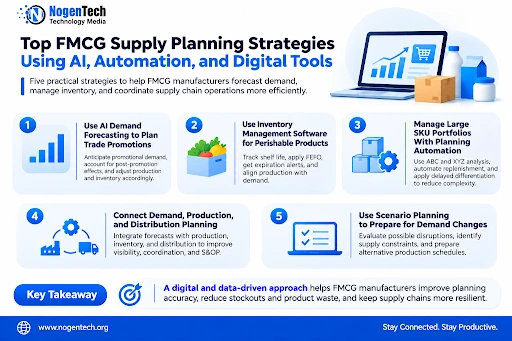
1. Use AI Demand Forecasting to Plan Trade Promotions
Trade promotions, including discounts, buy-one-get-one offers, and retail displays, can cause sudden demand spikes. AI-powered demand forecasting software helps manufacturers anticipate these changes using historical sales and promotional data.
Predict Promotional Demand
Planning software estimates promotional demand by analyzing:
- Historical sales: Performance of previous promotions
- Discount depth: How pricing changes affect demand
- Seasonal trends: Changes in customer purchasing patterns
- Retailer activity: Confirmed promotions and product displays
- Customer behavior: Previous purchasing and stockpiling patterns
These insights help manufacturers adjust production and inventory before promotions begin.
Account for Post-Promotion Demand
Sales may decline after a promotion because customers have already purchased additional products. Promotions can also reduce demand for similar products within the same brand.
AI demand planning tools can incorporate these effects into forecasts to help prevent overproduction.
2. Use Inventory Management Software for Perishable Products
Products such as dairy, bakery items, fresh meals, and certain beverages require careful planning because of their limited shelf lives.
Modern inventory management technology helps businesses improve stock visibility, while FMCG inventory systems also track expiration dates and prioritize shipments.
Key practices include:
- First Expired, First Out (FEFO): Ship products with the earliest expiration dates first.
- Real-time inventory tracking: Monitor stock quantities, batches, and shelf life.
- Automated alerts: Identify products approaching expiration.
- Demand-based production: Align manufacturing schedules with expected sales.
- Shelf-life-aware safety stock: Adjust inventory buffers based on expiration risks.
According to the UN Environment Programme’s Food Waste Index Report 2024, approximately 1.05 billion metric tons of food waste were generated across households, food service, and retail in 2022.
Better inventory visibility and demand forecasting can help manufacturers reduce avoidable product waste.
3. Manage Large SKU Portfolios With Planning Automation
FMCG manufacturers often manage hundreds or thousands of stock-keeping units (SKUs) across different flavors, packaging sizes, seasonal products, and retailer-specific variations.
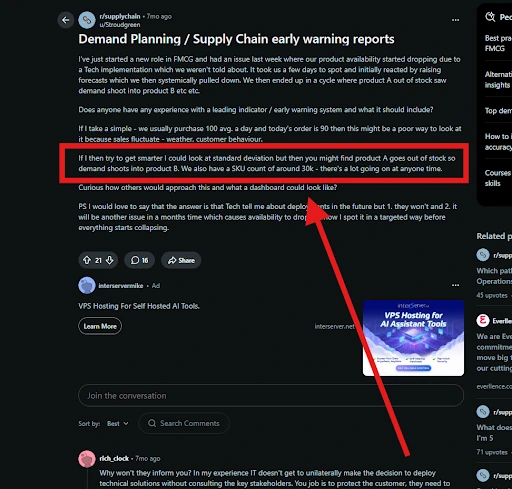
Large SKU portfolios also create challenges for supply chain professionals. In a Reddit discussion on FMCG demand planning, one professional described managing around 30,000 SKUs while dealing with product availability issues and unexpected demand shifts.
Supply planning automation reduces manual forecasting work and helps prioritize inventory decisions
Segment Products Using ABC and XYZ Analysis
Digital planning systems can support two common inventory classification methods:
- ABC analysis: Groups products by business importance, typically sales volume or revenue.
- XYZ analysis: Groups products by demand variability.
Combining these methods helps manufacturers identify which products need closer attention.
For example, stable, high-volume products may benefit from automated replenishment, while unpredictable products may require frequent forecast reviews.
Manufacturers can also compare AI demand planning software for CPG and FMCG manufacturers to evaluate forecasting and automation capabilities.
Use Delayed Product Differentiation
Delayed product differentiation, or postponement, involves keeping products in a generic form until customer requirements become clearer.
For example, a beverage manufacturer may store unlabeled bottles and apply retailer-specific labels closer to shipment.
Planning software helps coordinate these final production steps with confirmed orders, potentially reducing finished-goods inventory complexity.
4. Connect Demand, Production, and Distribution Planning
Disconnected planning systems make it difficult to respond to changing customer demand. Integrated supply chain planning platforms, including Sunstice supply chain planning solutions, help connect demand forecasts with production, inventory, and distribution decisions.
According to the World Economic Forum, AI-powered supply chain operations depend on trusted data and integrated processes to coordinate decisions across procurement, manufacturing, and logistics.
These systems help manufacturers evaluate:
- Inventory availability: Whether enough finished products are in stock
- Production capacity: Whether manufacturing can meet additional demand
- Material requirements: Whether raw materials and packaging are available
- Scheduling conflicts: How new orders affect existing production plans
- Distribution readiness: Whether deliveries can meet retailer requirements
Integrated planning also supports Sales and Operations Planning (S&OP) by bringing demand, supply, and operational priorities into a shared process.
5. Use Scenario Planning to Prepare for Demand Changes
Unexpected demand spikes, supplier delays, and production disruptions highlight the importance of supply chain risk management.
Scenario planning software helps manufacturers evaluate possible disruptions before making operational decisions. Common scenarios include:
- Demand increases: A promotion generates 20% more orders than expected.
- Supplier delays: Packaging materials arrive later than scheduled.
- Production disruptions: Equipment downtime reduces manufacturing capacity.
- Retailer changes: A major customer adjusts order quantities unexpectedly.
By comparing different scenarios, manufacturers can identify supply constraints, adjust inventory plans, and prepare alternative production schedules.
Final Thoughts
Effective FMCG supply planning depends on managing promotional demand, product freshness, and large SKU portfolios without creating excess inventory.
AI forecasting, inventory automation, integrated planning platforms, and scenario analysis help manufacturers improve planning accuracy and coordinate supply chain operations.
Combining these digital tools with established inventory practices can help reduce stockouts, limit product waste, and improve delivery reliability.