Artificial intelligence has become a regular part of how people work, study, and solve problems. From researching complex topics to summarizing reports and generating ideas, AI helps users complete tasks faster than ever before.
But as these tools become more capable, an important question is emerging: Does AI improve critical thinking, or does it gradually replace it?
The answer depends on how AI is used.
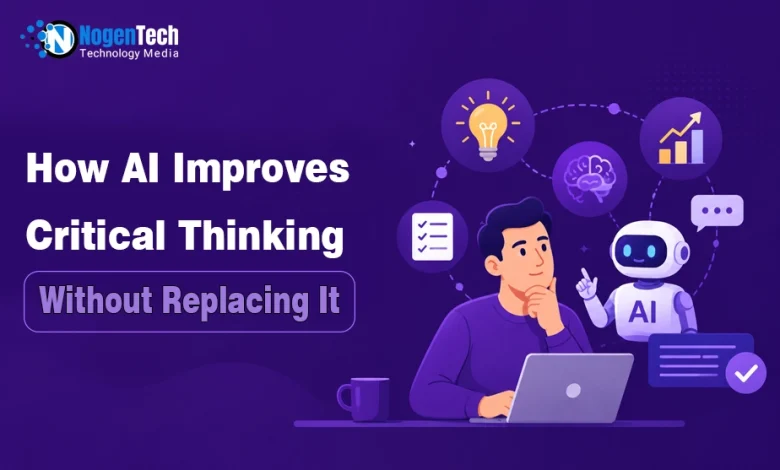
When treated as a thinking partner rather than a replacement for human judgment, AI can strengthen critical thinking by helping people analyze information, explore different perspectives, test assumptions, and make better-informed decisions.
However, relying on AI for every answer without questioning its output can weaken the reasoning skills that drive creativity, learning, and problem-solving.
In this guide, you’ll learn how AI improves critical thinking, where its limitations lie, and how to use it responsibly without sacrificing independent thinking.
What is Artificial Intelligence?
Artificial intelligence refers to computer systems designed to perform tasks that typically require human intelligence, like understanding language, recognizing patterns, and solving problems.
Modern AI, especially large language models, learns from vast amounts of data to generate text, answer questions, and assist with reasoning across nearly every industry.
Unlike traditional software that follows fixed rules, AI adapts its responses based on context, which is what makes it useful as a thinking partner rather than just a tool for automating repetitive tasks.
As a beginner in the field of AI, understanding these concepts can be a little confusing. This is why we recommend reading our full guide on what Artificial Intelligence is so that you can have a complete understanding of AI.
How AI Improves Critical Thinking without Replacing It?
The real value of AI isn’t in replacing human judgment, but in how it supports the way people think. When used intentionally, it can sharpen reasoning, surface new angles, and make complex problems easier to work through.
AI as a Tool for Better Thinking
Artificial intelligence should be viewed as an assistant rather than a substitute for human judgment. The most productive professionals use AI to organize information, evaluate alternatives, and accelerate research while keeping final decisions under human control.
Instead of replacing reasoning, AI can strengthen it by helping users:
- Analyze complex information
- Compare multiple perspectives
- Identify knowledge gaps
- Generate new ideas
- Test assumptions
- Improve problem-solving
Used this way, AI becomes an intellectual partner that expands human capability rather than replacing it.
AI Extends Working Memory
The human mind can only hold so much at once, and juggling multiple documents, data points, and deadlines often pushes that limit past its breaking point. AI steps in as an external memory of sorts, keeping track of details so people don’t have to hold everything in their heads at the same time.
Instead of manually cross-referencing reports or scrolling back through pages of notes, professionals can use AI search to pull relevant information quickly and offload that mental bookkeeping altogether.
This frees up their energy for the parts of the work that actually require judgment, like weighing options, spotting patterns, or deciding what matters most. This shift doesn’t just save time; it frees up mental space for the kind of thinking that machines still can’t do on their own.
AI Encourages Better Questions
One of AI’s greatest strengths isn’t providing answers; it’s encouraging deeper questions.
A well-designed AI assistant can:
- Challenge assumptions
- Present opposing viewpoints
- Identify logical inconsistencies
- Suggest alternative approaches
- Highlight overlooked scenarios
ChatGPT is a good example of this in practice. Through iterative conversations, it can challenge assumptions, present opposing viewpoints, and push users to think through a problem from multiple angles instead of settling for the first answer. If you want to understand how it works in more depth, check out our guide on what ChatGPT is and how it functions.
Rather than accepting the first solution, professionals can refine their thinking through iterative conversations.
This transforms AI into a collaborative brainstorming partner instead of a simple answer generator.
AI Supports Personalized Learning
Educational psychologists have long used cognitive scaffolding to describe temporary guidance that helps learners master increasingly complex concepts.
Artificial intelligence extends this approach by adapting explanations to each user’s knowledge level.
For example, AI can:
- Simplify technical concepts
- Generate real-world examples
- Explain difficult topics using analogies
- Break complex workflows into manageable steps
- Create personalized learning paths
Unlike static textbooks, AI responds dynamically to follow-up questions, making learning more interactive and accessible.
The Growing Role of AI Agents
Modern AI systems are evolving beyond chat interfaces into autonomous assistants capable of completing multi-step workflows.
An AI agent can:
- Conduct preliminary research
- Organize documents
- Summarize meetings
- Analyze datasets
- Monitor workflows
- Generate reports
Within businesses, these capabilities reduce repetitive administrative work while allowing employees to focus on higher-value activities such as planning, innovation, and strategic decision-making.
The key distinction is that AI agents should support decisions not replace human accountability.
The Risks of Overdependence on AI
Convenience has a trade-off. The more we let AI handle our thinking, the easier it becomes to stop thinking for ourselves. Here are some of the main risks of overdependence on AI:
- People who once worked through problems step by step may find themselves jumping straight to AI for a solution, skipping the messy but valuable process of figuring things out on their own
- Answers that come from AI often carry a tone of certainty, and that confidence can make users less inclined to pause and ask whether the information is actually accurate
- Skills like structuring an argument, digging through sources, or spotting patterns in data take repetition to build, and that repetition fades when AI is doing most of the work
- Recognizing a flawed assumption or a subtle bias in a piece of writing requires background knowledge that some users haven’t developed yet, especially if they’ve leaned on AI from the start
- Sitting with an open question or an unclear answer takes patience, and that patience can wear thin when AI has trained people to expect a clean, immediate response every time
Why Mental Effort Still Matters?
Learning often requires uncertainty, experimentation, and repeated practice. Solving problems independently strengthens memory, analytical reasoning, and creativity.
If AI always provides immediate answers, users may gradually avoid the productive struggle that develops expertise.
Some researchers argue that constantly outsourcing complex reasoning risks stunting the mind’s capacity to grow, particularly when individuals stop questioning AI-generated conclusions or exploring alternative solutions.
The goal should not be eliminating effort but directing effort toward higher-level thinking.
Automation Bias Can Reduce Critical Thinking
Automation bias occurs when people assume computer-generated recommendations are always correct.
Large language models generate highly convincing responses, even when factual errors or incomplete reasoning exist.
To reduce this risk, professionals should:
- Verify important information
- Compare multiple sources
- Question AI assumptions
- Validate statistics
- Review citations carefully
Critical thinking remains essential regardless of how advanced AI becomes.
AI Should Expand Knowledge, not Replace it
- Search engines changed how people retrieve information.
- AI changes how information is synthesized.
- Rather than memorizing every detail, professionals increasingly rely on AI to organize external knowledge.
- This shift offers enormous productivity benefits but also reinforces the importance of maintaining foundational expertise.
- Without sufficient domain knowledge, users cannot accurately evaluate whether AI-generated recommendations are reasonable.
Finding the Right Balance
Organizations adopting AI should establish clear guidelines for responsible use, starting with a clear understanding of the pros and cons of LLMs before rolling them out across teams. Best practices include:
- Using AI for research, not final decisions
- Verifying critical outputs independently
- Protecting sensitive business data
- Encouraging human review
- Maintaining continuous learning
- Developing strong analytical skills
When AI complements rather than replaces human expertise, businesses achieve greater efficiency without sacrificing judgment.
Final Thoughts
Artificial intelligence is neither a threat to human intelligence nor a guaranteed path to greater knowledge. Its long-term impact depends on how individuals and organizations integrate it into everyday work.
Used responsibly, AI accelerates research, expands learning opportunities, and improves productivity while leaving judgment, creativity, and ethical reasoning in human hands.
The professionals who gain the greatest advantage will be those who use AI to enhance their thinking, not replace it while continuing to question, analyze, and learn independently.
Frequently Asked Questions (FAQs)
Does AI improve critical thinking?
AI can improve critical thinking when it encourages exploration, comparison, and analysis rather than providing unquestioned answers. Its value depends on how users engage with the technology.
What is cognitive scaffolding in AI?
Cognitive scaffolding refers to temporary support that helps people understand increasingly complex concepts. AI provides personalized explanations, examples, and guidance that adapt to a learner’s current knowledge level.
Can AI replace human decision-making?
AI can support decision-making by analyzing information and generating recommendations, but important business, legal, medical, and ethical decisions should remain under human supervision.
What are the risks of relying too heavily on AI?
Excessive dependence may reduce independent problem-solving, critical thinking, and information verification. Users should always evaluate AI-generated outputs before acting on them.
How can businesses use AI responsibly?
Businesses should combine AI with human expertise by establishing review processes, validating important information, protecting sensitive data, and ensuring employees retain ownership of strategic decisions.
Will AI make people less intelligent?
Not necessarily. AI can either strengthen or weaken thinking depending on how it is used. When treated as a collaborative assistant instead of a replacement for reasoning, it can help people learn faster and make better-informed decisions.