AI is changing the way we test software, and “agentic testing” is one of the buzzwords everyone’s talking about now. Lots of platforms call themselves agentic, claiming they bring more automation and less upkeep.
But that label alone doesn’t tell buyers much. The real question is whether a platform actually makes testing better, or just bolts AI features onto the same old tools.
You may have heard that LambdaTest is now TestMu AI, a massive rebrand that perfectly mirrors how fast the industry is shifting toward agent-driven testing. Honestly, it’s a clear sign of where the market is heading, but if you’re like me, you’re probably a bit skeptical of flashy name changes. You have to look past the fresh coat of marketing paint.
But teams should judge any agentic platform on what it can actually do, not on marketing claims. Moving next, I will walk you through what to look for so you can tell real innovation from buzzwords.The term “agentic” is often used broadly across th
What Does "Agentic Testing" Actually Mean?
Agentic testing uses autonomous AI agents to make decisions, adapt to software changes, analyze failures, and optimize QA automation workflows.
The term “agentic” is often used broadly across the software industry, driven by the growth of top agentic AI development companies building autonomous systems. At its simplest level, it may refer to AI assistants that help write test cases, generate code snippets, or answer questions.
At a more advanced level, agentic systems can make decisions, adapt to application changes, coordinate testing activities, and analyze failures with limited human intervention.
This shift is happening because AI keeps getting better at handling tasks that used to need constant human input. If you’re new to how this technology works behind the scenes, our guide on Artificial Intelligence breaks it down in plain terms.
Knowing where a platform falls on this spectrum, from simple assistance to real decision-making, is the foundation for evaluating it properly.
With that baseline in mind, the next step is turning these concepts into concrete evaluation criteria. Rather than taking vendor claims at face value, QA teams need a structured way to test whether a platform’s “agentic” capabilities hold up in practice.
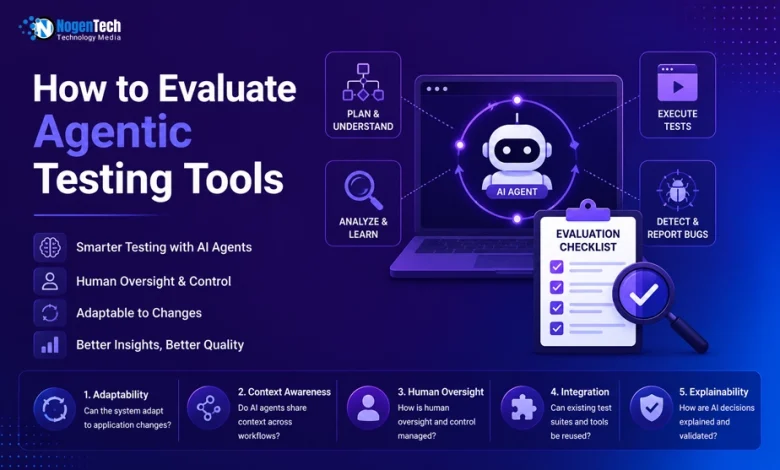
How to Evaluate an Agentic Test Cloud? 5-Question Checklist
Choosing the right agentic testing platform comes down to asking the right questions. Below are the key areas every QA team should dig into before making a decision:
- Adaptability: Can the system adapt to UI and layout changes?
- Context Sharing: Do AI agents share data across workflows?
- Oversight: How is human verification and control managed?
- Compatibility: Can existing frameworks (like Selenium) be reused?
- Transparency: How are AI decisions and fixes explained?
Can the System Adapt to Application Changes?
One of the biggest challenges in automated testing is maintaining test stability when applications evolve. Traditional automation scripts frequently fail when:
- UI elements are renamed
- Layouts change
- Navigation paths are updated
- Dynamic content behaves differently
An advanced agentic platform should be capable of understanding testing intent rather than relying solely on fixed rules and hardcoded locators.
When assessing a solution, ask vendors to demonstrate how the system responds to real application changes.
Important questions include:
- Does the test automatically adapt?
- Does AI recommend updates?
- Is human approval required?
- How are changes documented?
Platforms that can intelligently handle minor application changes may significantly reduce long-term test maintenance efforts.
Do AI Agents Share Context Across Workflows?
Many AI testing tools offer multiple AI-powered features, but those features often operate independently.
True agentic systems should share information across different stages of the testing process.
For example:
- Test creation should inform execution decisions.
- Execution data should support failure analysis.
- Failure analysis should influence future recommendations.
This interconnected workflow creates a more intelligent testing environment and reduces fragmented decision-making.
A practical evaluation method is to determine whether the platform can explain failures using information gathered throughout the entire testing lifecycle rather than from a single isolated event.
How Is Human Oversight Managed?
Despite advances in AI, software testing still requires human judgment.
Organizations should be cautious when vendors promise fully autonomous testing with no human involvement. While automation can increase efficiency, unsupervised systems may misinterpret bugs, overlook business requirements, or adapt to unintended changes.
The strongest agentic testing platforms typically position AI as a collaborator rather than a replacement for QA professionals.
Look for features that enable:
- Human review of critical decisions
- Approval workflows
- Explainable AI recommendations
- Transparent change tracking
- Confidence scoring for automated actions
Maintaining human oversight helps balance automation speed with software quality and business risk management.
Can Existing Test Suites Be Reused?
One of the most important practical considerations is compatibility.
Many organizations have invested years building Selenium frameworks, CI/CD pipelines, reporting systems, and automation infrastructure.
An agentic platform should enhance these investments rather than require a complete restart.
Evaluating compatibility works best when it’s structured rather than left to gut feeling. That’s where doing software testing based on a checklist comes in, since it helps teams compare platforms against the same set of criteria every time.
Our guide on software testing, based on a checklist, walks through how to build one, so you don’t miss anything important during evaluation.
Before adoption, evaluate:
- Selenium compatibility
- CI/CD integration support
- Existing framework compatibility
- API availability
- Migration complexity
Incremental adoption often produces better outcomes than large-scale platform replacements.
The ability to introduce agentic features gradually allows teams to evaluate performance on real projects before expanding adoption.
How Are AI Decisions Explained?
As AI takes on more responsibility for test creation and execution, transparency becomes essential to trusting its decisions. Teams can’t act on a recommendation they don’t understand, and they can’t catch mistakes in a process they can’t see into.
Problems arise when:
- A test fails, and the cause isn’t clear
- AI suggests a fix with no reasoning shown
- Confidence scores are missing or inconsistent
A strong agentic platform should explain the “why” behind its actions, not just hand over a result and expect teams to take it on faith.
Important questions include:
- Can it show its reasoning?
- Are confidence scores provided?
- Can decisions be traced back to specific test data?
Explainability helps teams trust automated decisions and know exactly when it’s worth stepping in.
Questions Every Testing Team Should Ask
Before any vendor call or demo, every testing team should ask these 5 questions:
- How does the platform adapt to application changes?
- How are AI decisions explained?
- Can AI agents collaborate across testing functions?
- What level of human oversight is required?
- Will existing automation frameworks continue to work?
Use these as a quick checklist to keep the conversation focused on what actually matters.
1. How does the platform adapt to application changes?
Understanding adaptability helps assess long-term maintenance benefits. Ask the vendor to show real examples of the system handling renamed elements, layout shifts, or new navigation paths, not just a demo on a static app.
2. How are AI decisions explained?
Transparency is critical when AI influences quality assurance workflows. If a platform can’t clearly explain why it flagged or fixed something, your team will struggle to trust its output during real audits or production issues.
3. Can AI agents collaborate across testing functions?
Integrated intelligence generally delivers more value than isolated features. A platform where test creation, execution, and failure analysis all share context will catch patterns that siloed tools tend to miss.
4. What level of human oversight is required?
Testing quality often depends on balancing automation with expert review. Look for approval steps on critical changes, since fully unsupervised systems can misread requirements or apply fixes that break business logic.
5. Will existing automation frameworks continue to work?
Compatibility reduces migration costs and implementation risks. Confirm Selenium support, CI/CD integration, and API access upfront, so your team isn’t stuck rebuilding pipelines just to adopt a new feature set.
A Practical Approach to Evaluation
Agentic AI testing remains an emerging category, which means marketing claims often outpace real-world performance.
Rather than relying solely on demonstrations, organizations should run pilot projects using their own applications, workflows, and test suites.
A successful evaluation should measure:
- Test maintenance reduction
- Execution efficiency
- Defect detection quality
- Adaptability to change
- Team productivity improvements
Real-world testing provides far more reliable insights than vendor presentations.
What People Should Also Be Aware of When Evaluating Agentic Testing Tools
What is agentic testing?
Agentic testing uses AI agents that can make decisions during the testing process, not just assist with isolated tasks. They can adapt tests, analyze failures, and recommend fixes with limited human input.
Is agentic testing fully automated?
No, most reliable platforms keep humans involved in reviewing key decisions. Full autonomy without oversight increases the risk of missed bugs or misread requirements.
Can I use agentic AI with my existing Selenium scripts?
Yes, many agentic platforms are built to work alongside existing frameworks like Selenium. Check compatibility before switching, since this affects migration cost and effort.
How do agentic platforms handle UI changes?
Advanced platforms can detect changes like renamed elements or new layouts and adjust tests automatically. Some require human approval before applying these updates.
How do I evaluate an agentic testing platform?
Run a pilot using your own apps and test suites instead of relying on vendor demos. Measure maintenance reduction, defect detection, and team productivity to see real results.
My Closing Thoughts on Evaluating Agentic Testing Tools
Evaluating agentic testing tools like TestMu AI (formerly LambdaTest) requires looking beyond market buzz to verify true QA automation autonomy.
In my opinion, the real breakthrough isn’t just automatic script generation; it’s how seamlessly AI agents share context to conquer test maintenance.
Before deploying an agentic test cloud, prioritize platforms that offer clear decision transparency and robust human oversight. Don’t rely solely on vendor promises; run a hands-on pilot with your own apps to ensure it truly optimizes your testing workflow.