Building AI agents, Retrieval-Augmented Generation (RAG) applications, or AI-powered search tools requires reliable access to live web data.
While traditional scraping solutions often involve multiple APIs, proxy services, browser automation, and HTML cleanup, Geekflare aims to simplify the entire workflow through a single platform.
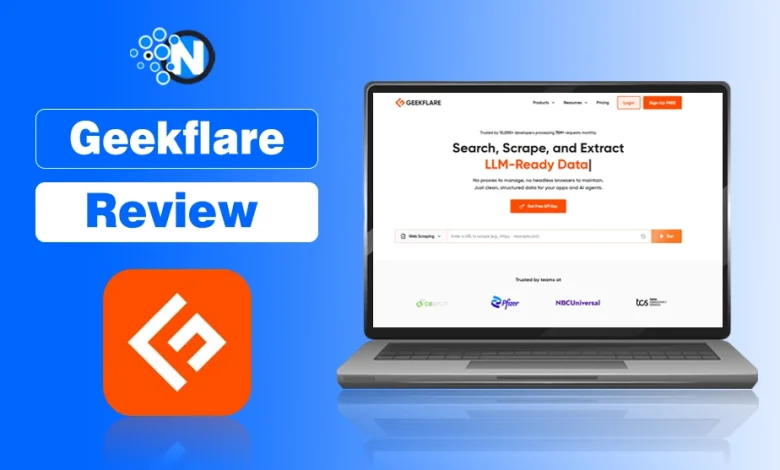
In this Geekflare review, we’ll examine its Web Scraping API, Search API, MCP integration, pricing, strengths, weaknesses, and whether it’s a good fit for AI developers in 2026.
What is Geekflare?
Geekflare is a developer-focused platform that provides APIs for web scraping, search, screenshots, DNS lookups, PDF generation, and other web automation tasks.
Instead of managing browser instances, proxies, and HTML parsers manually, developers can retrieve structured, AI-ready content using simple REST APIs or official SDKs.
How Does Geekflare Work?
Geekflare works by combining web scraping, search, browser rendering, and content processing into a single API platform.
Instead of managing proxies, headless browsers, and HTML parsers separately, developers can send one API request and receive structured, AI-ready content in Markdown or JSON. This simplifies data collection for AI agents, Retrieval-Augmented Generation (RAG) systems, and automation workflows.
AI Agent Data Bottleneck
When feeding web data into Large Language Models (LLMs), two main obstacles emerge:
- DOM Bloat & Token Waste: Raw HTML documents are filled with SVG, CSS, script tags, and boilerplate. Passing raw HTML into an LLM context window burns thousands of unnecessary tokens and increases inference costs.
- The Two-Step Network Latency Penalty: A typical web search workflow requires sending a query to a Search API, parsing the list of URLs, and then firing off individual requests to scrape each page. This doubles API round-trips and adds failure points.
Geekflare addresses both problems through a single platform with REST endpoints, official SDKs, and Model Context Protocol (MCP) support.
Why Does Markdown Matter for AI Models?
Markdown removes unnecessary HTML elements such as scripts, styles, navigation menus, and ads, making web content easier for Large Language Models (LLMs) to process.
Cleaner input reduces token consumption, lowers inference costs, and helps AI models focus on meaningful information instead of page structure.
Geekflare Web Scraping API for Token-Optimized Markdown
The Geekflare Web Scraping API abstracts headless browser management, anti-bot detection, and IP rotation behind a single REST call.
Key Capabilities
- JavaScript Rendering: Runs headless Chrome behind the scenes to render Single-Page Applications (SPAs) built with React, Vue, or Angular before extracting content.
- Bypass Anti-Bot Measures: Automatically handles CAPTCHAs, stealth fingerprinting, and challenges.Bypass Anti-Bot Measures: Automatically handles CAPTCHAs, AI Stealth Writer fingerprinting, and challenges.
Bypass Anti-Bot Measures: Automatically handles CAPTCHAs, stealth fingerprinting, and challenges. - LLM-Ready Formatting: Rather than messy DOM structures, the API converts page content directly into clean, token-optimized Markdown.
- Scraping Dynamic Pages to Markdown in Python: First, install the official PyPI SDK. Next, execute a JavaScript-rendered scrape targeting Markdown output.
Geekflare Search API: Single-Call Search + Scraping
For AI agents requiring real-time internet context, standard search APIs only return basic snippets and URLs. The Geekflare Search API offers a scrape: true flag: in a single API request, it queries web search engines and scrapes the full content of top-ranking pages into Markdown.
Features for Agentic RAG
- Single-Call Ingestion: Set scrape=True to fetch search SERPs alongside full page Markdown in one JSON response payload.
- Grounded Synthesis (groundedAnswer=True): Returns an AI-generated answer synthesized from the top search results with source citations.
- Precision Filtering: Localize searches by country code, restrict timeframes (d7, w, m), or target/exclude specific domain lists.
Model Context Protocol (MCP) Integration
If you use AI assistants like Claude Desktop, Cursor, or Windsurf, Geekflare provides a native MCP server @geekflare/mcp. This exposes many web automation tools through a single config point.
Claude Desktop / Cursor MCP Configuration
To equip your AI editor or assistant with web scraping, DNS lookup, and real-time search capabilities, add this to your claude_desktop_config.json or Cursor MCP settings.
Once configured, your local LLM environment can invoke web scraping, search, screenshotting, or domain monitoring commands natively on demand.
Pricing & Credit Structure Breakdown
Geekflare operates on a credit system, meaning one subscription pool covers all endpoints (Search, Web Scraping, Screenshot, DNS Lookup, PDF Generation).
| Tier | Monthly Price | Monthly Credits | Best Suited For |
| Free | $0 | 500 | Prototyping & testing |
| Starter | $19 / mo | ~10,000 | Small projects & hobby agents |
| Growth | $69 / mo | ~100,000 | Production agent pipelines |
| Business | $349 / mo | ~1,000,000 | High-volume scraping & RAG suites |
Credit Usage Rule of Thumb: Scraping without proxy or DNS requests consumes 1 credit. You can get started with credits without a subscription, which is great to use Geekflare without commitment.
Who Should Use Geekflare?
Geekflare is a good choice for:
- AI application developers
- RAG pipeline engineers
- SaaS companies
- AI startups
- Research teams
- Browser automation projects
- LLM-powered search applications
Geekflare vs Traditional Web Scraping
Compared to traditional web scraping stacks that require separate proxy services, browser automation, HTML parsing, and search APIs, Geekflare consolidates these capabilities into one platform.
This reduces development time, lowers maintenance overhead, and provides AI-ready content without building a custom scraping pipeline.
Frequently Asked Questions About Geekflare
Is Geekflare good for AI agents?
Yes. Geekflare is designed for AI agents by providing search, web scraping, JavaScript rendering, and AI-ready Markdown output through a unified API. This helps reduce development complexity and token usage for LLM-based applications.
Can Geekflare scrape JavaScript websites?
Yes. Geekflare renders JavaScript-heavy websites using headless browsers before extracting content, making it compatible with modern frameworks like React, Vue, and Angular.
Does Geekflare provide a free plan?
Yes. Geekflare offers a free plan with monthly credits, allowing developers to test its APIs before upgrading to a paid subscription.
Is Geekflare suitable for RAG applications?
Yes. Geekflare’s Markdown output and one-call search plus scraping workflow make it well suited for Retrieval-Augmented Generation (RAG) pipelines that require clean, structured web content.
Verdict: Is Geekflare Worth It?
Geekflare simplifies one of the most time-consuming parts of building AI-powered applications by combining web search, scraping, Markdown conversion, and developer tools into a single platform.
While large-scale projects should monitor API credit usage carefully, the platform offers a clean developer experience that can reduce infrastructure complexity for AI agents, RAG systems, and real-time search applications.
If you need AI-ready web data without maintaining your own scraping stack, Geekflare is worth considering.
What Geekflare Does Exceptionally Well
- Markdown-First Pipeline: Eliminates custom BeautifulSoup / Cheerio HTML cleaning code.
- 1-Call Search + Scrape: Dramatically cuts latency for RAG agents needing full web page access.
- MCP Support: Simple setup for local AI tools like Cursor and Claude.
- Unified API Suite: Access to DNS lookup, PDF conversion, screenshotting, and web scraping under one billing account.
Where to Watch Out
Credit Tracking on Heavy Scraping: Using premium proxies across millions of JavaScript-heavy pages will require monitoring credit consumption closely on higher tiers.