If you live in a rural area where cable or fiber Home Internet isn’t available, your best options are usually 5G Home Internet or Satellite Internet. While both can connect your home, they differ significantly in speed, latency, reliability, cost, and availability.
For most rural households in the United States, 5G Home Internet is the better choice if it’s available at your address. It typically offers lower latency, unlimited data on many plans, easier installation, and lower monthly costs.
However, if you live in a remote area without reliable cellular coverage, satellite internet, especially newer low Earth orbit (LEO) services like Starlink, may be your only practical option.
In this 5G Home Internet vs Satellite Internet guide, I have compared both technologies to help you choose the right internet service for your location and needs.
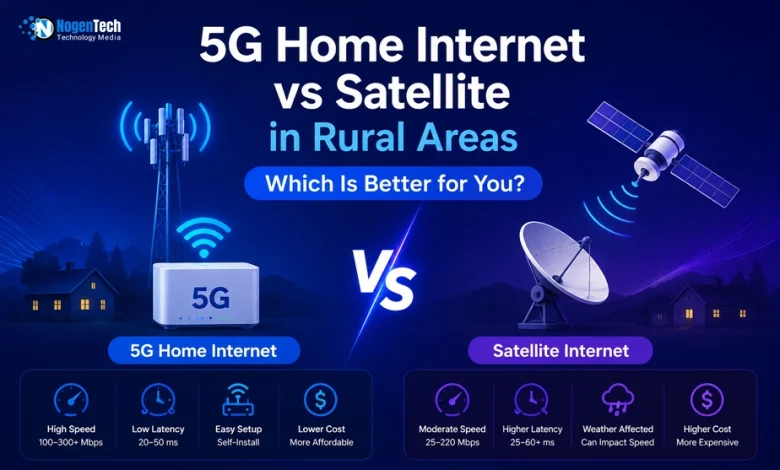
5G Home Internet vs Satellite: Quick Comparison
| Feature | 5G Home Internet | Satellite Internet |
| Best For | Homes with reliable 5G coverage | Remote areas without cellular service |
| Download Speed | 100–300 Mbps (can be higher) | 25–220 Mbps depending on provider |
| Latency | 20–50 ms | 25–60 ms (Starlink), much higher on traditional satellite |
| Gaming | Excellent | Good on Starlink, poor on older satellite services |
| Streaming | Excellent | Good |
| Weather Impact | Minimal | Rain, snow, and storms can reduce performance |
| Installation | Self-install in most cases | Dish installation required |
| Monthly Cost | Usually lower | Usually higher |
| Availability | Limited by carrier coverage | Available in most rural locations |
Which Is Better for Gaming: 5G Home Internet or Satellite?
5G Home Internet is generally the better choice for competitive online gaming because it offers lower latency, faster response times, and lower Internet Jitter.
Online games rely more on latency than raw download speed. A connection with 40 ms latency usually feels much smoother than one with 100 ms latency, even if both have similar download speeds.
Here’s how they compare.
| Activity | 5G Home Internet | Satellite Internet |
| Competitive Gaming | Excellent | Good only with Starlink |
| Cloud Gaming | Very Good | Fair to Good |
| Voice Chat | Excellent | Good |
| Game Downloads | Fast | Moderate |
Traditional satellite services often struggle with competitive multiplayer games due to high latency. Newer satellite networks like Starlink have improved significantly, but 5G Home Internet remains the better option when available.
Check my guide on the best Internet speed for gaming as well.
5G Home Internet vs Satellite: Which Costs Less?
5G Home Internet usually costs less than satellite internet because equipment fees are lower and installation is simpler.
Here’s a general comparison.
| Cost Factor | 5G Home Internet | Satellite Internet |
| Monthly Service | Lower | Higher |
| Equipment | Often included | Higher upfront cost |
| Installation | Usually self-install | Dish installation required |
| Maintenance | Minimal | Dish alignment may occasionally be required |
While pricing varies by provider, satellite internet generally has higher startup costs due to the required outdoor equipment.
If both services are available at your address, 5G Home Internet is often the more budget-friendly choice.
Is 5G Home Internet Better Than Satellite?
Yes, 5G Home Internet is better than satellite if your home has reliable 5G coverage. It is also easier to install and often costs less than satellite internet.
Satellite internet becomes the better choice when cellular coverage is weak or unavailable. For homes located deep in rural America, on farms, in mountain regions, or off-grid properties, satellite internet may be the only broadband option.
The most important factor is not advertised speed but service availability at your exact address. A nearby town may have excellent 5G coverage while your property does not.
Which Internet Should You Choose?
Choosing between 5G Home Internet and Satellite Internet services depends on where you live and how you use the internet.
Choose 5G Home Internet if:
- Your address qualifies for service from T-Mobile, Verizon, or AT&T.
- You work from home and attend frequent video meetings.
- You play online games.
- Your household streams multiple videos in HD or 4K.
- You want a lower monthly bill and simple installation.
Choose Satellite Internet if:
- No 5G or LTE home internet is available.
- You live in a remote farming community or mountain region.
- You need internet where wired and cellular networks do not reach.
- And you are willing to install a satellite dish for broader coverage.
5G Home Internet vs Satellite in Rural Areas
5G Home Internet is the better option for most rural households if reliable coverage is available.
It generally delivers:
- Lower latency
- Better responsiveness
- A smoother experience for gaming, video calls, remote work, and streaming
- Lower monthly costs than satellite internet
However, satellite internet remains the best solution for homes located beyond the reach of cellular networks.
Does 5G Work Better in Rural Areas?
Yes, but only where carriers have built sufficient network coverage.
Many wireless providers have expanded their rural 5G networks over the past few years, but coverage still varies widely across the United States.
Your experience depends on several factors:
- Distance from the nearest cell tower.
- Hills, forests, and other physical obstacles.
- Network congestion.
- Whether your provider uses low-band, mid-band, or high-band spectrum in your area.
Low-band 5G typically travels farther and provides better rural coverage, while high-band 5G delivers faster speeds but covers much shorter distances.
Before signing up, use the provider’s address checker instead of relying solely on a coverage map. Coverage maps show general availability, but only an address lookup can confirm whether your home qualifies for service.
Fixed Wireless vs 5G Home Internet vs Satellite
Although these services are often grouped together, they use different technologies.
- Fixed Wireless Internet uses dedicated radio towers operated by local internet providers.
- 5G Home Internet uses existing cellular networks.
- Satellite Internet communicates directly with satellites in space.
| Feature | Fixed Wireless | 5G Home Internet | Satellite Internet |
| Connection | Local wireless tower | 4G LTE and 5G cellular network | Satellites orbiting Earth |
| Speed | Moderate | Fast | Moderate to fast |
| Latency | Low | Low | Higher than wireless |
| Coverage | Limited to local providers | Depends on carrier coverage | Nearly nationwide |
| Best For | Small communities | Rural areas with 5G | Remote locations |
What Are the Downsides of 5G Home Internet?
The biggest downside of 5G Home Internet is that performance depends on cellular coverage and network congestion.
Unlike fiber or cable, your speeds can fluctuate if many people are connected to the same nearby cell tower. Rural terrain, trees, hills, and long distances from a tower can also weaken your signal.
Other limitations include:
- Service is not available in every ZIP code.
- Speeds vary depending on signal strength.
- Performance may slow during peak evening hours.
- Some providers prioritize mobile phone traffic during network congestion.
Despite these drawbacks, many rural households still experience faster and more responsive internet than traditional satellite services.
Is 5G Home Internet Better Than Starlink?
5G Home Internet is usually the better value than Starlink because it offers lower monthly costs, lower latency, and easier setup, only if you have strong 5G coverage,
However, Starlink has transformed internet access for extremely remote homes that previously relied on slow geostationary satellite services. Its low Earth orbit satellites provide much lower latency than older satellite providers, making video calls, streaming, and even online gaming possible in many rural areas.
Here’s a quick comparison:
| Feature | 5G Home Internet | Starlink |
| Best For | Areas with good cellular coverage | Remote homes without 5G |
| Latency | Lower | Slightly higher |
| Equipment Cost | Usually included or low | Higher upfront cost |
| Monthly Cost | Generally lower | Higher |
| Installation | Plug-and-play | Requires dish placement with a clear view of the sky |
For most people, the decision is simple:
- Choose 5G Home Internet if it is available.
- Choose Starlink if reliable 5G service is unavailable.
Is 5G Home Internet Fast Enough for Streaming?
Yes. Most 5G Home Internet plans easily support HD and 4K streaming, provided your home has a strong cellular signal.
Streaming services like Netflix, YouTube TV, Hulu, Disney+, and Max typically require between 5 Mbps and 25 Mbps per stream. Since many 5G Home Internet plans deliver real-world download speeds of 100 Mbps or more, multiple people can stream simultaneously without buffering.
Satellite internet can also handle streaming, but performance depends on your provider, network congestion, and weather conditions. Heavy rain or snow may temporarily reduce streaming quality on satellite connections.
If streaming is your primary concern, 5G Home Internet usually provides a more consistent experience.
Why Can't 5G Penetrate Walls?
High-frequency 5G signals have a harder time passing through walls, trees, and other obstacles than lower-frequency wireless signals.
This doesn’t mean all 5G performs poorly indoors. The experience depends on the type of 5G available in your area.
- Low-band 5G offers better building penetration and wider coverage.
- Mid-band 5G balances speed and coverage.
- High-band (mmWave) delivers extremely fast speeds but struggles to travel long distances or pass through walls.
For rural home internet, providers primarily rely on low-band and mid-band 5G because they provide better coverage over larger areas.
If your signal is weak indoors, placing the gateway near a window or an upper floor often improves performance.
Is 5G Home Internet Worth It?
Yes. If your address qualifies, 5G Home Internet is one of the best internet options available for rural households.
Compared to traditional satellite internet, it offers several advantages:
- Lower monthly costs
- Easy self-installation
- Better gaming performance
- Lower latency
- Unlimited data on many plans
- No annual contracts from many providers
However, it isn’t the right solution for every location. If your nearest cell tower is too far away or heavily congested, satellite internet may provide a more reliable connection.
Checking your address before ordering is the easiest way to determine whether 5G Home Internet is worth considering.
Which Internet Providers Offer Rural Coverage?
Several Internet Service Providers serve rural communities across the United States.
| Provider | Technology | Best For |
| T-Mobile Home Internet | 5G Fixed Wireless | Rural towns with strong T-Mobile coverage |
| Verizon 5G Home Internet | 5G Fixed Wireless | Eligible suburban and rural locations |
| AT&T Internet Air | Fixed Wireless | Select rural markets |
| Starlink | Low Earth Orbit Satellite | Remote homes with little or no cellular coverage |
| Hughesnet | Geostationary Satellite | Nationwide rural availability |
| Viasat | Geostationary Satellite | Rural areas without other broadband options |
Availability varies by address, so always verify service eligibility before ordering.
My Experience Comparing Rural Internet Options
After reviewing internet options and Internet speed for rural users, one trend becomes clear: coverage matters more than advertised speeds.
A 300 Mbps plan or a Gigabit Internet doesn’t help if the signal at your property is weak. On the other hand, a stable 100 Mbps 5G connection often provides a better everyday experience than a faster connection with high latency or frequent interruptions.
- For homes with reliable 5G coverage, fixed wireless internet usually delivers the best balance of speed, price, and responsiveness.
- For cabins, ranches, farms, and off-grid homes where cellular service is unreliable, satellite internet remains an essential solution despite its higher cost.
The smartest approach is to check your address with both a 5G provider and a satellite provider before making a decision.
My Take on 5G Home Internet vs Satellite Internet
For most rural households in the United States, 5G Home Internet is the better choice if it’s available at your address. It offers lower latency, faster real-world performance, simpler installation, and lower monthly costs than satellite internet.
Satellite internet is still the best option for homes located beyond the reach of reliable cellular networks. Modern services like Starlink have narrowed the performance gap considerably, making broadband internet accessible in places where no other service exists.
Instead of choosing based on advertised speeds, compare the providers that serve your exact location. A reliable connection that consistently delivers moderate speeds will almost always outperform a faster service with weak coverage or frequent interruptions.
People Also Ask Key Questions About 5G vs Satellite Internet
Is 5G home internet better than satellite internet?
Yes. If reliable 5G service is available at your address, it typically offers lower latency, better gaming performance, and lower monthly costs than satellite internet.
What are the downsides of 5G home internet?
Its biggest limitations are coverage availability, fluctuating speeds during network congestion, and weaker performance in areas far from cellular towers.
Is 5G home internet better than Starlink?
If you have strong 5G coverage, yes. If you live in a remote area without reliable cellular service, Starlink is usually the better choice.
Does weather affect satellite internet more than 5G?
Yes. Heavy rain, snow, and severe storms are more likely to impact satellite internet than 5G Home Internet.
Is 5G Home Internet worth it in rural areas?
Yes. It is an excellent choice for rural households with reliable carrier coverage because it combines fast speeds, lower latency, and affordable pricing.