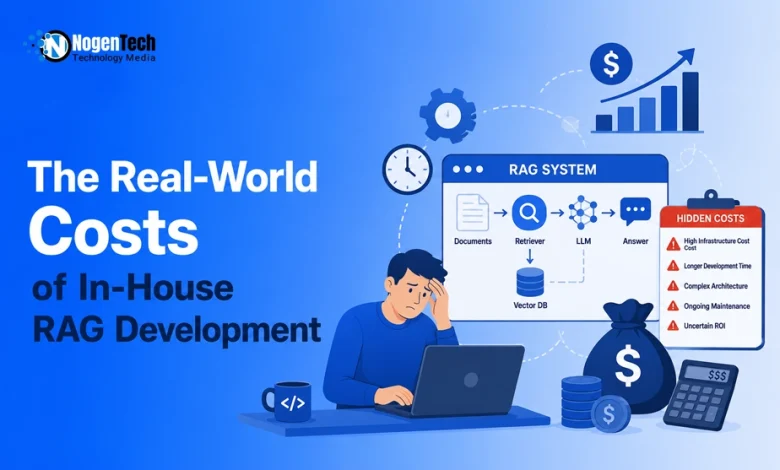
Most enterprise teams start a RAG project with a reasonable expectation: connect a document store to a language model, add a retrieval layer, and ship.
The first prototype appears in days. Six months later, a different picture emerges. Infrastructure tickets, security reviews, and reindexing jobs have consumed far more engineering capacity than the original build.
This article examines where those costs originate, why they tend to be underestimated, and what production-grade RAG development actually demands from an organization.
Why Enterprise Teams Underestimate RAG Development Complexity
Enterprise teams underestimate RAG complexity by ignoring critical production architecture, data cleaning, access controls, vector databases, and ongoing maintenance costs.
The most common mistake in enterprise RAG projects is scoping the build around what’s immediately visible and deferring the rest. Three patterns explain how that tends to happen.
The Misconception That RAG Is “Just a Chatbot With Documents”
Early RAG projects tend to focus on two elements: retrieval and prompting. A team picks a vector database, chunks some documents, embeds them, and writes a prompt template. That scope is manageable, but it accounts for a fraction of what a production system actually requires.
What falls outside that initial frame:
- Indexing pipelines for document ingestion
- Permissions layers that enforce access control at query time
- Orchestration logic for fallback scenarios
- Monitoring for answer quality degradation
- Lifecycle management for every component in the stack
Teams that optimize for demo-readiness usually discover the full scope only when the first serious production issue appears.
Moving From Proof of Concept to Production
A system that works in a controlled demo rarely holds up under real enterprise conditions. The gap shows up in three places:
- Reliability: query volume fluctuates, document sets grow, and model behavior shifts as providers update their models.
- Observability: uptime alone doesn’t show whether a RAG system is producing accurate, relevant answers.
- Compliance: regulated industries need audit trails and data residency controls from day one. Retrofitting them later is expensive.
The Growing Architectural Footprint of Enterprise RAG Systems
A production-grade RAG architecture includes far more than retrieval and prompting. The full stack typically includes:
- A vector database for storing and querying embeddings
- A document ingestion and chunking pipeline
- An embedding service for converting content into vector representations
- A reranker to improve retrieval relevance
- An orchestration framework such as LangChain or LlamaIndex
- An API gateway managing request routing and access controls
- Observability tooling covering latency, error rates, and retrieval quality
- A security layer with access controls and audit logging
Each component requires configuration, monitoring, and periodic updates. When an orchestration framework releases breaking changes or an embedding model is deprecated, the internal team owns that migration.
Teams looking to bypass this infrastructure headache often turn to multi-provider setups; evaluating options like the AIML API can help you understand if a managed routing service fits your architecture.
That ownership is ongoing, and it shapes how organizations evaluate external RAG consulting and development firms when internal engineering capacity runs thin.
What In-House RAG Actually Costs to Build
Single-source RAG systems cost $12,000–$30,000, while production multi-source platforms with access controls scale sharply from $30,000 to $60,000+. Build costs scale sharply with complexity, and most teams underestimate which tier they actually need.
An enterprise platform with fine-tuning, multi-tenant isolation, and observability costs $70,000 to $120,000 or more.
Other 2026 estimates place the top end of enterprise and agentic builds at $150,000 to $200,000 or higher, depending on scope and region.
A basic RAG pipeline involves simple document ingestion, vector search, a basic prompt template, and a web UI for Q&A.
A production system adds multi-format ingestion, hybrid search, re-ranking, source citations, conversation history, and an admin panel. An agentic or enterprise system adds query routing, multi-index search, an evaluation pipeline, and analytics.
Timelines move with the same complexity curve:
- Simple builds: 4 to 8 weeks
- Production builds: 8 to 14 weeks
- Enterprise builds: 14 to 22 weeks, sometimes stretching to 5 to 8 months for fully agentic or multi-tenant systems
How do Major Vector Database Billing Models and Costs Compare?
Vector database costs vary significantly by provider and depend closely on your query patterns and data volume:
- Pinecone Serverless: free tier available, with the standard tier at roughly $50 per month, billed on storage plus read and write units. Works well for spiky, low-frequency workloads but gets expensive as query volume climbs.
- Weaviate Cloud: starts around $25 to $45 per month, with dimension-based storage pricing and strong hybrid search support.
- Qdrant Cloud: around $0.014 per hour per node, with a self-hosted option that has zero per-query billing, which is attractive for predictable, high-volume workloads.
- pgvector on existing Postgres: incremental cost only, and a reasonable choice for under roughly 5 million vectors with simple retrieval needs.
The right pick depends on query pattern more than raw price.
A team running unpredictable, low-frequency queries is better served by a serverless model, while a team with steady high-volume traffic usually saves by moving to a fixed-cost, self-hosted node.
How do Embedding Dimensions Affect RAG Storage and Economics?
Embedding cost looks small in isolation, which is exactly why teams underbudget it. As of March 2026, text-embedding-3-small at 1,536 dimensions is the cost-performance optimum for most production RAG workloads.
It’s priced at $0.02 per million tokens, with strong recall on standard benchmarks. It also has wide native support across Pinecone, Qdrant, and Weaviate.
The real cost driver is dimension count, since it compounds storage and dimension-based billing:
- At 768 dimensions, storage per vector is 3,072 bytes. At 1,536 dimensions, storage doubles to 6,144 bytes. At 3,072 dimensions, storage doubles again to 12,288 bytes.
- For a dimension-based billing model like Weaviate Cloud’s, switching from 768-dim to 3,072-dim embeddings quadruples the monthly dimension bill at the same vector count.
The practical guidance: use the larger, higher-dimension embedding model only when a benchmark evaluation shows a measurable recall improvement that justifies the 2x to 4x increase in storage and dimension billing cost.
What is the Monthly Run Rate for a Production RAG System at Scale?
A typical enterprise RAG system handling 100,000 queries per day has baseline monthly costs of exactly $19,460 before any optimization.
That breaks down to embeddings at $12,000, reranking at $4,500, LLM generation at $1,500, vector database at roughly $960, and infrastructure at $500. This shows that even a single line-item estimate rarely reflects what a production system actually costs once it’s running.
And that number is not fixed. After optimization with caching and routing, the same workload can drop to $10,460 to $11,360 per month, a savings of 40 to 46 percent.
The gap between unoptimized and optimized run rate is large enough that it should be modeled before launch, not discovered after the first invoice.
What is the Highest Hidden Cost in Enterprise RAG Development?
Stratagem identifies data cleaning and preprocessing as the highest hidden cost, consuming 30 to 50 percent of the total project budget.
Separately, data quality is named as the biggest cost driver, with messy data able to consume 40 to 50 percent of the budget.
This shows up in a predictable pattern. Teams price the embedding model down to the cent and pick a vector database off its free tier, then run into the real cost six months later, in storage overruns, reindexing cycles, and an engineer spending half their week fixing retrieval quality.
Documents with inconsistent formats, scanned PDFs, and messy metadata are the actual reason small-budget RAG projects go over budget, more than any model or infrastructure choice.
How do Reranking Parameters Unexpectedly Multiply RAG production Costs?
Reranking is one of the easiest components to underprice, because the bill moves with a configuration setting most teams don’t think to monitor. Cohere reranks at 12,000 queries per day cost $680 per month in the first month.
That seemed reasonable until the corpus grew and the team raised top-k from 20 to 100, at which point the bill jumped to $3,400 per month.
The fix is straightforward: always budget reranker cost as top-k multiplied by queries multiplied by price, rather than assuming a flat monthly number.
A single parameter change, made to improve answer quality, can multiply the reranking bill five times over without any change in query volume.
What is Build Cost vs. Ongoing Cost Ratio for RAG?
The build is a one-time expense. The run rate is not, and it compounds in ways the original budget rarely accounts for.
- Ongoing maintenance for most production systems falls between $2,300 and $8,500 per month, covering updates, optimization, monitoring, and bug fixes.
- Infrastructure runs $300 to $1,600 per month at 10,000 queries, rising to $2,000 to $5,000 per month at 100,000 or more queries.
- Across basic and advanced RAG tiers, LLM inference alone typically makes up 60 to 80 percent of ongoing costs.
Within twelve months, the cumulative run rate on a mid-sized production system can equal or exceed the original build cost.
A $40,000 build paired with $3,000 in monthly maintenance crosses that threshold well before year two. And that’s before reindexing, model migrations, or a reranking change that triples the bill overnight.
What do People Also Ask About RAG Costs?
How much does it cost to build a RAG system?
Costs range from $12,000 for a simple system to $200,000 or more for an enterprise platform. The price depends mostly on data complexity and access control needs.
What does RAG stand for?
RAG stands for Retrieval-Augmented Generation. It retrieves relevant content from your documents before generating an answer, rather than relying only on training data.
What’s the biggest hidden cost in RAG development?
Data cleaning and preprocessing, which can eat up 30 to 50 percent of the total budget. Most teams underestimate this and overbudget the embedding model instead.
How much does it cost to run a RAG system every month?
Most deployments run $300 to $1,600 per month at moderate volume, rising to $5,000 at enterprise scale. Maintenance adds another $2,300 to $8,500 per month on top.
Is it cheaper to build RAG in-house or use a vendor?
It depends on your team’s infrastructure expertise and maintenance capacity. In-house gives more control, but you own every ongoing cost yourself.
Final Thoughts: Navigating the Realities of RAG Budgeting
Building an enterprise RAG system is often championed as a quick win, but the real challenge lies in the ongoing run rate. From messy data cleaning eating half your budget to reranker parameters and embedding dimensions quietly multiplying your storage invoices, the long-term economics scale unexpectedly.
To avoid post-launch sticker shock, teams must treat data prep and infrastructure optimization as core pillars of the operational lifecycle rather than afterthoughts.