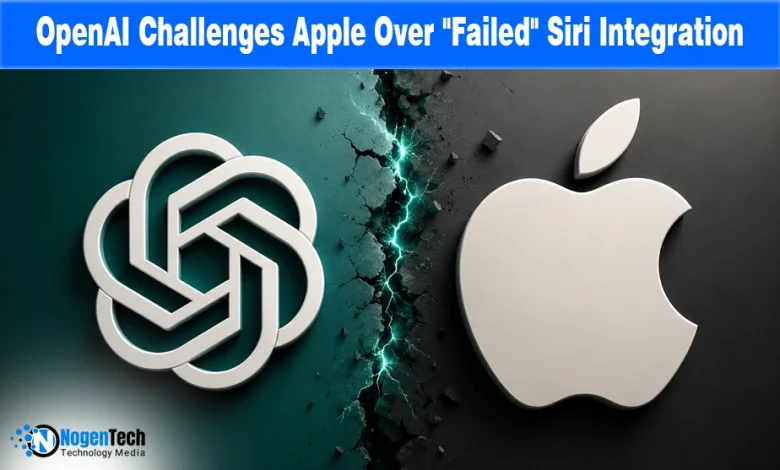
OpenAI Is Preparing Legal Action Against Apple, Two Years After Taking a “Leap of Faith”
OpenAI has enlisted an outside law firm to explore legal options against Apple, after the ChatGPT integration in iOS, iPadOS, and macOS delivered a fraction of the subscription revenue OpenAI had expected from the partnership.

When Apple announced at WWDC in June 2024 that ChatGPT would be integrated into Siri and Apple Intelligence, it looked like one of the biggest AI distribution deals ever. Two billion Apple devices.
One AI model, built into the operating system level. The expectation of billions in subscriptions for OpenAI.
Twenty-three months later, just days after Apple released iOS 26.5, Bloomberg’s Mark Gurman reported that OpenAI is considering legal action against Apple, accusing Apple of not delivering on its side of the deal.
What went wrong is a story about what happens when a closed platform company and an AI startup have fundamentally different definitions of what “partnership” means.
What OpenAI Says Apple Did, and Did Not Do
As TechCrunch reported, OpenAI’s main frustration is not technical failure but distribution failure.
OpenAI executives say Apple buried the ChatGPT integration, made features difficult to find, and barely promoted the partnership. Siri users must explicitly say “ChatGPT” to activate the integration instead of it appearing automatically.
Responses inside Siri also contain far less information than the standalone ChatGPT app. Meanwhile, the Settings-based subscription sign-up system, which OpenAI believed could generate billions annually, has produced revenue far below expectations.
This disconnect is highlighted by Apple’s shifting focus, as it prioritizes native features like Safari’s AI-powered tab organization over the integration’s success.
An unnamed OpenAI executive told Bloomberg: “We have done everything from a product perspective. They have not, and worse, they haven’t even made an honest effort.”
The same executive described the partnership’s origin story with a phrase that now reads as a warning: “They basically said, ‘OpenAI needs to take a leap of faith and trust us.'”
Why Apple’s Position Is More Complicated Than It Looks
As AppleInsider notes, Apple sees the partnership very differently. The company never intended to give ChatGPT major prominence inside its products, treating the integration as a temporary solution while building its own AI systems.
Apple has since reportedly signed a $1 billion-per-year deal with Google for Gemini to power Siri’s core intelligence and a reported standalone app in iOS 27, which will debut at WWDC on June 8.
iOS 27 will also introduce the Extensions framework, allowing Claude, Gemini, and other third-party models to power Apple Intelligence features. That would reduce ChatGPT from Apple’s primary external AI partner to one option among several.
Apple has also settled a $250 million class action lawsuit over allegedly misleading AI feature advertising, increasing scrutiny around its AI strategy.
As TechCrunch noted, Apple is also aware that OpenAI has been recruiting Apple hardware engineers for Jony Ive’s startup, io, and its upcoming camera-equipped AI speaker, a competitive move closely watched inside Apple Park.
What Happens Next and Why the Timing Is Complicated
As TechCrunch confirmed, OpenAI’s legal options include sending Apple a formal breach-of-contract notice without immediately filing a lawsuit.
That softer approach would give both companies room to renegotiate before entering a public legal battle, something both sides would likely prefer given the reputational and operational costs of courtroom conflict between two highly scrutinised tech companies.
The complication is timing. Any formal legal action is expected to wait until after the Musk v. Altman trial in Oakland, where OpenAI’s legal team is already heavily engaged. Opening another major legal front could stretch resources and attention.
OpenAI now reportedly has 900 million weekly active users, a valuation nearing $900 billion, and an IPO targeted for late 2026. A dispute with Apple is not the narrative it wants ahead of public markets.
But staying tied to a partnership it reportedly views as a failure, while Apple expands access to rival AI models, may leave OpenAI with limited options.
Source: Apple-OpenAI Alliance Frays, Setting Up Possible Legal Fight