Google Unveils Googlebook, A New Laptop Category Built Around Gemini Intelligence
Google announced Googlebook, a new premium laptop category built from the ground up for its Gemini Intelligence platform, with Acer, ASUS, Dell, HP, and Lenovo confirmed as launch partners and devices arriving in stores this autumn.

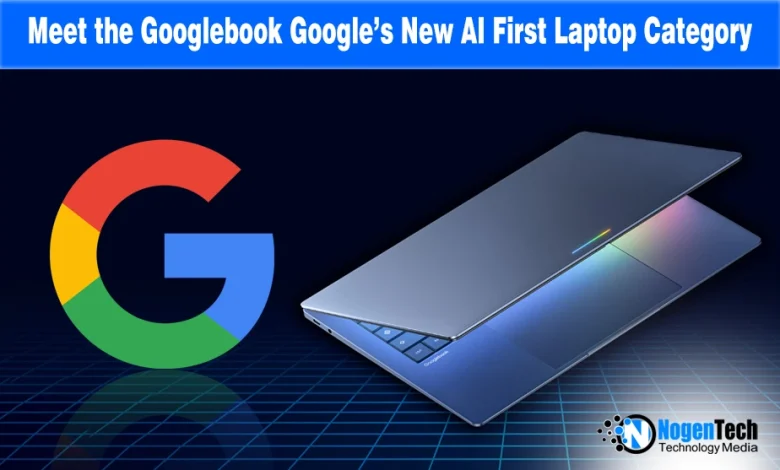
Google used the Android Show: I/O Edition on May 12, 2026, to do something it has not done in fifteen years: introduce an entirely new category of personal computer. As the Google official blog confirmed, Googlebook is premium hardware built with Gemini at the core, designed to work seamlessly with Android phones.
It is positioned as a direct answer to Microsoft’s Copilot+ PC initiative and Apple’s increasingly capable Apple Silicon lineup.
The announcement came one week before Google I/O 2026 on May 20, making the Android Show a deliberate preview of a broader AI computing strategy that Google is clearly ready to start shipping.
What Makes a Googlebook Different From a Chromebook
The distinction matters, and Google made it clear. As TechCrunch confirmed, Googlebook is not a rebrand of a Chromebook but a separate product category aimed at a different audience and use case.
Chromebooks were built as affordable, browser-focused machines for education and light computing. Googlebooks, by contrast, are premium devices designed from the ground up to run Gemini Intelligence as a system-level layer instead of an add-on app.
Arriving just days after the Fitbit Air launch, the devices run Chrome, support the full Google Play app library, and stay synced with a user’s Android phone, carrying over tasks, notifications, and context across devices automatically.
The first Googlebook models from Acer, ASUS, Dell, HP, and Lenovo, established Chromebook manufacturers, will launch this autumn, though pricing has not yet been announced.
The Glowbar and Magic Pointer Interaction Model
The signature hardware feature of every Googlebook is the Glowbar, an illuminated strip on the keyboard deck that signals Gemini Intelligence is active and integrated at the hardware level.
The signature software feature is something more immediately useful. As Mashable confirmed, Magic Pointer turns the cursor into a contextual AI shortcut: wiggling the mouse activates Gemini in the background, allowing the cursor to understand what it is hovering over.
Point it at a date in an email, and Gemini offers to set a meeting. Point it at two images, and Gemini offers to blend them. Point it at a document, and Gemini summarizes it: no additional clicks, no separate application, no prompt box to fill in.
Arriving just days after Google’s Fitbit Air launch, the interaction model is designed to feel like a natural extension of how people already use a cursor. This is either exactly what AI on a laptop should feel like or the kind of always-present computing that takes time to adjust to.
Gemini Intelligence and the Evolution of Googlebook
Gemini Intelligence, the broader platform underlying all of this, is a system-wide AI layer distinct from the current standalone Gemini app.
As the Google official blog confirmed, it handles tasks proactively across apps, browsers, and files rather than responding only when explicitly invoked.
It arrives on Samsung Galaxy and Google Pixel phones this summer, ahead of Googlebook hardware in autumn.
The Google Gemini Mac app that launched last month was the first sign of Google building a desktop AI presence; Googlebook is the hardware layer that makes that presence permanent.
What Google I/O Will Add and Why Microsoft Should Pay Attention
As TechCrunch notes, Google positioned Googlebook as its answer to Copilot+ PC.
Microsoft launched Copilot+ in 2024 with AI-first Windows laptops from its hardware partners, but adoption was slower than expected. The company later rolled back several Copilot features after criticism over AI being added across the interface.
Google is entering the same market with a different approach: Gemini Intelligence is designed to stay invisible until needed instead of appearing in every toolbar and right-click menu. Whether that restraint holds after launch remains to be seen.
Google I/O 2026 on May 20 is expected to reveal the developer APIs, pricing tiers, and Gemini Intelligence capabilities left unanswered at the Android Show, meaning the full Googlebook story is still a week away.
Source: Introducing Googlebook, designed for Gemini Intelligence