
Meta Acquires Assured Robot Intelligence to Build Humanoid Robots That Learn From Human Behaviour
Meta Platforms brings the startup’s co-founders, Lerrel Pinto and Xiaolong Wang, directly into Meta Superintelligence Labs to build foundation models for whole-body humanoid control

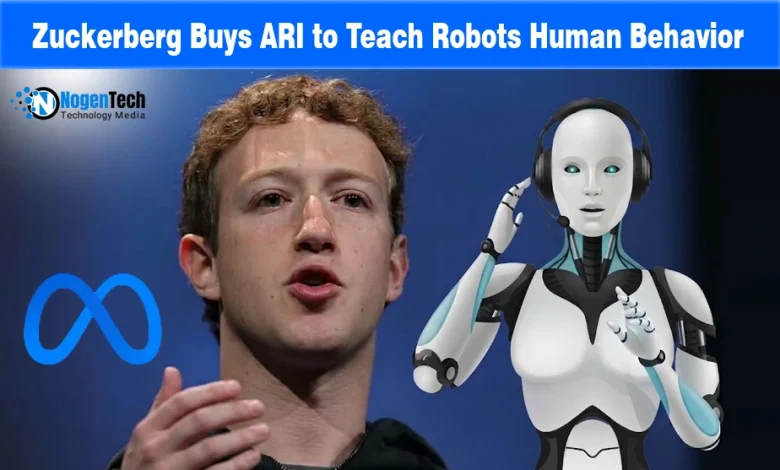
Meta Platforms completed the acquisition of humanoid robotics startup Assured Robot Intelligence (ARI) on May 1, 2026, a strategic pivot following the successful April launch of its Muse Spark AI model. This move places Meta directly in a rapidly commercialising physical AI race alongside Tesla, Amazon, Google, and Nvidia.
A Meta spokesperson stated that the startup is at the frontier of robotic intelligence designed to enable robots to understand, predict, and adapt to human behaviours in complex, dynamic environments.
However, financial terms were not disclosed. The ARI founding team, led by Lerrel Pinto and Xiaolong Wang, will join Meta Superintelligence Labs, the same research division Alexandr Wang was brought in from Scale AI to lead in mid-2025.
Who Pinto and Wang Are and Why Meta Wanted Both of Them
The ARI acquisition is as much about the founders’ track records as the startup’s technology.
As Bloomberg confirmed, Xiaolong Wang was previously a researcher at Nvidia and holds an associate professorship at UC San Diego.
He also has a research background that spans tactile sensing, legged locomotion, and dexterous manipulation, the core hardware challenges that make humanoid robotics physically difficult to solve.
Lerrel Pinto brings a different but equally consequential credential: he taught at New York University and co-founded Fauna Robotics, which builds small-scale humanoid systems, before departing in 2025.
Separately, Amazon acquired Fauna in March 2026 to accelerate its humanoid robot programme, just weeks after Alphabet unified Intrinsic with Google to advance its physical AI push.
The fact that both Fauna and ARI were acquired by two of the world’s largest technology companies within a period of just two months shows how narrow the pool of true physical AI experts has become and how aggressively Big Tech is moving to lock them in.
What ARI Was Building and How It Fits Meta’s Architecture
ARI’s technical distinction is its focus on learning-based control systems over rigid pre-programmed instructions.
Robots are trained through direct interaction with their environment, using motion planning, real-time decision-making, and whole-body coordination to handle unpredictable physical conditions.
As TechCrunch confirmed, ARI was developing foundation models for humanoid robots designed for general physical labour like Tesla’s Optimus, including household tasks, with adaptability beyond controlled environments.
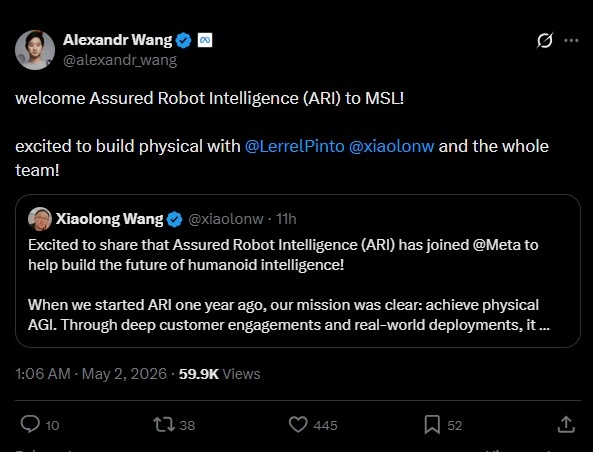
Alexandr Wang welcomed the team on X, describing the acquisition as part of the division’s push into physical AI. Lerrel Pinto said the goal is to transform AI that can think and talk into AI that can act, assisting humans safely in the physical world.
Xiaolong Wang said the team is targeting “physical AGI,” which Nvidia claims to have achieved, with scaling driven by learning from human experience rather than teleoperation alone.
Together, these statements position ARI not as a product acquisition, but as a capability acquisition aimed at solving one of AI’s hardest open problems.
Where This Fits in the Humanoid Race
The competition around the ARI acquisition clarifies its strategic intent.
As Stocktwits confirmed, Tesla showcased Optimus Gen 3 at the Appliance and Electronics World Expo in Shanghai in early 2026, using AI5 inference chips from its latest vehicles, with a full reveal planned for later this year.
Google partnered with Agile Robots SE in March to deploy reasoning-capable robots in high-value industrial manufacturing.
Figure AI, backed by Nvidia, OpenAI, and Jeff Bezos, is reportedly targeting 100,000 humanoid robot deployments over four years.
Similarly, the Swithbot’s Onreo concept launched at CES 2026, mirroring the same intended purpose for automating general household tasks.
Amazon’s Fauna acquisition and Meta Platforms’ ARI acquisition both closed within 60 days, signalling the start of the acquihire phase in humanoid robotics alongside hardware development.
Meta’s Robotics Studio, launched in 2025, builds foundational humanoid hardware and software and will work directly with the ARI team. It also plans to open its underlying technology to other companies, signalling a platform strategy rather than a closed system.
Whether Meta ships a consumer humanoid robot or targets enterprise deployment first remains unconfirmed.
Source: Meta Platforms Acquires Humanoid Robot Startup Assured Robot Intelligence



![Top Tech Stories of 6th week [2026]](https://www.nogentech.org/wp-content/uploads/2026/02/Top-Tech-Stories-of-6th-Week-2026-390x220.webp)