Musk v. Altman Trial Begins in Oakland With Two Claims, $150 Billion, and OpenAI’s Future on the Line
Jury selection opened on April 27, 2026, at the federal courthouse in Oakland, with Elon Musk seeking up to $150 billion over OpenAI's conversion from a nonprofit to a for-profit company valued at over $852 billion.

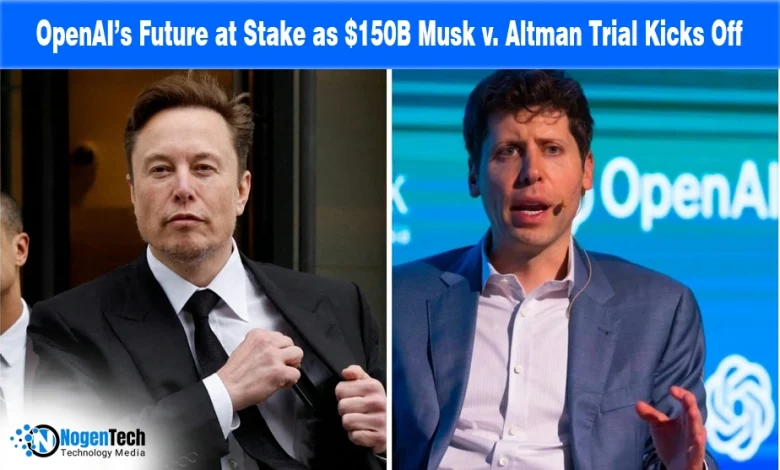
The most consequential technology governance trial in American history opened on April 27, 2026, as jury selection began in the federal courthouse in Oakland for Musk v. Altman.
It’s a lawsuit Elon Musk filed in November 2024 alleging that OpenAI and CEO Sam Altman betrayed the nonprofit mission under which the company was founded in 2015.
The case asks a federal court to decide whether OpenAI’s 2019 shift from a nonprofit research lab to a for-profit company, now valued at over $852 billion, breached its original charitable trust.
That trust covered early assets, including $38 million donated by Musk. The trial arrives just as OpenAI debuts GPT-5.5 Spud, a model reinforcing its pivot toward commercial utility. The answer will carry consequences that extend far beyond either man personally.
How the Musk v. Altman Case Narrowed to Two Claims
Of the 26 counts Musk originally filed, only two survived into trial week: breach of charitable trust and unjust enrichment.
As Barron’s confirmed, Musk voluntarily dropped his fraud and constructive fraud charges on April 25. His lawyers said the move would streamline the case and keep the jurors focused on whether OpenAI’s shift enriched insiders at the expense of its charitable mission.
A Fraud requires proof of intentional deception at a specific moment, a higher bar.
By contrast, charitable trust and unjust enrichment focus on outcomes. They ask whether the shift moved public benefit assets into a private structure, making them easier to argue on largely undisputed facts.
The most damaging evidence in the case is not an email from Altman.
As CNA confirmed, it is a 2017 diary entry from CEO Sam Altman and Greg Brockman, the tech visionary overseeing the transition to a unified Superapp, cited by Judge Yvonne Gonzalez Rogers in her January 2026 ruling:
“I cannot believe we committed to non-profit if three months later we’re doing B-corp. Then it was a lie.”
She found ample evidence and rejected most of OpenAI’s attempts to dismiss the case.
The Trial Structure and What a Win Actually Means.
The trial runs four weeks, Monday through Thursday, with each side allotted 22 hours to present its case and Microsoft receiving five hours.
As The Guardian confirmed, nine jurors will be seated, with no alternates. Judge Gonzalez Rogers alone will decide both damages and any structural remedies if liability is found. The remedies phase is set to begin May 18.
If Musk prevails, the outcome would be structural rather than personal. As CNA confirmed, Elon Musk has said he does not seek damages for himself, and any monetary award would go to OpenAI’s nonprofit arm.
His stated remedies include unwinding OpenAI’s for-profit conversion, removing Sam Altman and Greg Brockman from leadership, and ending its partnership with Microsoft, which is profiting from OpenAI.
This partnership began with a $1 billion investment in 2019 and has grown to a reported $13 billion commitment.
OpenAI calls the case “a harassment campaign driven by ego, jealousy, and a desire to slow down a competitor,” and will argue Musk once proposed a for-profit structure himself, including a potential merger with Tesla in 2017.
OpenAI’s Ethical Framework and the IPO Backdrop
The timing of OpenAI’s moves around the trial is deliberate.
The company has officially released a revised five-principle ethical framework this Sunday, just two days after final trial preparations concluded on April 24, 2026. These principles reinforce its mission to benefit humanity, its focus on safety, and the legitimacy of its corporate structure.
The document functions as both a public statement and a legal signal that the for-profit model conversion aligns with its original mission rather than betraying it. This proactive defense follows Musk’s recent momentum, as US regulators just cleared Tesla’s Smart Summon probe in a major win.
For OpenAI, the case also arrives as it prepares for a “largest” tech IPO in history, with a potential late 2026 market debut and a target valuation near $1 trillion. The company has disclosed the Musk lawsuit as a formal risk in materials shared with prospective investors.
A ruling that unwinds the conversion or reshapes the Microsoft partnership would extend beyond OpenAI. It would set a new legal precedent for AI research organisations that turn charitable assets into for-profit companies.
Source: Musk vs. Altman is here