Apple Plans to Let You Choose Your Own AI in iOS 27, and Here’s What That Actually Means
Bloomberg's Mark Gurman reported that iOS 27, iPadOS 27, and macOS 27 will let users select from competing third-party AI models to power Siri, Writing Tools, and Image Playground.

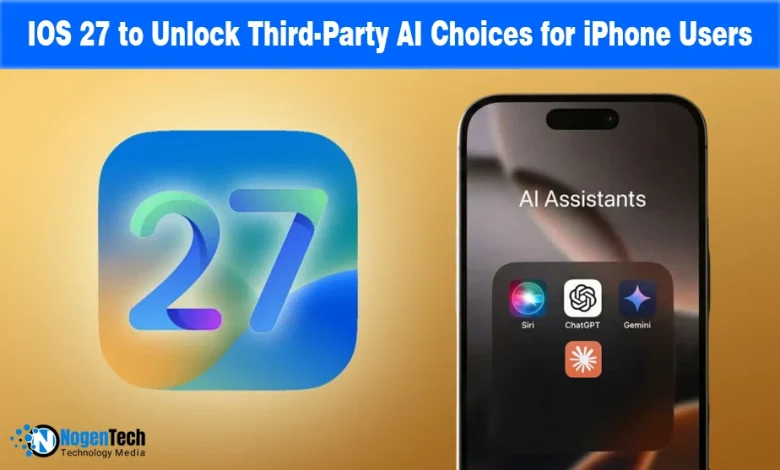
For the past year, using AI on an iPhone meant using Apple’s AI, on Apple’s terms, with OpenAI’s ChatGPT as the only permitted outside voice.
That arrangement is changing. Bloomberg’s Mark Gurman reported that Apple plans to let users choose third-party AI models across its software, arriving with iOS 27, iPadOS 27, and macOS 27 this autumn.
The feature, internally called “Extensions,” lets users access generative AI capabilities from installed apps on demand through Apple Intelligence tools like Siri, Writing Tools, and Image Playground. The formal reveal is expected at WWDC 2026 on June 8, with developer betas following and public releases in September.
How Extensions Actually Work and What You Can Swap
The practical experience, as MacRumors confirmed, is straightforward: users can go to Settings and choose which AI service handles specific tasks across Apple Intelligence.
That means choosing one model for text in Writing Tools, another for images, and potentially a preference for Siri.
Any AI provider that builds support for the Extensions framework, through the App Store, will be eligible to appear as an option.
In test builds, a message shown to users reads: “Extensions allow you to access generative AI capabilities from installed apps on demand, through Apple Intelligence features such as Siri, Writing Tools, Image Playground and more.”
The report adds that Google’s Gemini and Anthropic’s Claude are both currently being tested as Extensions providers in internal iOS 27 builds, with Apple engineering teams actively evaluating how each model integrates across the feature set.
Neither is confirmed for launch, but both are strong candidates for what Apple expects to be a populated ecosystem of AI providers by the time the operating system ships.
What This Means for ChatGPT and for OpenAI
The timing of this announcement is hard to ignore. Until now, ChatGPT has been the only external AI built directly into Apple Intelligence at the operating system level, available across more than two billion active devices without additional setup.
Per Bloomberg, that exclusivity is about to become much less exclusive, and the engagement numbers tell part of the story.
Gurman noted that ChatGPT’s reach on Apple devices fell short of expectations, suggesting the partnership has not delivered the boost both companies anticipated when it was announced last year.
This target miss follows a broader revenue struggle for OpenAI, which is currently facing heightened legal tensions as well.
The relationship has also cooled publicly, with reports that OpenAI is recruiting Apple engineers for its hardware ambitions, a move unlikely to go unnoticed by Apple.
Why Apple Is Doing This Now and the Strategy Behind It
Apple’s OpenAI choice is not just a consumer-friendly gesture. It reflects a practical shift: instead of waiting to match leading models, the company is positioning itself as a distribution platform rather than the builder.
At the same time, Apple continues its push toward independence, developing in-house models to reduce reliance on external providers, echoing its broader efforts to diversify away from TSMC through reported Intel and Samsung discussions.
And the Extensions approach allows both strategies to run in parallel.
Google’s Gemini is positioned differently from other Extensions providers.
Reports suggest Apple may be paying about $1 billion annually for Gemini access under a multi-year deal, with queries routed through Apple’s Private Cloud Compute to keep data isolated from Google’s infrastructure.
That level of integration is not confirmed for other providers like Claude, meaning model support may vary in privacy and system depth. The final structure, including eligible models, privacy rules, and default settings, is expected to be clarified at WWDC on June 8.
Source: Apple to Let Users Choose Rival AI Models Across Its iOS 27 Features