Apple Plans macOS 27 Design Fixes for Liquid Glass, and Safari Gets AI Tab Groups Too
Bloomberg's Mark Gurman reported on May 10, 2026, that macOS 27 will arrive with a "slight redesign" correcting the transparency and shadow quirks, alongside a new AI-powered Safari feature that organises open tabs automatically.

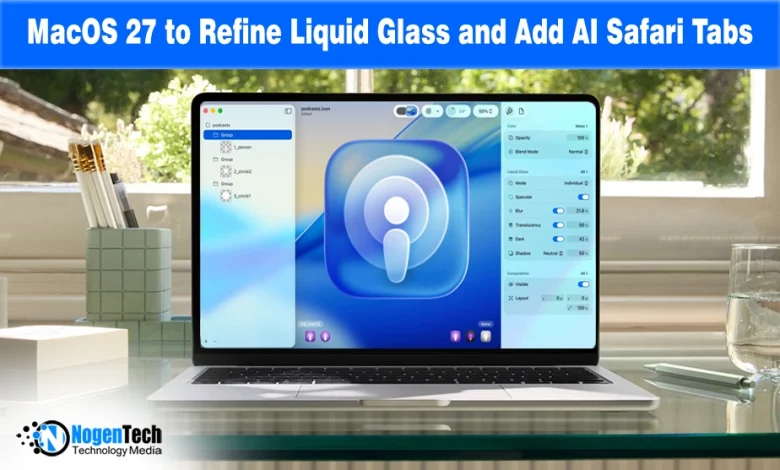
Apple is preparing a course correction for its Mac software ahead of WWDC 2026, and arriving just as the company plans an iOS 27 shift to let users swap AI models for specific tasks. Bloomberg’s Mark Gurman reported that macOS 27 will include what people inside Apple are calling a “slight redesign.”
It is not a reversal of the Liquid Glass design language introduced with macOS Tahoe, but a refinement of the elements that made Tahoe feel unfinished to many people using Macs.
Gurman was direct about the nature of the problem and said that the issue was not Liquid Glass itself, but that Tahoe’s implementation shipped before it was fully polished. macOS 27 is intended to fix that.
What Went Wrong With Tahoe’s Liquid Glass
Anyone who spent meaningful time in macOS Tahoe noticed the issues without needing them explained.
The transparency and shadow effects introduced through Liquid Glass, Apple’s visual overhaul featuring glass-like layering, refraction, and floating interface elements, did not translate cleanly across the Mac’s mix of LCD and OLED displays.
Menus became harder to read, Control Center panels blended into backgrounds, and dense sidebars added visual noise that hurt usability.
Even as Google recently launched a high-performance Gemini standalone app for Mac users, the underlying OS struggled to keep its own visuals crisp.
As 9to5mac confirmed, Gurman noted explicitly that “last year’s operating systems didn’t necessarily suffer from design problems, I’m told, but rather a not-completely-baked implementation from Apple’s software engineering team.”
That distinction matters: Apple is not admitting the design direction was wrong. It acknowledges that the execution was incomplete.
What the macOS 27 Redesign Will Actually Change
The macOS 27 focuses on refining shadows, opacity, and transparency, the elements that most affect readability against Liquid Glass backgrounds.
The goal, per Gurman, is to deliver what the design team always intended rather than what engineering managed to ship under Tahoe’s timeline.
Liquid Glass itself is staying, but Apple is recalibrating how reflective surfaces, shadow contrast, and overlapping transparency behave in apps like Finder and Reminders.
It is also refining how and how transparency behaves when overlapping windows stack in ways that Tahoe’s current implementation handled poorly.
Future Mac hardware release, especially the rumored high-end OLED touchscreen MacBook in development, is expected to showcase Liquid Glass more effectively. Apple’s ongoing chip supply diversification reflects the efforts that could support future hardware like this.
macOS 27 is what bridges that gap on existing hardware in the meantime.
Safari’s AI Tab Groups and the Productivity Angle
The macOS 27 story is not only about refining Liquid Glass. As MacRumors reported, Gurman also revealed that Apple is testing an AI-powered Safari feature that automatically organizes tabs into labeled groups.
The outlet notes the feature adds a new “Organize Tabs” option to the center-top tab-group button in test builds of iOS 27. Users can either let Safari group tabs automatically based on content and context or organize them manually on demand.
The feature is expected across macOS 27, iOS 27, and iPadOS 27, keeping the experience consistent across Apple’s platforms.
For users managing large numbers of tabs for research or work, automatic grouping targets one of modern browsing’s biggest usability frustrations through the expanding Apple Intelligence system planned for the iOS 27 and macOS 27 cycle.
What WWDC June 8 Will Confirm
All of this lands less than 2 months before Apple’s WWDC 2026 keynote on June 8, where macOS 27, iOS 27, iPadOS 27, watchOS 27, and visionOS updates will be formally unveiled.
The foundation for these shifts is already appearing in iOS 26.5 beta 1, which serves as a final bridge toward the new AI ecosystem.
Developer betas will likely launch immediately after the keynote, followed by public betas typically arriving in July and full releases in September alongside new iPhone hardware.
Whether the refinements satisfy the portion of Mac users who found Tahoe visually disorienting will become clear the moment the developer betas go live.
Source: Apple to Make Design Changes in macOS 27 to Address Tahoe Quirks