Beyond Chatbots: Gemini Omni and Spark Steal the Show at Google I/O 2026
Moving past simple chat interfaces, Google unveiled an interconnected ecosystem of multi-modal "world models," background agents, and collaborative creative hubs designed to manage daily life and advanced development without manual intervention.

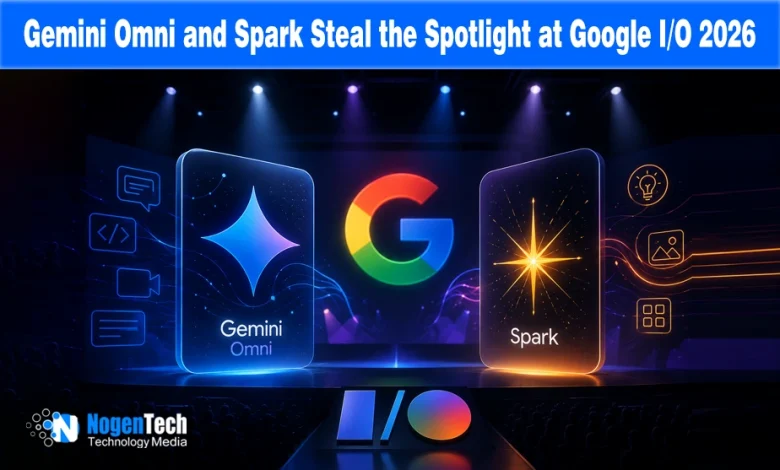
Google I/O 2026 at the Shoreline Amphitheatre firmly established that the tech sector has shifted from passive AI assistance to fully autonomous ecosystem integration. While early disclosures highlighted search adjustments and wearable hardware partnerships, the deep-tech reveals from Mountain View unveiled a unified software framework.
By deploying background orchestration engines and cross-modal creative tools, Google is positioning its architecture as a proactive agent layer that acts, builds, and coordinates on your behalf.
Gemini Omni: The Emergence of the Multimodal World Model
The definitive model drop of the event came from Google DeepMind’s Demis Hassabis, who unveiled Gemini Omni.
Moving beyond basic video generators that translate text prompts into isolated clips, Omni operates as a comprehensive “world model” that natively synthesizes text, photos, video, and audio reference layers simultaneously.
Reporting from CNET highlights how Omni converges Google’s foundational creative models, including Veo and the Nano Banana architecture, into a singular, cohesive family.
During live demonstrations, engineers showcased Omni’s ability to process a real video feed and execute complex, conversational video editing instructions.
Creators can completely transform a scene’s physical environment, add distinct visual effects, or introduce entirely new digital characters while fully preserving the nuances of the original human performance.
Built with an inherent grasp of physical properties like gravity and velocity, Gemini Omni Flash is rolling out immediately to paid Google AI subscribers, with direct integration launching inside YouTube Shorts and YouTube Create.
Gemini Spark: The Proactive Background Assistant
For daily productivity, Google introduced Gemini Spark, a persistent, cloud-based personal agent designed to manage long-horizon background automation.
Unlike traditional chat interfaces like ChatGPT, which require active user prompts, Spark runs continuously in the background even when user devices are completely offline.
Reporting from TechCrunch details how Spark utilizes the robust Antigravity agent harness to execute multi-step workflows across Google Workspace applications.
The agent can scan deep inbox histories via Gmail Live to extract travel data, isolate hidden corporate fees, and draft highly contextualized email replies ready for human review.
Furthermore, Spark coordinates third-party services via the Model Context Protocol (MCP), linking directly with platforms like Uber and Lyft to prepare retail or transit requests autonomously under user supervision.
Google confirmed that Gemini Spark is being rolled out initially to enterprise testers, with a beta planned for Google AI Ultra subscribers in the United States.
Workspace Live: Redefining Digital Creation and Collaboration
Concurrently, Google Workspace received its most aggressive feature upgrade in years. VP of Product Yulie Kwon Kim unveiled Google Pics, an all-new image creation and precise editing application anchored by the Nano Banana model.
Designed to challenge collaborative canvas tools, Google Pics introduces pixel-perfect object segmentation, letting users isolate image elements and change their shape, size, or color without affecting the background layer.
The app also features inline text editing and automatic translation that preserves original graphic fonts, alongside shareable digital canvases for real-time team collaboration.
Paired with Docs Live and Keep Live, these conversational voice-writing tools turn spoken thoughts or rough “brain dumps” into organized outlines, summaries, and drafts by using files stored in Google Drive as context.
These features aim to turn chaotic, spoken notes into polished executive summaries within seconds.
Neural Expressive: Re-Engineering the AI User Experience
To unify these underlying capabilities, Google unveiled Neural Expressive, a ground-up aesthetic and functional design language overhaul for the primary Gemini application across Android, iOS, and web platforms.
The redesign strips away the text-heavy input boxes of early AI interfaces, replacing them with fluid animations, dynamic typography, and contextual haptic feedback.
The Neural Expressive layout integrates Gemini Live directly into the core app experience, eliminating the need to toggle separate voice modes.
The interface adapts to usage, expanding into custom tables, interactive widgets, or multi-modal drop zones based on whether users provide a file, Chrome tab, or live video feed.
It also works with Daily Brief, an agent that turns notifications, Calendar events, and priority emails into a clean morning dashboard.
Industry Standards and Ecosystem Alignment
Beyond consumer applications, Google announced that its SynthID digital watermarking protocol is officially becoming a cross-industry standard, being adopted by top rivals OpenAI, Kakao, and ElevenLabs to flag AI-generated content transparently.
To make its premium services more accessible alongside these massive architecture rollouts, Google updated its pricing structure.
The company cut its top-tier AI Ultra plan from $250 to $200 and introduced a new $100 Ultra plan to bring these interactive, agentic workflows to broader markets.