Google Lets Anyone Check Images, Videos and Audio for AI Watermarks With SynthID
Anyone can now check images, videos and audio for Google's invisible AI watermark at synthid.com.

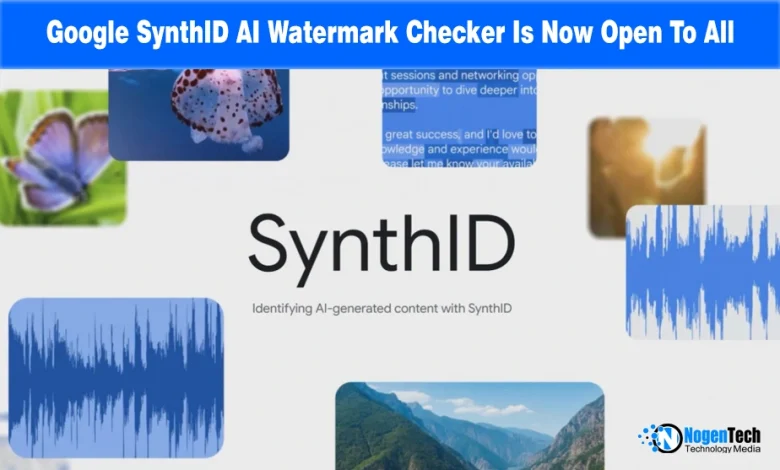
Google has made it much easier to answer a question many people now ask daily: is this real? On October 7, 2026, the company opened its SynthID checker to the public.
Anyone can upload an image, video, or audio file and check whether it has a SynthID watermark.
NogenTech tested it with an original graphic from our designer and later edited it slightly with AI. And it identified the embedded watermark successfully.
What Google Launched and What It Supports
SynthID, which Google introduced in 2023, embeds an invisible watermark into media at the moment an AI model generates it.
The new website searches uploaded files for that watermark. The detector is now available globally in English, with further expansion expected.
As TechCrunch details, the file support is broad.
For images, it accepts JPG, JPEG, PNG, BMP, WEBP, AVIF, HEIC, HEIF, TIFF, TIF and GIF. Video formats are MP4, MOV and WEBM, and audio formats are WAV, MP3, OGG, FLAC, AAC and M4A.
Google’s own tools all apply the watermark, including Nano Banana, Veo, Lyria, Gemini, Flow, ProducerAI and Vids.
Partners OpenAI, NVIDIA and Kakao also support SynthID.
Google says Apple Intelligence images will carry the watermark “soon,” according to 9to5Google.
SynthID verification is also built into the Gemini app and Google Chrome, and Google says people make about 1 million verification requests daily.
Pure AI vs. Human Work Edited With AI
We wanted to know whether the checker works in realistic situations, so we ran two tests.
Test 1: An Original Image by NogenTech’s Editor. The checker recognized it as not AI-generated. This is the expected case, since the image had no AI watermark in it.
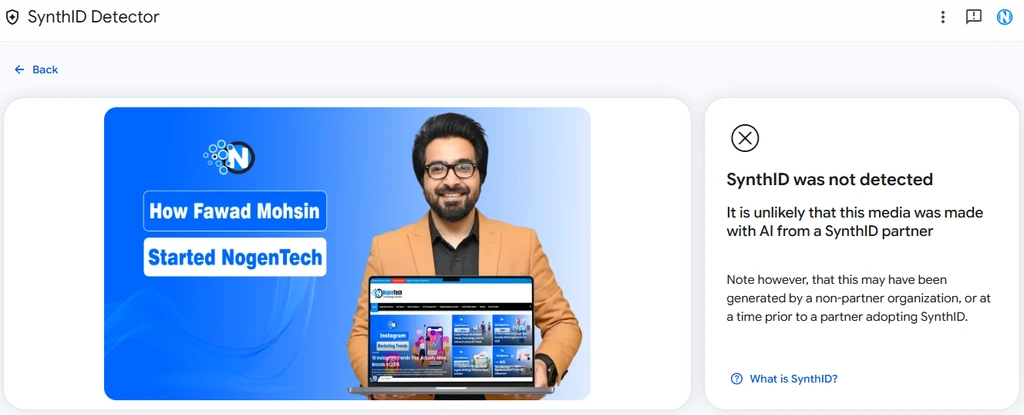
Test 2: A hybrid image. We modified the same image slightly with AI. This is the harder case, and the one most people will actually run into, since AI is increasingly used as an editing tool rather than a full generator. SynthID still recognized the AI involvement.
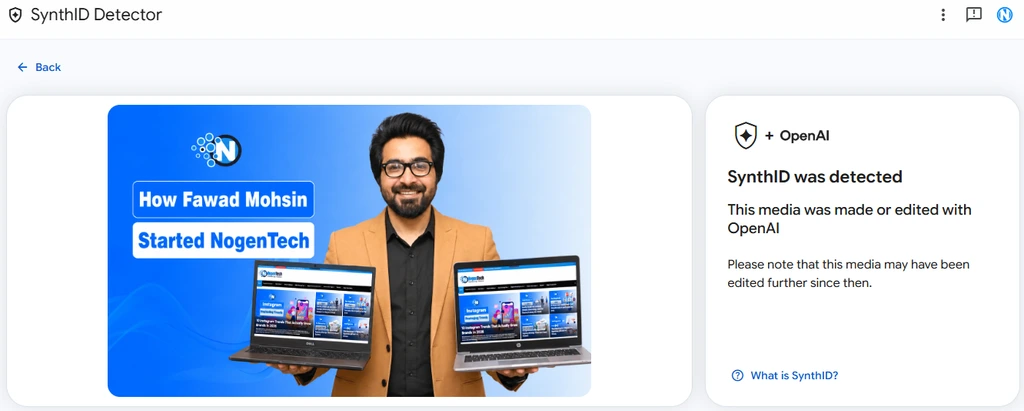
Two caveats apply. Two images are a small sample, not a benchmark.
Detection also depends on the AI tool leaving a SynthID watermark in the first place, which is why the tool’s coverage matters as much as its accuracy.
Limits and What It Means for You
SynthID only detects whether its watermark is present; it cannot confirm authenticity.
Since missing a watermark does not mean content is human-made, a clean result is not proof of authenticity.
Though Google reports watermarking over 180 billion media files since 2023, vast amounts of unmarked AI content remain online.
Verification across the ecosystem remains fragmented: OpenAI operates a proprietary verification site for its own tools.
While Microsoft and Meta use separate standards, which often miss their own output, as Reuters report showed, Meta’s detector missed cropped Meta-AI images.
SynthID serves best as an initial check for viral media: a positive detection confirms AI involvement, while a negative result simply means no SynthID watermark was found, requiring further source and context verification.
Source: A tool to watermark and identify content generated through AI