Instagram advertising used to reward brands that could consistently produce polished images, videos, captions, and campaign variations. That still matters, but the production model is changing.
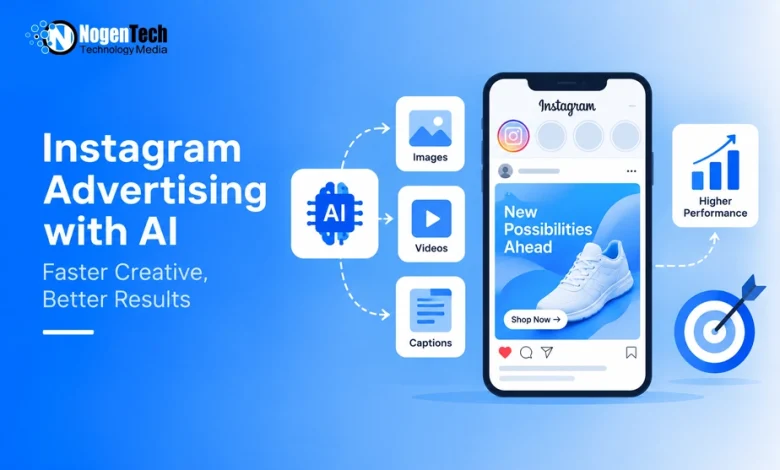
With Instagram AI ads, marketers can now move from a campaign idea to multiple creative directions much faster, giving brands more opportunities to test messages, formats, and audience angles without waiting for every asset to be built manually.
The change is a big one because Instagram is a visual platform and a fast-moving environment. A creative idea can be strong for a while, but can lose attention as audiences see it again and again. Brands need more than just a good ad.
They need a system for creating, testing, learning, and refreshing creative and staying true to the core offer and identity.
Why Instagram Advertising is a Creative Bottleneck
Instagram has a visual language. This makes the platform powerful for products and services that can be demonstrated, styled, compared, or explained quickly. It also generates pressure to create.
A campaign might require:
- Square and portrait photos;
- Video (Reels-style);
- Variations of stories;
- Some hooks;
- Captions (several);
- Product- and lifestyle-oriented concepts;
- Retargeting creative;
- Fresh versions as performance deteriorates.
For a large brand, this may be divided between a creative department, media team, agency, and freelancers. Smaller teams need the same diversity, but not the same headcount.
AI changes that equation, reducing the amount of manual labor required to get the first set of options.
Generative AI Increases the Quantity of Ideas a Team can Work Through.
One of the most obvious ways AI is being used in Instagram advertising is for creative ideation.
A marketer can take a product, offer, audience, or campaign objective and quickly generate alternative hooks, visual concepts, scripts, and captions. This reduces the cost of early exploration.
Nogentech has also examined how generative AI is transforming marketing more broadly, including the way brands can produce social content and creative variations at a speed that manual workflows struggle to match. Instagram advertising is a natural place for that capability because campaign performance depends heavily on having enough useful creative to test.
The key word is useful. More assets do not automatically imply more insights. Three concepts, based on different customer motivations, might be more valuable than ten almost identical images.
AI Makes Creative Testing Easier
Testing is most effective when each variation answers a question. A brand may want to know if customers respond better to:
- A lifestyle scene or product demonstration;
- A customer problem or desired end result;
- Custom-style delivery or refined brand production;
- A saving or a product benefit;
- A direct hook or a curiosity-driven opening.
Artificial intelligence can help bring down the cost of making those comparisons. Instead of a designer rebuilding every concept from scratch, the team can produce a first batch of executions and then iterate on the most promising directions.
This changes the role of the creative. Less time is spent on repetitive resizing and basic first drafts. There is more room to focus on the strategic differences that give a test its meaning.
Instagram Ads are Getting More Native to Social Content
Instagram’s visual language has changed. There is still a role for highly polished advertising, but many effective ads now take cues from organic content: direct-to-camera video, simple product demonstrations, captions, casual environments, creator-style storytelling, and fast edits.
AI tools can help brands play in that larger set of styles. They can come up with script ideas, develop presenter-led concepts, create visual variations, or repurpose existing product assets into new layouts.
The problem is to avoid content that looks generated because it was easy to generate.
Native doesn’t equal generic
A vertical video isn’t inherently “Instagram-native.” Not a casual font or a selfie-style presenter.
Native creative is how the people actually consume content on the platform. It respects pacing, framing, sound, captions, and the fact that an ad is competing with posts from friends, creators, and entertainment accounts.
Artificial intelligence can accelerate production, but marketers still have to question if the end product is something that belongs in the feed.
Personalization is More Than Demographics.
AI also changes advertising in terms of message variation.
Two people may have the same demographic profile but care about a product for different reasons. Some will value price, some convenience, some status, some speed.
AI makes it easier to develop different creative angles around those motivations. It’s the same product, but the entry point is different.
A productivity app, for example, might run an Instagram ad about saving time, one about reducing stress, and one about keeping a team organized. Each version can have different visuals and copy, but the brand stays the same.
This kind of customization is more helpful than just a name or location switch. It connects the message to a reason the audience should care.
The Way Campaigns Are Run Is Changing Too
Creative production is just one piece of the AI shift.
Meta already employs machine learning in its advertising systems to assist with things such as delivery, audience optimization, placements, and campaign performance. This means that marketers are increasingly operating in a world in which both the media system and the creative workflow are automated.
This shifts the locus of human contribution.
As platforms automate more of the distribution logic, marketers need to have strong inputs: clear objectives, reliable conversion data, accurate product information, and enough creative variety for the system to learn from.
HubSpot’s guidance on AI tools for Instagram notes that marketers can use AI to create content faster and support tasks such as editing, analytics, and scheduling without giving up brand quality or authenticity.
That balance matters in advertising: AI can expand the number of creative options, but the marketer still has to provide truthful, relevant material and measure the outcome against a real business goal.
Learning System for Creative Volume
AI advertising has one danger: teams confuse production with progress.
It’s tempting to post all fifty when a tool can generate fifty ads in a flash. But a campaign with too many uncontrolled differences can make learning difficult. Organizing around hypotheses is a better approach.
For each concept, note:
- The problem of the audience;
- The core promise;
- The format;
- The opening hook;
- The proof point;
- The call to action;
- The outcome;
- What to test next.
This turns the volume of AI-generated information into structured experimentation. It’s not about more content. The aim is more proof about what works with customers.
Artificial Intelligence Can Reduce the Feedback Cycle
Traditionally, creative production and media analysis have often been separate. A creative team produces the assets, a media team launches the assets, and the insights come back later.
AI-enabled workflows can cut down that loop.
New creative briefs can be informed faster by performance data. If one hook is consistently driving better qualified traffic, the team can build more around that concept. If a format receives attention but does not convert, the next test can be on the message or offer, not that the whole concept is wrong.
This produces a cycle:
- Formulate a clear hypothesis;
- Develop a set of meaningful variations;
- Start under similar conditions;
- Review performance,
- Identify the strongest pattern;
- Advance to the next round.
And the faster that cycle becomes, the more valuable Instagram ads can be as a source of customer insight.
Brand Consistency Gets More Important, Not Less
Inconsistencies can spread rapidly if the pace of production accelerates.
A single team can have dozens of images, videos, captions, avatars, and variations generated by dozens of different tools. Without clear rules of the brand, the campaign can begin looking like a number of unrelated businesses.
Before scaling production, brands need to define stable elements:
- Use of the logo;
- Color rules;
- Type:
- Tone of voice;
- Claims of core product
- Visual treatment,
- Words or commitments that should never be used.
Then the AI is able to change the flexible parts and leave the fixed parts as they are.
This is especially true for Instagram, as consumers are exposed to a brand through a lot of touchpoints. The ad could lead to a profile, Reel, Story highlight, product page, or direct message. Consistency helps those pieces feel tied together.
Human Review to Preserve Accuracy and Trust
The advertising produced still needs to be reviewed.
AI may generate wrong product descriptions, clumsy hands or objects, misleading scenes, unsupported claims, or text that sounds confident even if it’s wrong. The faster teams make ads, the easier it is for small mistakes to accumulate.
Marketers should check before publishing:
- Whether the product is portrayed accurately;
- Whether claims are substantiated.
- Whether prices and offers are up-to-date;
- Whether the visual can mislead the viewer;
- Whether the language is on-brand;
- Rights and permissions obtained;
- Whether any AI disclosure requirements are implicated by the disclosure.
Speed is only useful if it doesn’t incur costly corrections later.
AI Is Changing What Marketers Need To Know
As it becomes easier to generate, the value of manual production shifts.
Marketers need to be better at briefing, selecting, evaluating, and learning. A good prompt is important, but understanding the customer is more important. Five concepts are easy; deciding which concept deserves budget is harder.
This raises the value of:
- Research on customers;
- Placement;
- Creative planning;
- Performance analysis;
- Brand assessment;
- Design of experiments.
AI reduces the difficulty of execution, increasing the importance of the quality of decisions.
The Future of Instagram AI Advertising
The way forward is greater integration.
Marketers are increasingly working with systems that link several stages of the process, rather than individual tools for research, copy, image creation, video, resizing, campaign setup, and reporting.
This could greatly speed up campaign iteration. Creative generation might be fed with a product catalog. The next set of variations may be affected by performance data. Outputs may be constrained automatically by brand guidelines.
The chance is a more flexible advertising platform. The software is easy to use, and the risk is a deluge of similar content being created. Brands still need a reason to be remembered.
Summing Up
AI is revolutionizing advertising on Instagram by cutting down the time to create, modify, and test visual ideas. It enables brands to test more messages, personalize creative to the customer’s motivation, and respond to performance more quickly than traditional production cycles permit.
The advantage is not from producing the most ads. It comes from building a disciplined loop where AI turbocharges the number of ideas a team can test, and human judgment protects strategy, accuracy, and brand recognition.
Instagram is still a visual attention competition. AI alters the economics of production, but the brands that will cut through will still be the ones with the clearest message and the best understanding of the people they want to reach.