Zuckerberg Predicts Billions Will Have Personal AI Agents Within Five Years
Meta CEO Mark Zuckerberg used Wednesday's second-quarter earnings call to predict that within five years, billions of people will rely on personal AI agents working around the clock, even as the company's AI spending continues to rattle investors.

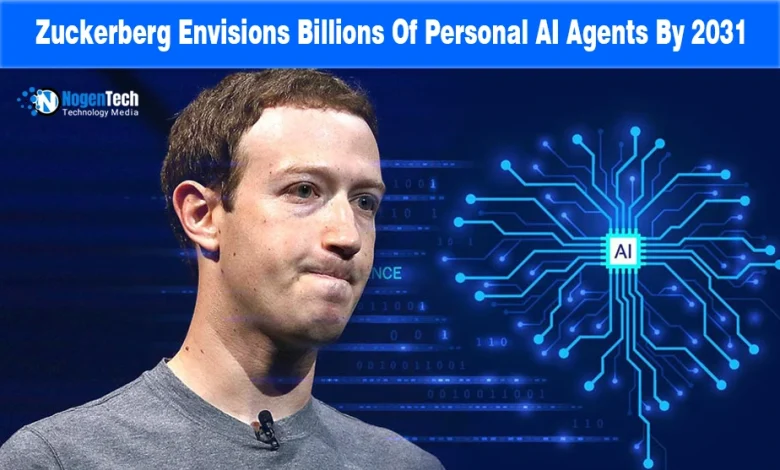
Meta CEO Mark Zuckerberg has spent much of this year trying to convince Wall Street that Meta’s enormous machine intelligence bill will eventually translate into products people actually want, and Wednesday’s call marked his most direct pitch yet for what that future looks like.
Rather than framing AI agents as a distant experiment, he described them as close to inevitable, a bet Meta is making at a moment when its own financials are under real strain from the scale of that same buildout.
A Bold Timeline for Agents That “Just Work”
TechCrunch reported that Zuckerberg told investors it’s extremely unlikely that, within five years, people won’t have billions of personal AI agents that understand their goals and work on their behalf across finances, health, relationships, and household management.
Benzinga’s coverage cited by Yahoo Finance added important nuance to that prediction, noting that Zuckerberg was responding directly to a Bernstein analyst’s question about whether consumer AI could move past being “glorified search” toward something more transformative.
Zuckerberg pointed to coding agents as the first real proof point, saying developers adopted them early because they’re technically skilled and comfortable troubleshooting new tools, while a product for billions simply needs to work without that kind of hand-holding.
WhatsApp Positioned as the Agent Gateway
Beyond the prediction, TechCrunch noted that Zuckerberg identified WhatsApp and Meta’s other messaging platforms as central to how people will interact with multiple AI agents, adding that WhatsApp is already Meta’s leading surface for AI interaction.
That framing reflects Meta’s global messaging reach and echoes a broader shift toward agentic AI, with Google pursuing its own Search overhaul this year while Anthropic has seen Claude subscriptions climb among developers using its coding assistant.
Meta’s business agents, rolled out on WhatsApp and Messenger this quarter, have already been adopted by more than a million businesses, giving Zuckerberg an early data point even as the consumer version of his vision remains unbuilt.
Investors Weigh the Vision Against the Bill
CNET’s earnings coverage underscored just how costly Zuckerberg’s ambitions have become, with the company’s Reality Labs division alone losing around $4.6 billion this quarter, pushing its cumulative losses to more than $80 billion since late 2020.
Zuckerberg told analysts that Meta sees higher margins from selling AI intelligence than raw compute, while still viewing compute as a growth opportunity. The strategy comes as Google has reportedly limited external Gemini compute because of capacity shortages.
That tension, between building toward a long-term agentic future and satisfying shorter-term investor patience, was on full display this week when Meta and BlackRock announced a $14 billion data center partnership in El Paso, Texas.
This added to an already aggressive infrastructure buildout that Zuckerberg insists will ultimately become the foundation for Meta’s next wave of products and revenue.
Source: Mark Zuckerberg predicts that billions of people will have personal AI agents