
Google Restricts Meta Gemini AI Usage as Infrastructure Capacity Limits Cause Delays
Google imposed limits on Meta's use of its Gemini AI models earlier this year after it sought more computing capacity than Google could supply, disrupting and delaying some of Meta's internal AI projects, with staff directed to be more efficient with AI token usage.

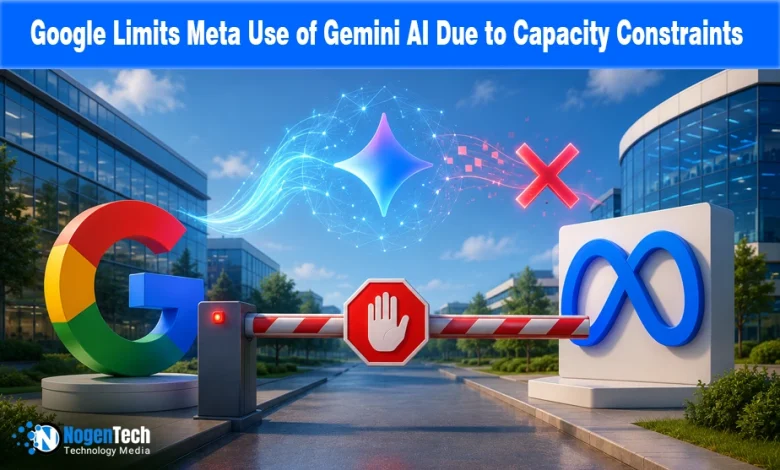
Google has limited Meta’s use of its Gemini AI models after the social media company requested more computing capacity than Google could provide, the Financial Times reported on Sunday.
The development complicates the AI industry’s narrative of frontier model APIs as a growth business.
It shows that even two of the world’s largest technology companies, with vast capital and engineering resources, are facing infrastructure constraints that spending plans and supply agreements cannot quickly resolve.
Google and Meta did not immediately respond to requests for comment. The restrictions, which began around March 2026, remain in place as of late June.
Why Meta Was Particularly Hard Hit
Several other Google clients were also affected, though to a lesser extent, as Financial Times reports. Meta was hit particularly hard because of its exceptionally high demand for Google’s models, an ironic twist given the companies’ competitive relationship.
Meta develops and publicly releases its own Llama family of open-source LLMs under permissive licenses. Yet, it was also relying heavily on Gemini’s infrastructure for internal projects that its own models could not support at the required scale or quality.
As a result, Meta instructed employees to use AI tokens more efficiently, indicating the capacity shortfall was significant enough to require operational changes across teams rather than simply higher spending.
Just two months after launching Muse Spark to compete with ChatGPT and Claude, the company revealed it was buying Gemini capacity from Google, highlighting the widening gap between AI ambitions and the infrastructure needed to support them.
What This Reveals About Google’s Own Supply Constraints
The Meta situation is not isolated. Google Cloud revenue reached $20 billion in Q1 2026, but CEO Sundar Pichai said computing power constraints limited further growth and contributed to the cloud unit’s backlog nearly doubling quarter over quarter.
This increase is a direct sign that demand is outpacing available infrastructure.
That backlog growth is significant because it means Google is accepting orders it cannot yet fulfill, while customer demand rises faster than its capacity can expand.
The same pressure led Google to sign a $920 million-per-month compute deal with SpaceX in early June, renting Colossus data center capacity while its West Memphis, Arkansas, facility comes online.
Even that move has not been enough to reduce the backlog quickly enough to avoid restricting access for one of its largest enterprise customers.
The Broader Structural Problem No Spending Announcement Can Fix
The Google-Meta capacity dispute is the latest concrete example of a structural problem that has been building across the AI industry throughout 2026.
Supply chains for advanced AI compute, including HBM4 memory, NVIDIA GB200 systems, the same architecture that powers GPT-5.5, and advanced packaging capacity, remain constrained at multiple levels.
No announcement of a new data center changes that reality until the facility is operational and delivering compute to customers.
For enterprises and developers building on third-party AI model APIs, the Google-Meta situation highlights a critical risk: supplier-side capacity constraints can disrupt internal roadmaps even when contracts remain valid, and payments are current.
Meta encountered that reality in March, months after the broader memory crunch was already well underway.
Source: Google caps Meta’s Gemini use as AI demand strains capacity




![Top Tech Stories of 9th Week [2026]](https://www.nogentech.org/wp-content/uploads/2026/03/Top-Tech-Stories-of-9th-Week-2026-390x220.webp)