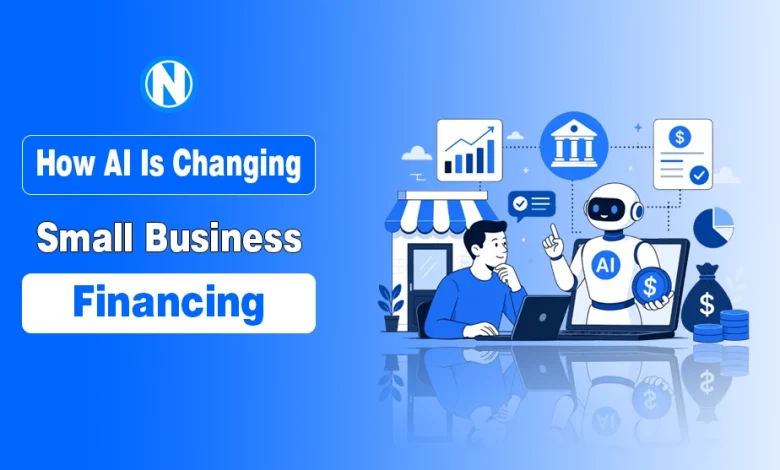
Small businesses have traditionally faced major challenges when trying to secure financing. Strict lending requirements, limited credit history, slow approval processes, and excessive paperwork often make funding difficult, especially for startups and growing companies.
Artificial intelligence is changing this by helping lenders analyze data faster and make quicker, more accurate decisions. It also allows the use of alternative data when assessing businesses, improving access to credit.
As a result, financing is becoming more accessible and flexible for small business owners. Now, let’s explore how AI is changing small business financing options in detail.https://www.nogentech.org/lease-accounting-software-reporting-accuracy/
- AI is making small business financing faster and more accessible.
- Automated lending systems reduce approval times significantly.
- AI uses alternative data beyond traditional credit scores for better analysis.
- Startups and growing businesses benefit from AI-driven evaluation.
- Human oversight remains important in AI-powered lending decisions.
What Does Artificial Intelligence Mean in Business Financing?
Artificial intelligence in business financing refers to the use of machine learning, automation, predictive analytics, and data-driven algorithms to evaluate loan applications and financial risk with minimal human intervention.
Instead of relying only on traditional credit scoring systems, AI analyzes multiple sources of financial and operational data to understand a business’s financial health more accurately.
Modern AI lending systems can evaluate:
- Cash flow patterns
- Transaction history
- Online sales performance
- Payment processing activity
- Inventory movement
- Customer purchasing behavior
- Accounting software data
- Business growth trends
This gives lenders a broader and more realistic picture of how a business operates.
AI is also helping support modern funding models, such as:
- Revenue-based financing
- Embedded finance
- Flexible repayment loans
- Automated credit lines
- Real-time working capital solutions
For small and growing businesses with fluctuating revenue and changing cash flow needs, these financing models offer far greater flexibility than traditional bank loans.

How AI is Changing Business Financing Options for Small Businesses?
Artificial intelligence is reshaping small business financing by improving speed, accuracy, and accessibility. It helps lenders move beyond traditional evaluation methods and use data-driven systems to make better financial decisions.
Below are some of the key ways AI is changing financing options for small businesses.
1. Faster Loan Approval Processes
AI has significantly reduced the time needed to process loan applications. In traditional systems, approval can take several days or even weeks because of manual reviews, document verification, and back-and-forth checks.
AI automates much of this process by instantly analyzing financial records and application data. As a result, small businesses can receive loan decisions within minutes or hours, which is especially important when they need quick access to working capital.
For example, when you explore Crestmont Capital for small business loans, you’ll find financing solutions that can include short-term funding options with approvals in as little as 24 hours, along with longer repayment structures designed to support ongoing business growth.
2. Use of Alternative Data for Credit Evaluation
Instead of relying only on credit scores and banking history, AI evaluates a wider range of data sources.
These include cash flow patterns, online sales performance, digital payment activity, and real-time lease accounting and reporting accuracy from modern financial tools
This broader view allows lenders to assess businesses that may not have strong traditional credit records but still show healthy financial activity. It makes financing more inclusive for newer or less established businesses.
3. More Accurate Risk Assessment
AI models can process large amounts of data and identify patterns that are difficult for humans to detect. By analyzing financial behavior in real time, these systems can predict the likelihood of repayment more accurately.
This helps lenders reduce the risk of defaults while also ensuring that creditworthy businesses are not unfairly rejected. The result is a more balanced and data-driven lending process.
4. Personalized Financing Options
AI allows lenders to create more tailored financial products for different types of small businesses. Loan amounts, interest rates, and repayment schedules can be adjusted based on a company’s financial performance and risk profile.
Marketing performance can also be considered as part of the overall business growth signals when evaluating a company’s potential.
This personalization ensures that businesses are not forced into one-size-fits-all loan structures and can instead access financing that matches their actual needs and capacity.
5. Increased Access for Small and New Businesses
Many small and newly established businesses struggle to qualify for traditional bank loans due to limited credit history.
AI-based systems help solve this problem by considering alternative data and real-time financial activity. This gives lenders a clearer picture of a business’s potential, increasing the chances of approval for startups and underserved entrepreneurs who were previously overlooked.
SBA-backed financing reached $56 billion in fiscal year 2024, according to AP News, reflecting continued support for smaller firms. Entrepreneurs who research eligibility criteria carefully can further improve their odds of securing funds.
6. Automation of Administrative Tasks
AI reduces the need for manual work in areas such as document verification, identity checks, and application processing.
These tasks are handled quickly and consistently by automated systems, which reduces errors and speeds up the overall lending process.
For lenders, this also lowers operational costs, allowing them to process a higher volume of applications and serve more small businesses efficiently.
Best Practices for Using AI in Small Business Financing
While AI improves financing efficiency, lenders and businesses should follow best practices to ensure fairness, transparency, and security.
1. Use High-Quality and Diverse Data
AI systems work best when they are trained on accurate and diverse data. Lenders should include different types of financial and business information to reduce bias and improve decision-making. Relying on limited or poor-quality data can lead to unfair or incorrect results.
2. Ensure Transparency in Decision-Making
Financial institutions should make AI-driven decisions as transparent as possible. Even if complex models are used, lenders should explain the key factors that influenced loan approval or rejection. This helps build trust with small business owners and improves accountability.
3. Regularly Monitor and Audit AI Systems
AI models should not be left unchecked after deployment. Regular audits help identify errors, bias, or outdated patterns in the system.
Continuous monitoring ensures that the model remains accurate and fair over time as market conditions change.
4. Protect Data Privacy and Security
Since AI relies on large amounts of sensitive financial data, strong data protection measures are essential. Lenders should use secure systems, encryption, and strict access controls to protect business and customer information from misuse or breaches.
5. Combine AI with Human Judgment
AI should support decision-making, not fully replace human oversight. Human reviewers can better understand complex or unusual cases that AI might misinterpret. A balanced approach improves both accuracy and fairness in lending decisions.
Drawbacks of AI in Business Financing
While AI improves speed and access to financing, it also comes with certain limitations and risks that both lenders and small businesses need to consider.
- Bias in algorithms: AI systems can sometimes produce unfair results if they are trained on biased or incomplete data, which may lead to unequal lending decisions.
- Lack of transparency: Many AI models work like “black boxes,” meaning it is not always clear why a loan was approved or rejected.
- Data privacy concerns: AI relies on large amounts of financial and personal data, which raises concerns about how securely this information is stored and used.
- Dependence on technology: Over-reliance on automated systems can be risky if there are technical errors or system failures.
- Limited understanding of unique cases: AI may struggle to properly evaluate businesses with unusual models or non-standard financial patterns.
- Regulatory challenges: Laws and regulations around AI in finance are still developing, which can create uncertainty for both lenders and borrowers.
The Future of AI in Small Business Financing
The future of artificial intelligence in business financing is bright. AI will continue playing a larger role in financial services in the years to come.
Emerging trends include:
- Real-time lending decisions
- Predictive cash flow financing
- Embedded finance inside business software
- AI-powered financial advisors
- Automated bookkeeping integration
- Smarter fraud prevention systems
As AI technology becomes more advanced, financing will likely become even more personalized, accessible, and efficient for small businesses worldwide.
AI Evolution in Small Business Financing
Artificial intelligence is changing small business financing by making loan processes faster, more accurate, and more accessible.
It helps lenders use better data, reduce manual work, and offer more personalized funding options. At the same time, it also brings challenges such as bias, privacy concerns, and a lack of transparency.
When used carefully with proper oversight and best practices, AI can improve how small businesses access funding and support their growth in a more efficient way.
People Also Ask
How does AI help small businesses get financing?
AI helps lenders analyze business data faster and make quicker decisions. This can reduce approval times and improve access to funding.
Can AI approve loans without human involvement?
AI can automate many parts of the loan process and provide recommendations. However, many lenders still use human oversight for final decisions.
Does AI only use credit scores to evaluate businesses?
No, AI can also analyze alternative data such as cash flow, online sales, and payment history. This gives lenders a broader understanding of a business.
Are AI-based financing systems safe to use?
Many platforms use security measures to protect business and financial information. However, proper data privacy and security practices are still important.
Can startups benefit from AI-based financing?
Yes, startups can benefit because AI can evaluate more than traditional credit history. This may improve funding opportunities for newer businesses.