What if you’re not paying too much for your CRM, but you’re paying for the wrong things?
Many businesses overspend on CRM software by choosing plans, features, and licenses they don’t actually need.
If you’re evaluating a new customer relationship management (CRM) platform or reviewing your current investment, understanding what drives CRM costs can help you avoid unnecessary expenses.
Now I will let you know about:
- Why businesses overpay for CRM software.
- Whether expensive CRM tools are worth the investment.
- What increases CRM costs over time.
- How to choose a CRM that fits your business without overspending.
By the end, you’ll know how to evaluate CRM software based on real business requirements, not feature lists or price alone.
What Is the Cost of CRM Software?
CRM software average pricing in 2026 ranges from free plans to more than $550 per user per month. However, most small and mid-sized businesses typically pay $9–$40 per user per month.
While larger organizations investing in enterprise CRM platforms may spend $100–$500+ per user per month, depending on features, security, and support.
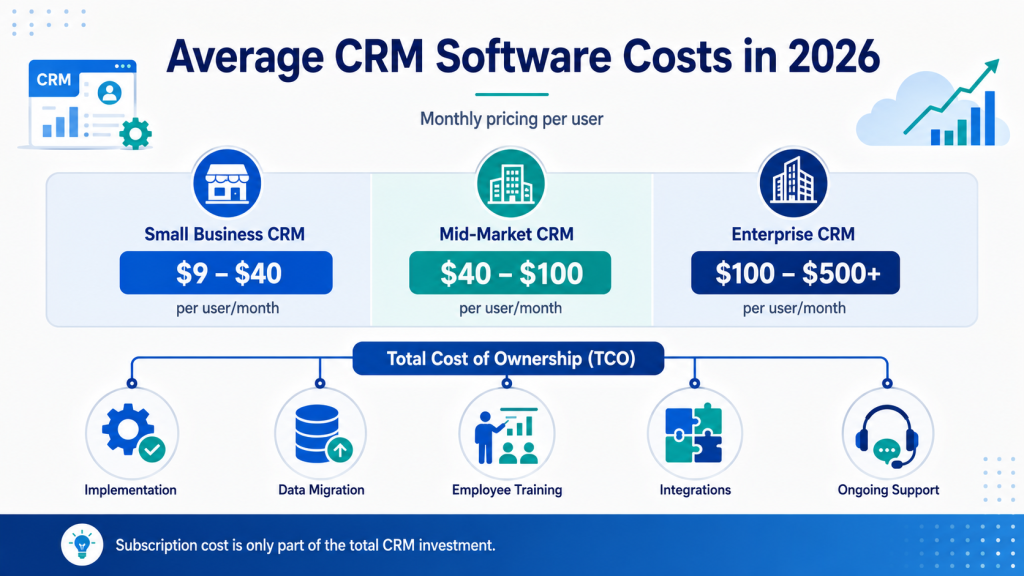
Here’s a general pricing breakdown:
| CRM Plan | Typical Cost (Per User/Month) | Best For |
|---|---|---|
| Free / Entry | $0–$15 | Startups and small teams |
| Mid-Tier | $15–$100 | Growing businesses |
| Enterprise | $100–$500+ | Large organizations |
Keep in mind that the subscription price is only part of the investment. Implementation, training, integrations, customization, and additional user licenses can significantly increase the total cost of ownership (TCO).
That’s why two businesses using different CRM platforms can end up with dramatically different annual costs, even if both are using software labeled as a “CRM.”
Why Do Businesses Overpay for CRM Software?
Businesses overpay for CRM software when they invest in capabilities that exceed their current requirements. In most cases, the problem isn’t the CRM’s price; it’s paying for features, user licenses, integrations, or enterprise plans that don’t deliver enough value to justify the additional cost.
The most common reasons businesses overspend include:
- Purchasing advanced features that their teams rarely use.
- Upgrading to enterprise plans before they’re needed.
- Paying for inactive or unnecessary user licenses.
- Using multiple disconnected tools instead of an integrated CRM.
- Overlooking long-term costs such as implementation, customization, training, and ongoing upgrades.
1: Buying More Features Than the Business Actually Needs
Advanced CRM features are only worth the price when they solve real business problems. Capabilities such as AI-powered analytics, workflow automation, predictive sales forecasting, advanced reporting, and custom modules can improve productivity, but they also increase subscription costs.
Before paying for premium features, ask:
- Does this feature solve an existing business challenge?
- Will employees use it consistently?
- Can you measure its impact on efficiency, revenue, or customer experience?
2: Choosing Enterprise Plans Too Early
Many businesses upgrade to enterprise CRM plans before they outgrow standard plans. Enterprise subscriptions typically include enhanced security, governance, advanced permissions, and extensive customization.
Choose a plan that supports your current operations and upgrade only when growth creates a clear business requirement.
3: Paying for Unused User Licenses
Unused user licenses are one of the easiest ways to waste money on CRM software. As teams change, organizations often continue paying for employees who no longer use the platform or require full access.
Review license usage regularly and remove inactive accounts or downgrade users who only need limited access. This simple audit can significantly reduce recurring CRM costs.
4: Purchasing Multiple Tools Instead of One Integrated CRM
Using separate tools for tasks your CRM already supports increases both software costs and operational complexity. So, evaluate whether your needs are best served by mobile CRMs or traditional CRMs to ensure your sales team has native access without needing supplementary add-ons.
5: Ignoring Long-Term CRM Costs
The monthly subscription is only one part of the total cost of ownership (TCO). Expenses such as implementation, data migration, employee training, customization, integrations, ongoing support, and plan upgrades can significantly increase the overall investment.
Evaluating these long-term costs before selecting a CRM helps prevent budget overruns and ensures the platform continues to deliver value as your business grows.
What Makes CRM Software Expensive?
CRM software becomes more expensive as it offers advanced capabilities, greater flexibility, and enterprise-grade services. Higher pricing usually reflects additional functionality rather than better quality.
The biggest factors that increase CRM costs include:
- Advanced features: AI-powered analytics, workflow automation, predictive forecasting, and advanced reporting increase pricing because they automate complex tasks and improve decision-making.
- Enterprise security: Features such as single sign-on (SSO), encryption, audit logs, and compliance with regulations like GDPR help protect sensitive customer data and meet enterprise security requirements.
- Customization: Custom fields, dashboards, workflows, and business-specific configurations require greater flexibility, which is typically available in higher-tier plans.
- Integrations: Native integrations and API access allow a CRM to connect with marketing, accounting, customer support, and other business applications, adding to the platform’s value and cost.
- Support and onboarding: Premium plans often include implementation assistance, employee training, dedicated account managers, and priority customer support.
- Scalability: CRM platforms built for growing businesses can support more users, larger customer databases, and increasingly complex sales operations without requiring a system change.
A higher-priced CRM isn’t automatically the better choice; it simply offers capabilities that some businesses need and others may never use.
Are Expensive CRM Tools Actually Better?
Not necessarily. Expensive CRM tools are better only when your business needs the advanced capabilities they provide. For many small and mid-sized businesses, a lower-cost CRM can deliver the same results without the added expense.
When a premium CRM is worth the investment:
- Your sales process is complex and requires advanced workflow automation.
- Multiple teams need to collaborate within the same CRM.
- Custom reporting and analytics are essential for decision-making.
- Enterprise-grade security and compliance are business requirements.
- Scalability is a priority as your business grows.
A lower-cost CRM is often the better choice when:
- Your team mainly manages contacts, leads, and deals.
- You don’t need advanced automation or custom workflows.
- Your business has a small sales team with straightforward processes.
- You’re looking for a CRM with a lower total cost of ownership (TCO).
Least Expensive CRM Software vs. Premium CRM Platforms
The least expensive CRM software is often enough for businesses with simple sales processes, while premium CRM platforms are built for organizations that need advanced capabilities and greater scalability. The best choice depends on your business requirements, not your budget alone.
| Least Expensive CRM | Premium CRM |
|---|---|
| Lower cost | Higher cost |
| Core CRM features | Advanced features |
| Basic automation | Advanced automation |
| Limited customization | Extensive customization |
| Best for small teams | Best for growing businesses |
Before making a decision, ask yourself:
- Will your team actually use advanced features?
- Can a lower-cost CRM support your business for the next few years?
- Does the higher price deliver measurable business value?
Evaluating specific platform breakdowns like Monday CRM illustrates how mid-range platforms deliver core capabilities without enterprise markup.
A premium CRM is worth the investment only when its additional capabilities improve productivity, customer relationships, or business growth. Otherwise, a lower-cost CRM can provide better value.
What Causes CRM Costs to Increase Over Time?
CRM costs often increase as your business grows and your requirements become more complex. While the initial subscription may seem affordable, additional users, upgrades, and services can significantly raise the total cost over time.
The most common reasons include:
- More user licenses: Adding employees usually increases subscription costs.
- Plan upgrades: Growing businesses often move to higher-tier plans for additional features.
- Add-ons and modules: Advanced analytics, AI tools, or marketing automation may require separate purchases.
- Third-party integrations: Connecting your CRM with other business applications can introduce additional subscription or API costs.
- Implementation and training: Onboarding new employees, customizing workflows, and ongoing support require time and resources.
- Data growth: Larger customer databases and higher storage or API usage can increase costs on some CRM platforms.
As organizations scale, adopting current small business CRM transformation trends allows growing companies to modernize processes without jumping directly into expensive enterprise licenses.
Why Companies Upgrade to Paid CRM Plans?
Most companies upgrade to a paid CRM plan when the free version can no longer support their business needs. As teams grow and sales processes become more complex, businesses often need additional features, users, and automation to manage operations efficiently.
The most common reasons for upgrading include:
- More users: Free plans often limit the number of users or teams.
- Workflow automation: Businesses need to automate repetitive sales, marketing, or customer service tasks.
- Advanced reporting: Growing teams require deeper insights into sales performance and customer data.
- More storage and contacts: Expanding customer databases can exceed free plan limits.
- Integrations: Connecting the CRM with tools like email marketing, accounting, or customer support platforms often requires a paid plan.
- Security and permissions: Larger organizations need role-based access, audit logs, and stronger security controls.
Upgrading to a paid CRM plan makes sense when the additional features solve operational challenges and deliver measurable business value, not simply because they’ve become available.
How to Reduce Operational Costs of CRM?
Lowering operational CRM costs starts with improving efficiency, not cutting functionality. Small process improvements often reduce ongoing expenses without affecting sales or customer service.
Standardize Workflows
Inconsistent processes create duplicate work and unnecessary administrative effort. Establishing standardized workflows helps teams complete tasks faster and reduces the need for manual intervention.
Clean Up Your Data
Outdated contacts, duplicate records, and incomplete customer information slow teams down and make reporting less reliable. Regular data maintenance improves accuracy and keeps day-to-day operations efficient.
Automate Repetitive Tasks
Identify routine activities, such as lead assignment, follow-up reminders, or status updates, that can be automated. Reducing manual work allows employees to spend more time on high-value activities.
Monitor Adoption and Usage
Review how teams interact with the system to identify bottlenecks, underused capabilities, or inefficient processes. Continuous optimization helps ensure your technology supports productivity instead of creating unnecessary overhead.
Reducing operational expenses isn’t about using fewer tools; it’s about making better use of the ones you already have.
People Also Ask About CRM Cost
How much should a business budget for CRM software?
CRM budgets vary based on team size, features, and implementation needs. Instead of focusing only on the subscription price, compare the total cost of ownership (TCO) to understand the true investment.
What is the average cost of a CRM system?
The average cost of a CRM system ranges from $15 to $100 per user per month, while enterprise solutions can cost significantly more. The total price depends on features, team size, implementation, integrations, and ongoing support.
Is a free CRM enough for a small business?
Yes. A free CRM is often sufficient for startups and small businesses that need basic contact management and sales tracking. As your business grows, you may need a paid plan with more advanced capabilities.
What’s the biggest mistake businesses make when buying a CRM?
The most common mistake is paying for features they don’t need. Choose a CRM based on your current business requirements, not the largest feature list.
How often should businesses review their CRM subscription?
Review your CRM subscription at least once a year or whenever your team, processes, or business goals change. Regular reviews help eliminate unnecessary spending.
Can switching CRM providers save money?
Yes, if your current CRM no longer fits your needs. Compare migration costs, training, and long-term savings before making the switch.
Should businesses choose a CRM for future growth?
Yes, but avoid paying for years of unused functionality. Select a CRM that meets your current needs and offers flexible upgrade options.
What’s the difference between CRM cost and CRM value?
CRM cost is what you pay to own and maintain the software. CRM value is the measurable business benefit you gain through improved productivity, customer relationships, and sales performance.
Choose the Right CRM, Not the Most Expensive One
One thing I’ve learned is that the best CRM software isn’t the one with the most features; it’s the one your team actually uses. Paying for advanced capabilities only makes sense when they solve real business challenges and deliver measurable value.
Before choosing a CRM, ask yourself: “Are we paying for outcomes or just more features?” That simple question can help you avoid unnecessary costs and make a smarter investment.
In my opinion, a CRM should grow with your business, not your expenses. Choose a platform that fits your needs today, scales when you’re ready, and delivers long-term value, not just a higher monthly bill.