What if your CRM Software could predict customer behavior instead of simply recording it?
While researching the latest CRM trends, I found that modern CRM platforms are no longer just tools for storing customer data. They now help businesses:
- Automate routine tasks with AI
- Predict customer behavior and sales opportunities
- Deliver personalized customer experiences
- Unify customer data across every channel
The CRM landscape has evolved rapidly over the past 18 months. Generative AI, agentic automation, omnichannel CRM, and privacy-first architecture are no longer future concepts; they are features already available in leading CRM platforms.
So now you will get the info about the CRM trends shaping 2026, and also what each one means for your business, and help you identify which trends are worth adopting first.
What Are CRM Trends?
CRM trends are the latest technologies and strategies that help businesses improve customer relationships, automate workflows, and deliver better customer experiences.
In 2026, AI, automation, personalization, and data privacy are driving the biggest changes in CRM software.
While researching the latest CRM platforms, I found that most innovations fall into a few key areas: smarter automation, unified customer data, and AI-powered decision-making.
These are the trends are given below:
- AI-powered task automation
- Generative AI in CRM
- Predictive analytics
- Agentic AI
- Hyper-personalization
- Omnichannel CRM
- Mobile-first CRM
- Low-code and no-code CRM
- CRM and CDP integration
- Privacy-first CRM
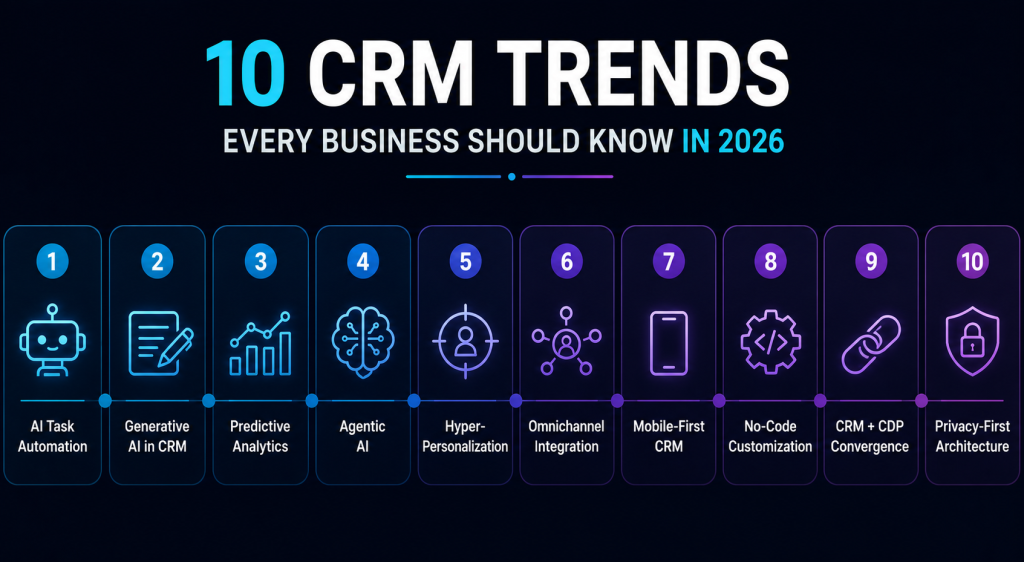
Each trend below explains how these technologies are changing modern customer relationship management.
Why CRM Matters for Small Businesses?
CRM helps small businesses manage customer relationships, automate daily tasks, improve sales, and deliver better customer experiences as they grow.
While researching the latest CRM developments, I found that businesses adopting modern CRM capabilities are gaining a clear advantage through faster workflows, better personalization, and data-driven insights.
Why CRM trends matter:
- AI automates repetitive tasks and saves time.
- Predictive analytics helps anticipate customer needs.
- Personalized experiences improve engagement and retention.
- Modern CRMs unify customer data across multiple channels.
- Privacy and compliance features protect customer information.
The business impact is significant. CRM delivers an average ROI of $8.71 for every $1 spent, while businesses report up to a 29% increase in sales when using CRM effectively.
As CRM adoption continues to grow, staying current with these trends can help businesses maximize their investment instead of using CRM as only a contact database.
Key CRM Trends for 2026 for Higher Success Rate
CRM tools have evolved into a smarter, more powerful supporter for small businesses in 2026. Here’s what’s coming:
How Are AI and Machine Learning Integrated?
Artificial intelligence (AI) is the biggest force shaping CRM in 2026. Modern CRM platforms no longer just store customer information; they automate workflows, generate content, predict customer behavior, and help businesses make faster decisions.
While researching the latest CRM platforms, I found that AI is becoming the foundation of customer relationship management rather than just another feature. Businesses are increasingly using AI to improve productivity, personalize customer interactions, and reduce manual work.
According to recent industry reports:
- 83% of companies use AI for automation and personalization.
- 51% of businesses consider Generative AI the most important CRM trend.
- Organizations using Generative AI are 83% more likely to exceed their sales goals and 34% more likely to deliver exceptional customer service.
The biggest AI CRM trends include 4 stages of AI-powered automation, Generative AI, Predictive Analytics, and Agentic AI.
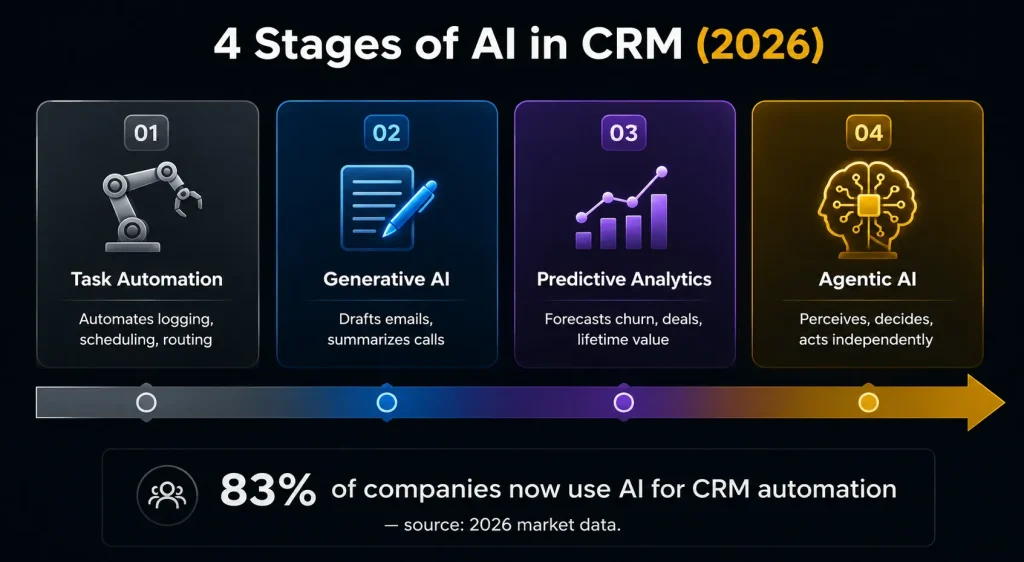
1: AI-Powered Task Automation in CRM
AI-powered task automation reduces repetitive administrative work, allowing sales and support teams to spend more time building customer relationships.
While reviewing modern CRM platforms, I found that manual data entry remains one of the biggest challenges for CRM adoption. AI helps solve this by automatically recording customer interactions and keeping data accurate.
Today, AI can automatically:
- Update customer records
- Log emails, meetings, and phone calls
- Schedule follow-up tasks
- Route leads to the right sales representative
- Send reminders
- Identify stalled opportunities
Instead of spending hours updating CRM records, teams can focus on selling and supporting customers, improving both productivity and sales velocity.
2: Generative AI Inside CRM Platforms
Generative AI enables CRM platforms to create content, summarize conversations, and recommend next steps directly within existing workflows.
As I explored this trend, I noticed that businesses no longer need separate AI writing tools for many daily tasks because these capabilities are now built into modern CRM platforms.
Generative AI can help businesses:
- Draft personalized emails
- Summarize meetings and call transcripts
- Generate campaign briefs
- Recommend the next action for a deal
- Analyze customer sentiment
Leading CRM platforms, including HubSpot Breeze AI, Salesforce Einstein AI, Salesforce Agentforce, and GoHighLevel AI Employee, already integrate these capabilities into their workflows.
There is also an important distinction:
| AI Type | Purpose |
|---|---|
| Assistive AI | Creates drafts, summaries, and recommendations that employees review before using. |
| Autonomous AI | Automatically performs tasks such as qualifying leads, launching outreach campaigns, and routing customers based on predefined conditions. |
Understanding this difference helps businesses choose the right level of automation without sacrificing customer experience.
3: Predictive Analytics and Sales Forecasting
Predictive analytics uses AI and historical customer data to forecast future outcomes before they happen.
While researching CRM trends, I found that predictive analytics is no longer limited to enterprise software. Many mid-market CRM platforms now include AI-powered forecasting as part of their standard feature set.
It helps businesses:
- Identify high-converting leads
- Predict customer churn
- Forecast sales revenue
- Estimate customer lifetime value
- Recommend personalized engagement strategies
Rather than reacting after a customer leaves or a deal is lost, businesses can identify risks earlier and make proactive decisions that improve retention and revenue.
4: Agentic AI — CRM as a Decision-Maker
Agentic AI allows CRM systems to analyze customer data, make decisions, and complete tasks with minimal human involvement.
Unlike Generative AI, which focuses on creating content, Agentic AI can independently execute workflows based on customer behavior and business rules.
While reviewing this trend, I found it represents one of the biggest changes in CRM because AI is evolving from an assistant into an active participant in daily operations.
Agentic AI can automatically:
- Prioritize sales leads
- Update CRM records
- Trigger follow-up sequences
- Schedule meetings
- Route customer inquiries
- Flag churn risks
Platforms such as Salesforce Agentforce, Zoho Zia Agent Studio, and Freshworks Freddy AI Agent Studio are leading this shift by allowing businesses to build AI agents with little or no coding.
As AI agents become more capable, CRM systems are evolving from passive databases into intelligent platforms that actively support sales, marketing, and customer service.
Latest CRM Trends Changing How Businesses Operate
Modern CRM trends are changing how businesses manage customers, automate workflows, and make decisions.
While researching CRM platforms, I found that the biggest changes beyond AI focus on personalization, unified customer data, mobile accessibility, flexible customization, and smarter data management.
1: Hyper-Personalization at Scale
Hyper-personalization uses customer data to deliver relevant experiences based on individual behavior, preferences, and purchase history. In 2026, customers expect personalized interactions across every touchpoint rather than generic marketing messages.
I found that modern CRM platforms use AI and real-time customer data to personalize experiences at scale without manually creating audience segments.
Businesses use hyper-personalization to:
- Recommend products based on browsing and purchase history
- Send personalized emails and offers
- Tailor sales follow-ups using previous conversations
- Deliver customer-specific promotions and loyalty rewards
2: Omnichannel CRM Integration
Omnichannel CRM brings customer interactions from multiple channels into one unified profile.
This helps businesses deliver a consistent experience across email, phone, live chat, social media, and messaging apps.
While reviewing this trend, I noticed that customers expect businesses to remember previous conversations regardless of the communication channel.
Key benefits include:
- Unified customer history across every channel
- Consistent customer support and sales conversations
- Better collaboration between teams
- Higher customer retention and engagement
Leading CRM platforms, including HubSpot, now integrate channels such as WhatsApp, Instagram, SMS, Slack, email, and live chat into a single customer record.
3: Mobile-First CRM Adoption
Mobile-first CRM allows sales and support teams to access customer information and manage workflows from anywhere. This trend supports remote work, field sales, and faster customer response times.
While testing mobile CRM features, I found that the best platforms provide nearly the same functionality as their desktop versions.
Important mobile CRM features include:
- Offline data access and syncing
- Voice-to-text note capture
- Push notifications
- Mobile dashboards
- Real-time customer updates
While mobile CRMs and traditional CRMs show how mobile-first accessibility allows sales and support teams to manage workflows from anywhere.
4: Low-Code and No-Code CRM Customization
Low-code and no-code CRM platforms allow businesses to customize workflows without programming knowledge.
Teams can automate processes and adapt CRM workflows without depending on developers. Platforms like Monday CRM software allow teams to automate processes and adapt workflows without depending on developers.
I found this especially useful for growing businesses that need to update sales, marketing, or customer service processes quickly.
Businesses can:
- Build custom workflows
- Automate approvals and follow-ups
- Create custom sales pipelines
- Launch marketing automations faster
This flexibility helps organizations improve CRM adoption while reducing development time.
5: CRM and CDP Convergence
CRM and Customer Data Platforms (CDPs) are becoming increasingly connected to create a unified customer view.
Instead of storing only contact information, modern CRM platforms combine relationship history with behavioral data from websites, apps, and marketing campaigns.
While researching this trend, I found that businesses benefit from a more complete understanding of customer behavior without switching between multiple tools.
A unified customer profile can include:
- Contact and purchase history
- Website and app activity
- Marketing engagement
- Sales interactions
- Customer support history
This convergence helps businesses make more informed decisions, deliver personalized experiences, and improve customer engagement from a single platform.
CRM Trends for Customer Support Teams
Modern CRM platforms are helping customer support teams resolve issues faster through AI, automation, and unified customer data. While reviewing the latest CRM trends, I found that businesses are using AI not only to improve response times but also to deliver more personalized support.
1: AI Chatbots and Self-Service CRM
AI-powered chatbots and self-service tools handle routine customer requests without human intervention. Modern CRM platforms go beyond answering FAQs by accessing customer records, order history, and account details during conversations.
Key benefits include:
- Answering common customer questions
- Checking order status and account information
- Processing returns and basic requests
- Reducing support workload and response times
2: Unified Support History Across All Channels
Unified customer history gives support agents a complete view of every interaction across email, chat, phone, and social media.
I found this especially valuable because customers no longer need to repeat the same issue when switching channels.
It helps teams:
- Access previous conversations instantly
- Maintain consistent customer support
- Resolve issues faster
- Improve collaboration across support teams
3: Emotion-Aware CRM Interactions
Emotion-aware CRM uses AI to detect customer sentiment during support interactions. It can identify frustration, urgency, or satisfaction and help teams respond before issues escalate.
Modern CRM platforms can:
- Analyze customer sentiment in real time
- Alert supervisors during difficult conversations
- Identify customers at risk of churning
- Improve long-term customer retention
Platforms like Salesforce Agentforce already use AI to summarize conversations and identify customer sentiment.
4: Automated Ticket Routing and Resolution
AI-powered ticket routing automatically assigns customer requests to the most appropriate support agent. Instead of relying on manual assignment, CRM systems categorize requests, prioritize urgency, and provide agents with relevant customer context.
This helps businesses:
- Route tickets faster
- Prioritize urgent requests
- Improve first-contact resolution
- Reduce support backlogs
- Speed up issue resolution
Which Trends Will Define Future CRM Platforms?
The next generation of CRM platforms will focus on voice interaction, privacy, modular architecture, and trusted customer data.
While researching emerging CRM technologies, I found these trends are shaping how businesses will build and scale their CRM systems over the next few years.
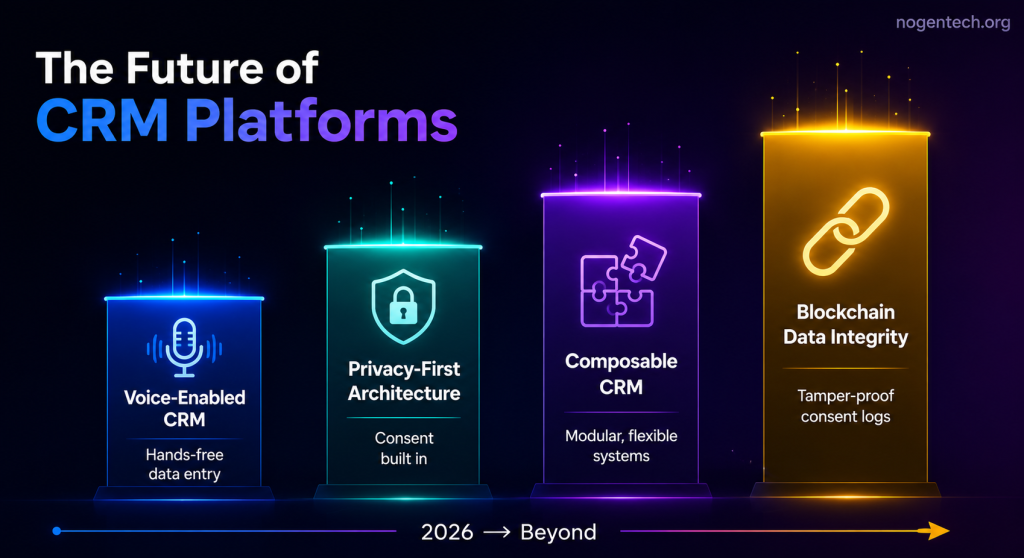
1: Voice-Enabled and Conversational CRM
Voice-enabled CRM lets users update records, retrieve customer information, and manage tasks using voice commands instead of manual data entry. This is especially valuable for field sales teams and mobile professionals who need hands-free access to CRM.
Key benefits include:
- Log calls and meeting notes with voice commands
- Update deals without typing
- Retrieve customer information instantly
- Improve CRM adoption by reducing manual work
Platforms like Zoho CRM already offer voice assistant capabilities, with more advanced conversational CRM features expected in future releases.
2: Privacy-First CRM Architecture
Privacy-first CRM puts data security, customer consent, and regulatory compliance at the center of CRM strategy. As privacy regulations continue to evolve, businesses need CRM platforms that protect customer data and simplify compliance.
Modern privacy-first CRMs help businesses:
- Manage customer consent
- Comply with regulations such as GDPR and CCPA
- Secure customer data with stronger access controls
- Support data access and deletion requests
I found that privacy is no longer just a compliance requirement—it’s becoming an important factor in building customer trust.
3: Composable and Modular CRM Platforms
Composable CRM allows businesses to build customized CRM ecosystems by connecting specialized applications instead of relying on one all-in-one platform.
This approach offers:
- Flexible CRM customization
- Easier integration through APIs
- Scalable business workflows
- Better control over software costs
While composable CRM offers greater flexibility, I found that all-in-one platforms remain the better choice for many small businesses because they are easier to implement and manage. Choosing the wrong setup is a primary reason businesses overpay for CRM software.
4: Blockchain for CRM Data Integrity
Blockchain can strengthen CRM data integrity by creating secure and tamper-resistant records of customer information and consent. Although adoption is still limited, it has the potential to improve transparency and regulatory compliance.
Potential use cases include:
- Consent management
- Secure audit trails
- Data verification
- Regulatory compliance
For now, I see blockchain as an emerging CRM trend worth monitoring rather than a technology most businesses need to implement today.
People Also Want More to Know About CRM Trends
What are the latest trends in crm software?
The latest CRM technologies include agentic AI, predictive analytics, conversational AI, low-code automation, unified customer data, and voice-enabled CRM.
What is the current trend and challenge of CRM?
The biggest CRM trend is AI-driven automation, while the main challenge is maintaining accurate customer data and integrating multiple systems without increasing complexity.
What are task trends in CRM?
Routine tasks such as lead assignment, follow-ups, data entry, ticket routing, and customer communication are increasingly being automated with AI.
What trends are shaping the future of Pharma CRM?
The future of Pharma CRM is being shaped by AI-powered insights, predictive analytics, omnichannel engagement, personalized healthcare communication, and stricter data privacy and regulatory compliance.
What trends stand out in sales CRM today?
The biggest sales CRM trends include AI-assisted selling, predictive lead scoring, sales forecasting, automated follow-ups, and revenue intelligence.
How to Stay Updated on CRM Trends?
Keeping up with CRM trends is easier when you rely on trusted sources instead of following every new update. While researching this article, I found these resources to be the most reliable for tracking CRM developments.
- Follow vendor blogs: Read updates from HubSpot, Salesforce, Zoho, Microsoft, and Pipedrive to learn about new features and product improvements.
- Review analyst reports: Annual reports from Gartner and Forrester provide valuable insights into CRM market trends and platform comparisons.
- Track user reviews: Platforms like G2 and Capterra highlight feature trends and real user feedback.
- Set Google Alerts: Monitor keywords such as “CRM trends,” “AI CRM,” or your preferred CRM platform to receive the latest updates.
- Join professional communities: Follow CRM experts and LinkedIn communities for practical implementation tips and industry discussions.
- Subscribe to industry newsletters: Publications like CRM Magazine, Destination CRM, and GTMnow regularly cover emerging CRM trends.