
Buying the Dip in Crypto: What the Strategy Demands
Buying the dip in crypto requires more than purchasing at a lower price. Your investment timeframe, risk tolerance, and buying strategy determine how you approach market declines.


Buying cryptocurrency after a price drop sounds like a good opportunity. You purchase at a lower price and hope to profit when the market recovers. But how do you know whether a decline is a temporary dip or the beginning of a much larger fall?
Crypto prices change due to supply and demand, competition, production costs for some cryptocurrencies, and market sentiment. Understanding these factors helps, but it doesn’t tell you exactly when to buy or whether prices will recover.
So, is buying the dip in crypto worth considering? The strategy depends on your investment timeframe, risk tolerance, and decisions after entering a trade. Here’s what you need to know before buying.
What Makes Buying the Dip in Crypto Appealing?
Buying the dip means purchasing cryptocurrency after its price falls, expecting it to recover and potentially increase in value.
The idea comes from traditional investing, where temporary market declines can create opportunities to build long-term holdings at lower prices. In crypto, sudden pullbacks during rising markets can make this approach attractive.
However, a lower price doesn’t guarantee a recovery. You still need to decide whether the decline fits your investment goals and how much risk you’re prepared to take.
The buying process matters too. If you plan to buy Bitcoin through Binance, check the available payment methods before funding your account. Card payments may be supported in some regions, but convenience alone shouldn’t determine your investment decision.
How Does Your Timeframe Change What Counts as a Dip?
A price decline can mean different things depending on how long you plan to hold your cryptocurrency.
Charles Dow compared market movements to waves and tides. Short-term price fluctuations resemble individual waves, while the broader trend represents the tide. A small decline within an upward trend is different from a fall during a prolonged downturn.
For example, a Binance BTC/USDT chart captured on November 5, 2026, shows:
- Bitcoin Price: $80,410.45
- 24-Hour High: $81,196.01
- 24-Hour Low: $78,001.77
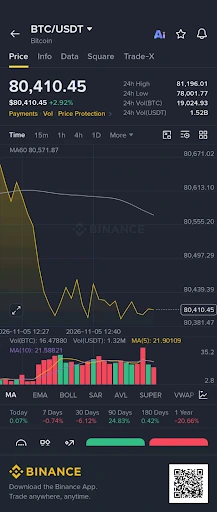
These price movements don’t establish whether Bitcoin will recover or continue falling. A day trader and a long-term investor may interpret the same chart differently.
Short-Term Trading
A day trader might look for a 1–2% pullback on a five-minute or fifteen-minute chart, aiming to profit from a quick recovery before closing the position.
This approach involves:
- Short holding periods: Positions may remain open for minutes or hours.
- Careful timing: Prices can move against a trade quickly.
- Leverage risk: Borrowed exposure magnifies both gains and losses. An adverse movement can trigger liquidation and result in the loss of the margin committed to a position.
Long-Term Investing
Someone planning to hold cryptocurrency for years may consider a 30–50% decline a potential buying opportunity rather than focusing on smaller daily movements.
However, no fixed percentage defines a good dip, and even a substantial decline doesn’t guarantee recovery.
Another approach is dollar-cost averaging (DCA), where you invest the same amount at regular intervals regardless of price.
DCA allows you to:
- Buy through both rising and falling markets.
- Reduce the need to predict the lowest price.
- Build a holding through regular purchases.
You can also make additional purchases during a decline, but those involve separate market-timing decisions. DCA doesn’t prevent losses if prices continue falling.
Why Can Waiting for a Bargain Disappoint?
Waiting for a dip doesn’t always lead to a better purchase price.
- Prices may keep rising: A cryptocurrency could increase substantially before the expected decline arrives.
- The dip may be difficult to identify: Small declines can resemble ordinary market fluctuations.
- Recoveries can happen quickly: By the time you feel confident buying, the price may already have moved higher.
This is why buying the dip isn’t automatically better than other investment approaches. The outcome depends on the asset, market conditions, and timing.
Not Every Falling Cryptocurrency Is a Bargain
Some cryptocurrencies have few clear measures of value, making it difficult to determine whether a lower price represents a genuine opportunity.
Market sentiment can also influence price movements:
- During price increases: Social media attention can encourage more buying as investors fear missing out.
- During price declines: Buyers may lose interest, reducing trading activity and liquidity.
- During high volatility: Thin trading can make price swings more unpredictable.
A cryptocurrency that performed poorly yesterday isn’t necessarily undervalued, just as one that recently gained value isn’t guaranteed to keep rising.
Emotional Decisions Can Make Losses Worse
Buying the dip also tests how you respond when prices move against your expectations.
Two common mistakes are:
- Selling winners too early: Fear can lead to selling during a recovery and missing further gains, including the exceptional tenfold or hundredfold returns occasionally seen in crypto.
- Holding losers too long: Waiting indefinitely for a rebound can increase losses when the reasons for buying are no longer valid.
Recognizing when a trade isn’t working is just as important as identifying a buying opportunity.
How Can You Give the Strategy Room to Work?
Buying the dip doesn’t require predicting the exact market bottom. It requires a plan you can follow when prices remain uncertain.
Before entering a trade, consider:
- Investment timeframe: Decide whether you’re trading for a short-term recovery or holding for years.
- Buying in stages: Spread purchases across different price levels instead of relying on one entry point.
- Risk tolerance: Decide how much you’re prepared to lose if prices continue falling.
- Exit conditions: Know what would make you reconsider or close your position.
- Emotional discipline: Avoid reacting to every price movement.
A temporary recovery can be followed by another decline, and some cryptocurrencies may take months or years to regain their previous value, if they recover at all.
Is Buying the Dip in Crypto Worth It?
Buying the dip can offer opportunities to purchase cryptocurrency at lower prices, but it doesn’t guarantee profitable returns. A decline may be temporary or signal a longer downturn.
Your investment timeframe, risk tolerance, and ability to manage uncertainty matter more than finding the perfect entry price.
Buying in stages and following a clear plan can reduce reliance on market timing. The goal is to make decisions you can manage even when prices don’t recover as expected.