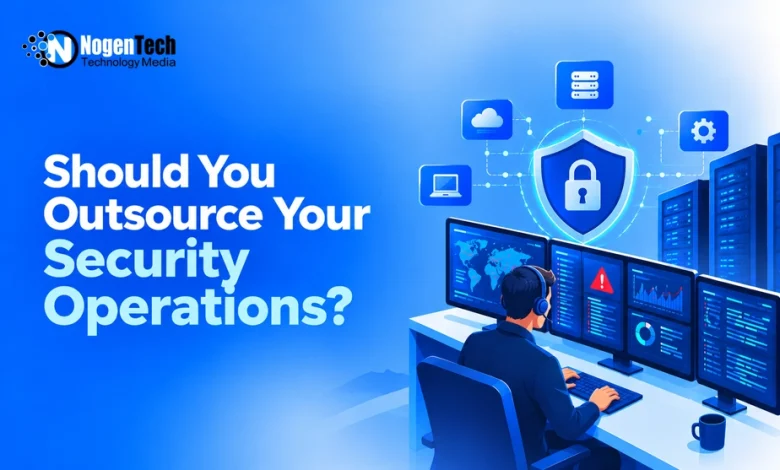
Every business now runs on systems that generate security alerts around the clock. Very few have anyone awake to read them.
That mismatch is the entire reason managed SOC services exist. Rather than building a security operations center yourself, you rent one, and someone else takes the overnight shift.
Whether that is the right call depends on your size, your data and what you are already spending. Here is a practical way to work through the decision.
What a Managed SOC Service Actually Covers
A security operations center is the function that watches your environment and acts when something is wrong. A managed SOC delivers that same function through an outside provider on a subscription.
Four jobs sit at the center of it:
● Continuous monitoring. Telemetry from endpoints, servers, cloud applications and identity systems flows into one place and gets watched constantly.
● Threat detection. Analysts and automated tooling work together to separate real attacks from ordinary noise.
● Incident response. Confirmed threats are contained, and affected systems are cleaned up and restored.
● Vulnerability management. Known weaknesses are surfaced and tracked before somebody exploits them.
Speed matters more here than most teams expect. Effective cyber crisis management turns one compromised laptop into a minor inconvenience, while the same infection left running over a weekend can reach your backups.
What you are really buying is attention. Your software already tells you when something looks unusual. The managed SOC is the part that decides whether it matters and then does something about it.
The Benefits Businesses Actually Notice
Coverage when nobody is at their desk. A suspicious login at 1am on a public holiday gets investigated within minutes rather than on Tuesday. The FBI and CISA have warned that ransomware crews time attacks for holidays and weekends precisely because offices are normally closed.
Faster containment. Detection and response happen in the same workflow, so nothing waits for a handover. That removes the delay that turns a contained incident into a reportable breach.
Tooling you would struggle to justify alone. Providers spread the cost of detection platforms, threat intelligence feeds and behavioral analytics across their whole client base. You get the benefit without the licensing bill or the tuning work.
Predictable spending. A subscription replaces a shifting mix of salaries, training, software renewals and recruitment costs. Budgeting becomes a single line rather than an annual negotiation.
Evidence you can hand over. Auditors, regulators and insurers increasingly want proof of continuous monitoring and documented incident handling. A decent provider produces that as a routine output rather than a scramble.
How a Managed SOC Engagement Works
Most providers follow roughly the same four phases, and knowing them makes vendor conversations far easier to steer.
Onboarding and assessment. The provider maps your environment, identifies your critical systems and deploys sensors across endpoints, servers and cloud services. Tuning follows, because an untuned service buries you in false positives in week one.
Monitoring and detection. Telemetry is collected continuously and correlated against known attacker behavior, threat intelligence and anomalies in your own baseline.
Investigation and response. This is where providers differ most. Stronger services publish a target mean time to respond and act on your behalf rather than simply raising a ticket and waiting.
ESET can be a useful illustration of how that gets packaged. Its managed detection and response is split into a tier built for small and mid-sized businesses and an enterprise tier that adds digital forensics assistance and a dedicated incident response lead. The service publishes a six-minute mean time to respond, which the company says it measures from the moment an incident is first detected to the moment someone acts on it.
Reporting and review. Regular reports cover what was detected, what was done and where your environment remains weak. The review cycle is the part most buyers underuse, and it is where the service earns its keep over time.
Is a Managed SOC Right for Your Business?
Work through three honest audits before you talk to anyone.
Audit what you have. List every device, user, cloud service and third-party connection touching your data. Then mark which systems would genuinely hurt if they went down or leaked.
Audit what you are missing. Look at your existing tools, policies and response procedures, then ask what actually happens between 6pm and 8am. If the answer is that alerts queue up until morning, you have found your gap.
Audit the real cost of doing it yourself. True 24/7 coverage takes several analysts, not one hire. Add tooling, training, on-call arrangements and the cost of replacing people who leave, then compare that against provider quotes.
A managed SOC tends to make obvious sense for growing companies whose security needs have outpaced their IT team, for organizations in regulated sectors and for anyone whose insurer is now asking detailed questions about detection and response.
It makes less sense for very small operations holding little sensitive data, where managed endpoint protection may cover the realistic risk. It also fits differently at large enterprises, which often want a co-managed arrangement to extend an existing team rather than replace it.
What It Costs and How Providers Price It
There is no standard price, and any quote issued before someone has scoped your environment is guesswork.
Charging by device or by seat is the norm, since both scale cleanly as your headcount shifts. Packaged tiers are common too, with the lower ones covering working hours and the upper ones extending to full overnight response and forensic help.
Scope is what moves the number. How many devices and people you have, how much log data lands each day, the response times you lock in, any regulatory standards the provider has to support and how far their incident help extends will all pull the quote up or down.
Set that against what you are trying to avoid. In its 2026 Cost of a Data Breach report, IBM puts the worldwide average cost of a breach at USD 4.99 million and records a 56 percent rise in attacks driven by AI.
Settle These Before You Sign
- Will the provider act, or only alert? Get containment authority written into the contract, not implied in a sales call.
- What is the contracted response time, and what happens if it is missed? A published average is marketing. A contractual commitment is not.
- What is in scope? Endpoints alone leave gaps. Cloud identity, email and SaaS applications belong in the coverage too.
- Who is your named contact during an incident? Reaching a shared queue mid-breach is a bad discovery to make in real time.
- What happens if you leave? Clarify data retention, log export and offboarding at the start rather than at renewal.
Making the Call
A managed SOC is not software you install. It is coverage you subscribe to, and its value sits almost entirely in the hours your own team is offline.
Run the three audits first. If they show real data at risk, obligations you must evidence and no realistic path to staffing round-the-clock coverage yourself, outsourcing is likely the cheaper and faster route. If they show a small, simple environment, spend the money on fundamentals instead.
Frequently Asked Questions
What is a managed SOC service?
It is a security operations function you buy in rather than build. An external team watches your systems continuously, digs into anything suspicious and steps in when a real threat is confirmed.
What is the difference between a managed SOC and an MSSP?
An MSSP generally manages your security devices, such as firewalls and patching. A managed SOC focuses on detecting, investigating and responding to active threats across your environment.
How much does a managed SOC cost?
Most providers charge by device or by seat on a monthly or yearly agreement. Where you land depends on how many systems you run, how much log data you generate, the response times you contract for and how much hands-on incident help is bundled in.
How long does it take to get up and running?
Timelines vary with environment size, but expect an assessment phase, sensor deployment and a tuning period before detection settles into a steady state.
Does a managed SOC replace an internal IT team?
No. Your team keeps running infrastructure and projects while the provider absorbs the alert queue, and they gain specialist backup on the days something serious lands.
Can a small business use a managed SOC service?
Yes, and many providers now offer tiers built for smaller environments. Whether it is worth it depends on how much sensitive data you hold and what downtime would cost you.