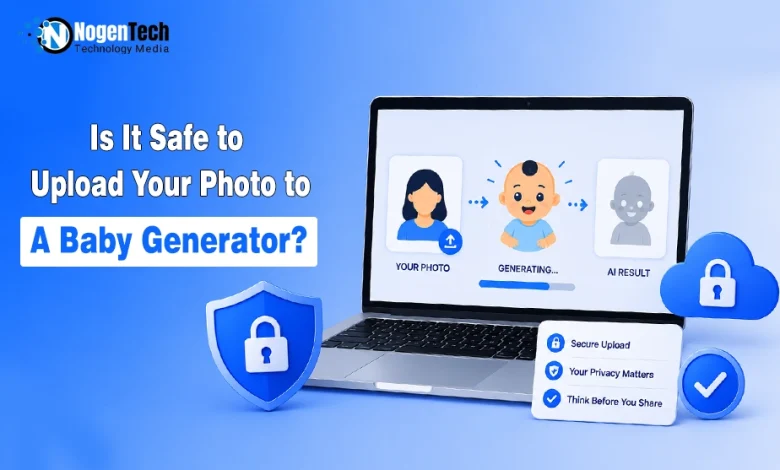
It often starts as harmless fun: someone uploads two photos to an AI baby generator to see what a future child might look like. The real question comes afterward: what happens to those photos?
The answer depends on how the service handles your data. While some AI baby face generators securely process and delete uploads, others may:
- Store your photos on their servers
- Use them for AI model training
- Share them with third parties
Because your face is biometric data, choosing the right tool matters. Here you will explore:
- How to identify a trustworthy service before you upload
- How AI baby generators process your photos
- The privacy risks to watch for
- Why storage and deletion policies matter
What Actually Happens to a Photo You Upload?
When you upload a face to a baby generator, the service sends it to an AI model that reads facial features and produces a predicted image. That part is the same everywhere. What differs, and what decides your privacy, is what the service does with your photo once the result is made.
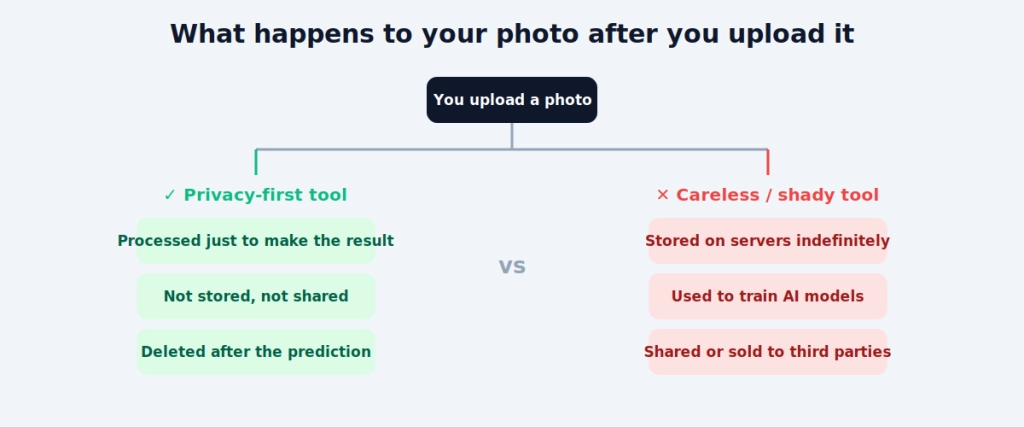
There are two paths. A privacy-first tool treats your upload as disposable: it generates the prediction, then removes the original.
A careless or shady tool treats your upload as an asset; it may keep the file on its servers, feed it into model training, or share it with advertising and analytics partners. Same baby photo on the screen, very different outcome for your face.
What Are The Real Privacy Risks?
A face is not just a picture. It is biometric data that can be linked to your identity, which is why a casual upload deserves more thought than it usually gets. The concerns below are the ones worth weighing before you hand over an image.
| Concern | Why it matters |
| Biometric data | A face can identify you; it is harder to “reset” than a password |
| Indefinite storage | The longer a photo sits on a server, the more it can leak or be misused |
| Training on your face | Your image may end up shaping a model you never agreed to |
| Third-party sharing | Photos passed to ad or data partners escape your control |
| Someone else’s likeness | Uploading a partner’s or child’s face raises consent questions |
None of this means baby generators are inherently unsafe. It means the safe ones are specific about what they do, and the risky ones stay vague. Vagueness is the signal to walk away.
How Can You Tell if a Baby Generator is Safe?
You do not need to read a full legal document to judge a tool. A few concrete checks tell you most of what you need, and any service worth trusting will answer them plainly.
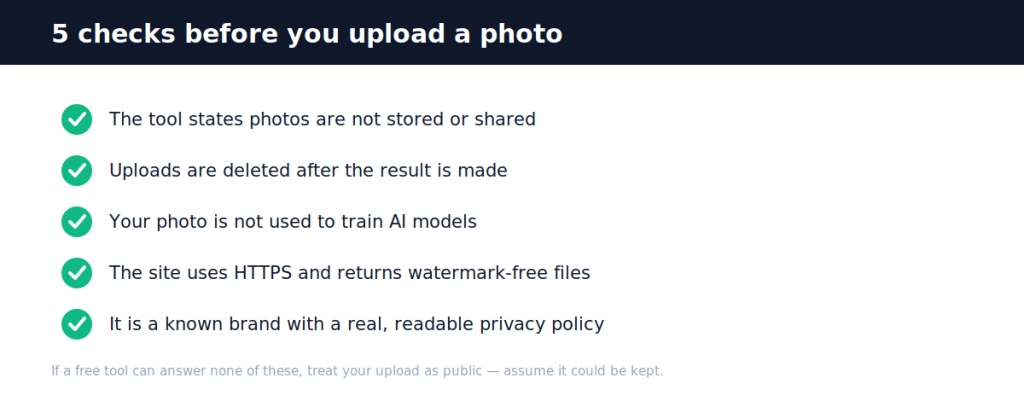
Run through the five points above before you upload. If a free tool cannot answer a single one no mention of deletion, no privacy policy, no company behind it treat your photo as if it will be kept, because it might be. The table further down turns these checks into green and red flags you can spot quickly.
Is Overchat's Baby Generator a Safe Option?
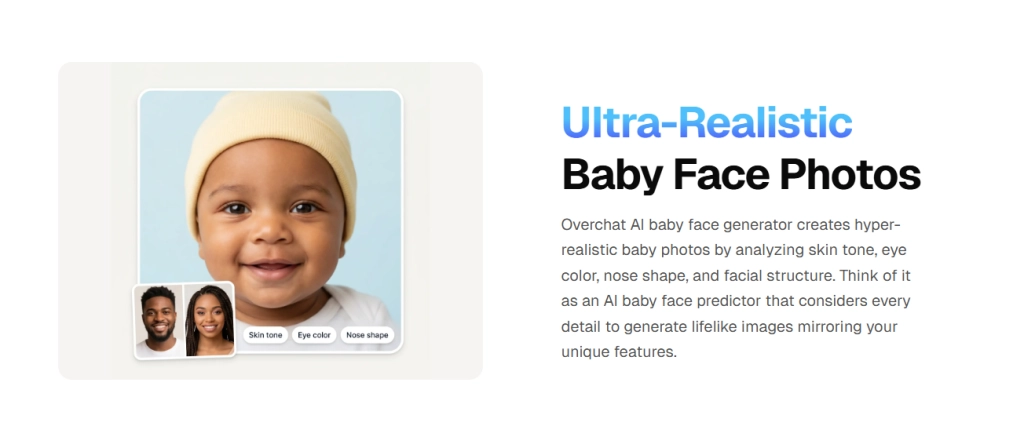
Among mainstream tools, Overchat is one that states its data practices directly on the page rather than burying them. That transparency is the first thing to look for, because a tool that is willing to describe what happens to your photo is easier to trust than one that stays silent.
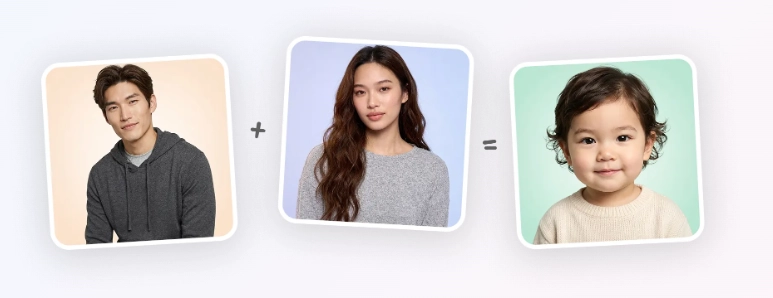
The generator takes a mother and father photo plus a style choice. If you want a tool that spells this out, Overchat’s baby face generator states that uploaded photos are processed securely, are not stored or shared with third parties, and are automatically deleted after the prediction is made.
It takes a photo of each parent, produces a result in about two seconds, and returns it without watermarks. As with any service, it is still worth reading the privacy terms yourself, but a clear on-page statement is exactly the kind of signal the checklist above is looking for.
There is useful context here too. The baby generator is one of more than 150 purpose-built tools inside Overchat AI, an all-in-one app spanning image, video, audio and text, built on models from OpenAI’s GPT, Anthropic’s Claude, Google’s Gemini, xAI’s Grok and others, and available on web, iOS and Android with over 350,000 users.
The practical point for privacy is that keeping this kind of task inside one established app rather than scattering your face across a dozen unknown free sites means fewer places your data can end up.
It also consolidates cost: whether there is a free plan that offers you 20 credits for free, it also has a paid plan at $59.99 a month that covers unlimited AI chat and access to advanced models like Claude, Nano Banana, and Gemini.
Green Flags vs Red Flags at a Glance
When you are comparing tools, the difference between a safe and a risky one usually shows up in the same handful of places. Use this as a quick scan.
| Signal | Green flag (safer) | Red flag (riskier) |
| Storage | “Photos are not stored” | No mention of storage at all |
| Deletion | Deleted after processing | Kept indefinitely or unclear |
| Training | Not used to train models | Silent, or broad reuse rights |
| Policy | Clear, readable privacy page | No policy or a dead link |
| Delivery | HTTPS, watermark-free files | Insecure site, odd redirects |
If a tool lands on the right-hand column for most rows, the smart move is to close the tab. The prediction is not worth handing your face to a service that will not say what it does with it.
Are Free Baby Generators Riskier Than Paid Ones?
Free is not automatically unsafe, but “free” tools have to make money somehow, and sometimes the product is your data. A no-cost site with no company name, no privacy policy, and no mention of deletion has little reason to protect an upload it can quietly keep. That is the profile to avoid.
A paid or established app is not virtuous by default either; plenty of paid tools have weak terms. What tilts the odds is accountability: a named company with a reputation and a published policy has more to lose by mishandling your face than an anonymous page does. Judge the terms, not the price tag, but treat a free tool that answers none of the checklist as the higher risk.
What Should You Do After You Get Your Result?
Your privacy habits do not end when the image appears. If you do not plan to keep the result, delete it from your device and downloads, and clear it from the tool’s history if the app stores one.
Think before resharing, too: posting a predicted “future baby” is harmless, but reposting a real photo of a partner or child you uploaded is a separate consent question. Treat the faces you put into any tool, including your own, as data you would not want floating around indefinitely.
Frequently Asked Questions
Do baby generators keep your photos?
Some do, some do not. Privacy-first tools process your image and then delete it, and say so on the page. Others keep uploads on their servers or reuse them. Always check for a clear statement about storage and deletion before you upload.
Can a baby generator use my face to train its AI?
It can, if its terms allow it. Some services reserve broad rights to reuse uploaded content, which can include model training. Look for an explicit line saying your photos are not used for training, or choose a tool that deletes them after the result.
Is it legal to upload someone else’s photo?
Uploading another adult’s face without their consent, or a child’s, raises real privacy and consent issues, and some regions regulate biometric data closely. As a rule, only upload photos of people who have agreed to it.
What is the safest way to try a baby generator?
Use a known app that states it does not store or share your photos and deletes them after processing, upload over a secure connection, and avoid random free sites with no company or policy behind them. Remove the result from your device if you do not plan to keep it.
Closing Thoughts on AI Baby Generators
AI baby generators are only as safe as the company behind them. The image itself is harmless; the real concern is how your photos are stored, shared, or reused after processing.
In my view, transparency should be the deciding factor. If a service clearly explains its storage, deletion, and AI training policies, it has already earned more trust than one that stays silent.
Before uploading your face or someone else’s, spend a minute checking the privacy terms. A cute prediction is never worth risking your biometric data with a tool that won’t tell you what happens next.