
Macron Urges Europe to Ban Social Media Access for Under 15s
French President Emmanuel Macron urged the children's social media ban after France’s Constitutional Council rejected a similar national law.

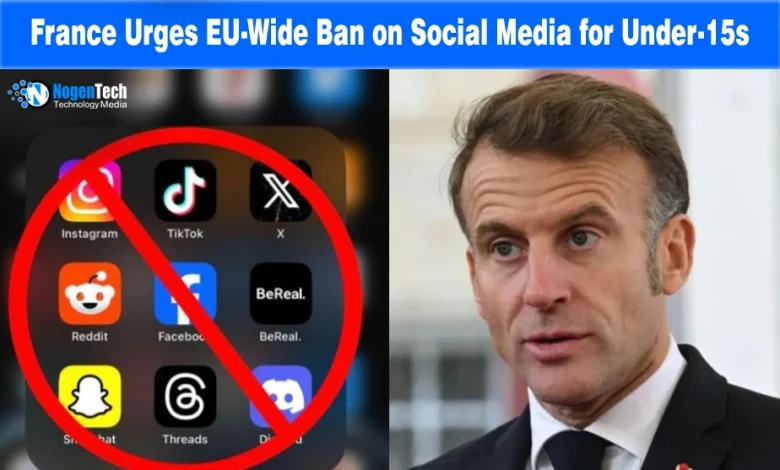
Emmanuel Macron has formally asked the European Commission to adopt an EU-wide ban on social media for children under 15, according to an August 29 letter to Commission President Ursula von der Leyen seen by Reuters and other media.
The appeal follows earlier lawmaker approval, which ended when France’s Constitutional Council rejected the national law just before it was due to take effect in September.
Rather than abandon the effort, Macron is now asking Brussels to succeed where Paris couldn’t, arguing that protecting children cannot wait for individual countries to act alone.
Macron’s Case for Going Over France’s Own Courts
In his letter, Macron wrote that it has become essential to “harmonise a ban on access to social media platforms for children under the age of 15, ” focusing on child protection across the bloc.
He cited Australia’s under-16 social media ban, which took effect in December 2025, as proof that a hard age cutoff is both legally workable and politically achievable elsewhere.
Macron’s argument aligns with a broader global momentum, following the UK social media ban for under-16 users and similar international efforts aimed at protecting young teenagers online.
Notably, Firstpost’s coverage of the letter highlights that Macron also plans to revise France’s rejected law, though political fragmentation in the French parliament and ongoing budget negotiations could complicate any second attempt.
Macron Wants a Harder Line Than Brussels Has Proposed
The timing of Macron’s letter puts him at odds with the European Commission’s own developing position.
In July, von der Leyen backed a tiered approach where children under 13 would have limited, supervised access, with restrictions easing as they get older.
Macron’s letter calls for a stricter full ban until age 15, a two-year gap that reflects a different view of how much online independence young teenagers should have.
That gap matters because Macron’s letter lands just weeks before von der Leyen’s State of the Union address to the European Parliament, where she could adopt Macron’s approach or defend the Commission’s gradual model.
This tension mirrors the ongoing debate in the United States, where the Sixth Circuit rules Ohio can force parental consent for teen social media use, showing that youth social media restrictions remain fiercely contested on both sides of the Atlantic.
Why Macron Is Betting on Brussels Now, Not Paris
What makes Macron’s letter more than routine lobbying is the political timing.
With his final year as French president ahead of the 2027 election, child online safety, on which global regulators are increasingly cautious, gives him an issue he can still champion after getting the same policy rejected at home.
Taking the fight to Brussels lets Macron maintain pressure on the issue while shifting the political burden to the slower EU legislative process.
The challenge is that he is asking 26 other governments to support the same age 15 cutoff that France’s own institutions rejected.
If Brussels adopts a tiered system instead of Macron’s blanket ban, his letter may be remembered less as the moment Europe acted and more as the starting point for a compromise Macron never wanted.
Source: Macron urges EU ban on social media for under-15s in letter to Von der Leyen




![Top Tech Stories of 6th week [2026]](https://www.nogentech.org/wp-content/uploads/2026/02/Top-Tech-Stories-of-6th-Week-2026-390x220.webp)