
How a Cyber Risk Platform Evaluates Third-Party Security Posture
A cyber risk platform evaluates third-party security posture by continuously monitoring vendor vulnerabilities, external exposures, threat activity, and business dependencies to identify changing risks, prioritize assessments, and guide remediation.

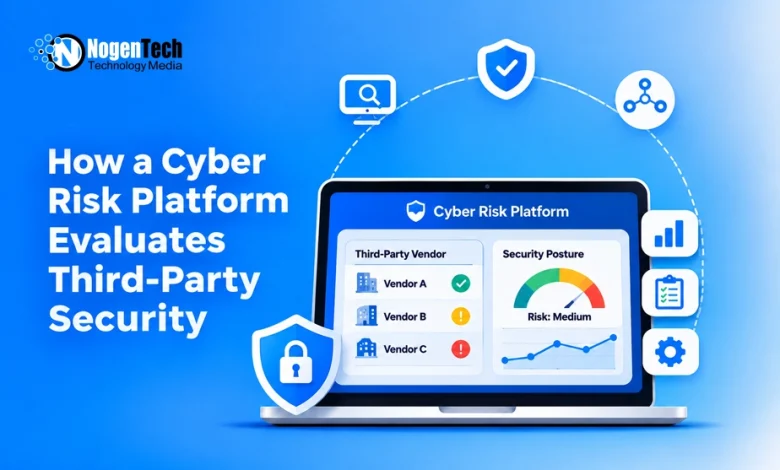
A third-party security posture changes as systems, exposures, vendors, and dependencies shift under changing conditions. Annual reviews cannot capture those shifts with enough precision for timely decisions across the year.
A cyber risk platform combines external signals, security controls, threat activity, and business context into a current view of vendor exposure.
That view helps security teams prioritize reviews, investigate changes, and assign remediation work promptly. The evaluation starts with several measurable inputs that reveal how risk changes between formal assessments.
What the Evaluation Measures
A cyber risk platform first gathers observable evidence about a vendor’s internet-facing environment and current security posture.
Inputs include exposed services, known vulnerabilities, configuration weaknesses, threat activity, and other indicators tied to external exposure. Continuous monitoring matters because a vendor’s posture can change soon after a planned annual assessment.
For security teams, Black Kite describes a third-party risk approach using continuous visibility instead of point-in-time reviews. Its page also describes transparent cyber ratings, deeper third-party intelligence, security questionnaire automation, and visibility across direct and downstream dependencies.
Those elements help teams evaluate whether a vendor’s current posture matches the risk assigned during onboarding.
How Evidence Becomes a Risk View
A cyber risk platform organizes raw observations into a security posture that teams can interpret and act upon.
A useful evaluation separates current exposure from historical findings, because unresolved issues and newly observed changes require different responses.
Threat exposure provides another layer of evidence beyond vulnerability counts. Active threats, threat actor targeting, ransomware susceptibility, and financial impact indicators can change how a team prioritizes a vendor. Ransomware Susceptibility Index predicts a vendor’s likelihood of being hit by ransomware before an attack occurs.
Context also matters when comparing vendors with similar technical findings. A data processor, technology provider, logistics partner, and managed service provider can create different business consequences. This is where risk-based security becomes important, as teams need to consider business impact before assigning review priorities.
How Continuous Monitoring Changes Assessments
Continuous monitoring turns vendor assessment into an ongoing process rather than a fixed annual event. A change in exposed infrastructure can trigger investigation before the next scheduled review, while stable evidence can reduce unnecessary assessment work.
This approach also helps teams focus questionnaires on identified gaps. Existing monitoring data establishes a baseline, while artificial intelligence can analyze vendor documentation and map controls to industry frameworks or custom questionnaires. Vendors then receive questions tied to observed gaps instead of broad requests that repeat known information.
The result is a clearer connection between external evidence and vendor engagement. Security teams can investigate the finding, request supporting information, assign remediation actions, and track the response through a defined workflow.
Why Dependencies Affect Security Posture
A vendor’s direct security posture does not show every path through which an organization can be exposed. Shared infrastructure, subcontractors, cloud dependencies, software providers, and third-party integrations can connect separate vendors to the same underlying risk.
Concentration risk is especially important when multiple vendors depend on one provider or regional infrastructure. A single disruption can affect several relationships at once, increasing operational and financial exposure across business units.
Nth-party relationships add another layer of uncertainty because direct vendors often rely on suppliers that the customer does not assess directly, making cybersecurity supply chain risk management an important part of understanding downstream exposure. A cyber risk platform can extend visibility into those dependency chains and reveal where one failure could propagate through multiple tiers.
What Teams Should Do With the Results
Risk evaluation is useful only when teams connect findings to decisions, ownership, and follow-up actions. Security teams can use current evidence to prioritize vendors and evaluate vendor security controls, while procurement can adjust review requirements based on measured exposure.
Executives also need explainable current risk drivers rather than unexplained scores. Transparent ratings show what changed, which evidence supports the rating, and what remediation action addresses the finding.
A practical workflow starts with a baseline assessment, monitors material changes, validates important findings, and engages vendors on documented gaps. Each review should leave a clear, dated record of the exposure, business impact, responsible owner, and next action.
Conclusion
A cyber risk platform evaluates third-party security posture by combining continuous external evidence with threat intelligence and business context. The strongest workflow connects those findings to vendor engagement, remediation, and dependency analysis.
Teams should review how their current program handles changing exposure between assessments, then identify where continuous monitoring would replace outdated checks. That next step creates a measurable path toward better prioritization, clearer accountability, and faster response when a vendor’s posture changes.