What happens when AI starts answering questions instead of search engines? This AI Search vs Google Search Study has the answers.
In my 15+ years of SEO experience, I’ve witnessed major shifts in search, but the rise of AI-powered search feels like the biggest transformation since Google became the dominant search engine.
Today, millions of users rely on Perplexity AI, ChatGPT Search, Google AI Overviews, Claude, and Microsoft Copilot to find answers and conduct research.
This shift raises a critical question: Will AI search replace Google Search? While Google still dominates web discovery, AI platforms are changing how people access information through direct answers.
This study examines user behavior, accuracy, energy consumption, costs, SEO impact, and future search trends in the United States.
What Is AI Search?
AI search is a system using large language models (LLMs) and retrieval augmented systems to answer questions directly instead of simply displaying webpages.
Popular AI search platforms include:
- OpenAI ChatGPT Search
- Perplexity AI Perplexity
- Microsoft Copilot
- Anthropic Claude
- Google Google AI Overviews
Instead of presenting ten blue links, AI search synthesizes information and delivers a direct response.
As an example, a traditional Google search for “best electric SUVs in America” may return review sites, dealership pages, and automotive publications.
An AI search engine can summarize the top options, compare prices, discuss pros and cons, and cite sources in a single response.
What Is Google Search?
Google Search is a web search engine that indexes billions of pages and ranks them according to relevance, authority, quality, and user intent.
Although Google now incorporates AI extensively, its core experience still revolves around:
- Crawling webpages
- Indexing content
- Ranking results
- Delivering relevant links
This approach allows users to verify information directly from source websites.
What Is AI Search in Google and How Does It Work?
Google now integrates AI through features such as:
- AI Overviews
- Gemini-powered search experiences
- Search Generative Experience technologies
- AI-powered answer summaries
Instead of replacing traditional results, Google combines AI-generated summaries with standard search listings. This hybrid model aims to provide faster answers while maintaining access to original sources.
What is the Major Difference Between AI Search and Google Search?
The primary difference between AI search and Google search is that AI systems generate answers while Google primarily retrieves and ranks webpages.
Google helps users find information. AI search attempts to deliver information directly.
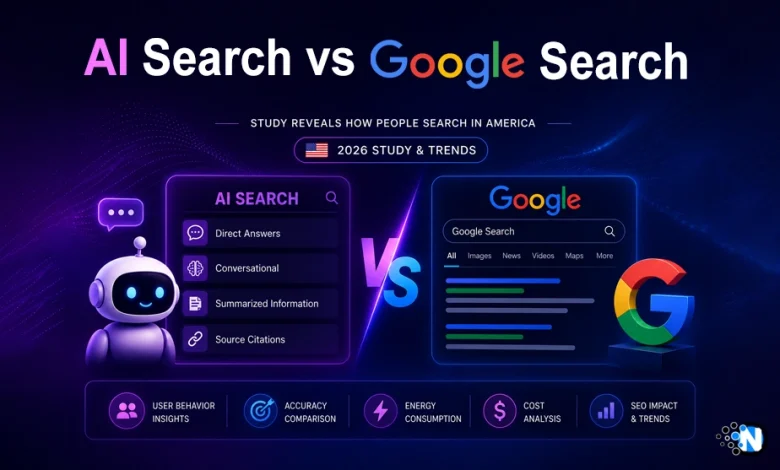
| Factor | AI Search | Google Search |
| Results Format | Direct answers | Ranked webpages |
| Research Speed | Faster | Requires multiple clicks |
| Source Transparency | Varies | High |
| Content Discovery | Limited | Excellent |
| Website Traffic | Lower | Higher |
| Fact Verification | Can be difficult | Easier |
| User Interaction | Conversational | Query-based |
Perplexity AI Search vs Google Search
One of the most discussed comparisons in 2026 is Perplexity AI Search vs Google Search.
Perplexity has gained popularity because it:
- Provides source citations
- Summarizes multiple websites
- Supports follow-up questions
- Reduces research time
Google remains stronger for:
- Shopping searches
- Local searches
- Maps
- News discovery
- Website navigation
For researchers, Perplexity often offers a better experience. For broad web exploration, Google still dominates.
Vertex AI Search vs Google Search
Organizations frequently compare Vertex AI Search vs Google Search. Vertex AI Search is designed for enterprise environments rather than public web search.
It enables businesses to:
- Search internal documents
- Build AI-powered knowledge bases
- Improve customer support
- Create custom search experiences
Google Search focuses on public web information. Vertex AI Search focuses on organizational knowledge retrieval.
What is the Cost of AI Search vs Google Search?
An AI search query costs roughly $0.01 to $0.02, compared to $0.003 for a traditional Google search.
One of the biggest challenges facing AI search providers is operational cost.
What is the Cost of Google Search?
Traditional search infrastructure has been optimized for decades. A standard Google query costs only a fraction of a cent to process.
What is the Cost of AI Search?
AI-powered queries require:
- Large language models
- GPU processing
- RAG systems
- Context generation
As a result, AI search queries can cost many times more than traditional searches. This cost difference explains why many AI search platforms are introducing subscription models.
AI Search vs Google Search Energy Usage
A growing concern among researchers is AI search vs Google search energy usage. Traditional search engines are highly efficient because they primarily retrieve indexed information.
AI systems must:
- Load large models
- Generate responses
- Perform complex computations
- Process contextual information
Researchers often highlight the computational intensity of large language models. AI search generally requires:
- More GPU cycles
- Larger data center workloads
- Higher cooling requirements
Consequently, AI searches require significantly more electricity. However, Google Search remains more energy-efficient per query due to its mature infrastructure.
How Much Energy Does AI Use vs Google Search?
Although estimates vary, many studies suggest AI-generated responses may consume several times more energy than a traditional search query.
The exact amount depends on:
- Model size
- Query complexity
- Response length
- Infrastructure efficiency
How Much Energy Does a Google Search Use vs AI?
Google Search typically performs less computation because it retrieves indexed content instead of generating original responses. This makes traditional search significantly more energy-efficient on a per-query basis.
How Much Water Does AI Use vs Google Search?
Data centers require cooling systems that consume water. As AI workloads grow, researchers have started examining water consumption alongside electricity usage.
AI systems generally require:
- More computing power
- More cooling infrastructure
- More intensive data center operations
As a result, AI-generated searches can indirectly contribute to greater water consumption. However, traditional search infrastructure typically uses fewer computational resources, which often translates to lower cooling demands and lower water requirements.
This topic is becoming increasingly important as AI adoption accelerates across the United States.
AI Search User Behavior Trends in the USA
Recent consumer behavior trends reveal several changes:
Users Prefer Faster Answers
Americans increasingly want:
- Immediate answers
- Summaries
- Comparisons
- Recommendations
Younger Audiences Adopt AI Faster
Gen Z and younger millennials are more likely to use:
- ChatGPT
- Perplexity
- Claude
- Copilot
for informational queries.
Google Remains Dominant for Discovery
Users still prefer Google for:
- Shopping
- Travel
- Local businesses
- Maps
- Product research
How Do I Optimize for AI Search vs Google SEO?
The answer is to optimize for both AI and Google Search at once, which is now called Hybrid Engine Optimization.
Traditional SEO Best Practices
- Create helpful content
- Build topical authority
- Earn backlinks
- Improve page speed
- Optimize metadata
AI Search Optimization Strategies
- Answer questions directly
- Use clear headings
- Add expert insights
- Include statistics and studies
- Improve EEAT signals
- Create entity-rich content
- Publish original research
AI systems increasingly favor content that demonstrates expertise and provides unique information. To help streamline this process, you can utilize specific top AI search tools to audit your brand’s visibility and automate your optimization workflow.
What is the Future of Search?
The future is unlikely to be AI search versus Google search. Instead, search will become increasingly hybrid.
Google is already blending:
- AI-generated answers
- Traditional search results
- Knowledge graphs
- User-generated content
The winning platforms will combine:
- Accuracy
- Transparency
- Speed
- Trustworthiness
For businesses, publishers, and marketers, the best strategy is to prepare for a world where both AI search and traditional search coexist.
People Also Ask
Is AI Search More Accurate Than Google Search?
AI search can provide faster answers, but Google Search often makes fact-checking easier because users can access original sources directly.
Will AI Search Replace Google Search?
No. AI search is expected to complement Google Search rather than replace it completely, as both serve different user needs.
Why Does AI Search Use More Energy?
AI search generates responses using large language models, which require significantly more computing power than traditional search engines.
Is Perplexity Better Than Google Search?
It depends on the task. Perplexity is often better for research and summaries, while Google Search remains stronger for web discovery, shopping, maps, and local searches.
How Should Websites Optimize for AI Search?
Websites should focus on EEAT, answer-focused content, structured headings, original insights, and strong topical authority.
Does AI Search Send Less Traffic to Websites Than Google?
Yes. AI search often provides answers directly within the platform, reducing the number of clicks to external websites compared to Google Search.
Can AI Search Be Trusted for Research?
Yes, but users should verify important information through original sources because AI-generated responses can occasionally contain inaccuracies.
Is Google Losing Market Share to AI Search?
AI search adoption is growing rapidly, but Google remains the dominant search platform in the United States.
What Types of Searches Are Better for AI Search?
AI search works best for summaries, comparisons, explanations, brainstorming, and research-based queries.
Will AI Search Change the Future of SEO?
Yes. SEO is evolving beyond traditional rankings, requiring businesses to optimize for both search engines and AI-powered answer platforms.
Are AI Search Results Personalized Like Google Search?
Yes. AI search platforms may use conversation history and context, while Google Search primarily relies on search history, location, and user behavior signals.
Why Are Younger Users Adopting AI Search Faster?
Many younger users prefer AI search because it delivers direct answers, conversational experiences, and faster research results.
What Is the Biggest Advantage of AI Search?
Its biggest advantage is providing direct, summarized answers without requiring users to visit multiple websites.
Final Thoughts on this Discussion About AI Search vs Google Search
This AI Search vs Google Search study shows that the future of search is not a winner-takes-all battle. Google remains the dominant gateway to the web, particularly for discovery, navigation, shopping, and local searches.
However, AI-powered search platforms are rapidly changing user expectations by providing instant, conversational answers.
As adoption grows across the United States, businesses must adapt their content strategies to serve both traditional search engines and AI-driven answer platforms.
Organizations that invest in authoritative, well-structured, and trustworthy content today will be best positioned for the next generation of search.