YouTube Doubles the Watch-Hour Bar for New Creators to Start Earning Money
YouTube will require new creators to hit double the current watch-hour threshold before they can join its Partner Program and start earning.

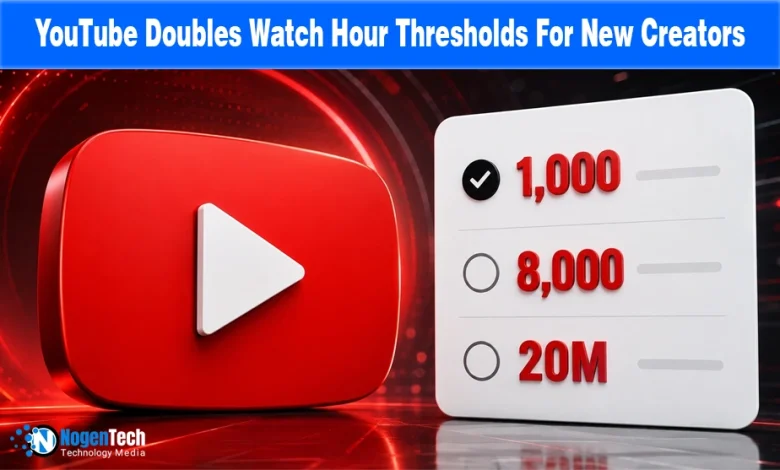
YouTube announced Monday that new creators applying to its Partner Program will need at least 8,000 qualified watch hours over the past year, or 20 million qualified Shorts views in the last 90 days, up from the current 4,000 hours or 10 million Shorts views, effective February 1, 2027.
The change is aimed at new applicants only and leaves the roughly 3 million creators already in the program unaffected.
The changes also include the cheaper Premium Lite expanding to all countries where YouTube Premium is available, along with new shopping and brand deal bonuses, marking YouTube’s first major monetization overhaul since 2018.
Doubling the Bar, and What Stays the Same
The current requirements sit at 1,000 subscribers plus 4,000 watch hours over the past year, or 1,000 subscribers plus 10 million Shorts views over 90 days.
The new thresholds represent an exact doubling of both the long-form watch-hour requirement and the Shorts-view requirement, though YouTube’s own blog post notably didn’t mention any change to the 1,000-subscriber floor itself.
This leaves the most commonly discussed barrier to entry untouched while quietly raising the harder-to-fake engagement metrics around it, a clear hurdle for those using AI slop within YouTube automation models.
YouTube also introduced a separate ongoing Shorts requirement: creators must maintain 10 million Shorts views over a rolling 90-day period to keep earning from the Shorts Creator Pool.
The revenue sharing pauses if a channel falls below that threshold and resumes once it crosses it again.
A Platform-Wide Growth Number Doing the Justifying
YouTube’s blog post grounded the change in scale, telling creators the update exists to keep pace with the platform’s growth, which now sees over 200 billion daily Shorts views and more than a billion hours of watch time on TV every day.
That TV reach is also growing as YouTube tests Gemini-powered conversational AI assistants on connected TVs.
Those numbers are significant, and YouTube’s choice to lead with them rather than revenue figures frames the change as a response to platform-wide growth, not tighter monetization rules.
The doubled thresholds are presented as keeping pace with an ecosystem that has outgrown its decade-old entry bar, rather than making it harder for new creators to qualify for a share of that growth in the first place.
The Real Tradeoff Sits Outside the Headline Number
What the coverage hasn’t fully addressed is the update’s uneven impact: existing creators are grandfathered in, while new entrants face thresholds twice as high.
At the same time, YouTube is rolling out Shopping bonuses, brand deal incentives, and trend-related earnings boosts for creators who haven’t yet qualified, making early channel growth more important.
That’s a coherent strategy if the goal is retention over acquisition: reward existing creators through Premium Lite’s revenue split, which YouTube says pays creators more per subscriber than ad-supported viewing, while making entry harder.
The timing also matters. TechCrunch noted that X has overhauled creator payouts to reward original content, while Facebook is pushing its own monetization program to attract creators from TikTok and YouTube.
The bottom line is that platforms increasingly appear focused on retaining proven creators rather than recruiting new ones, changing what it takes to make starting a YouTube channel a viable income path.
Source: New opportunities to earn and changes to the YouTube Partner Program