Microsoft Unveils Project Solara at Build 2026, An Android-Based OS for AI Agent Devices That Replaces Apps Entirely
At Build 2026 on June 2, Microsoft introduced Project Solara, a chip-to-cloud platform built on Android designed for "agent-first" devices that replace traditional apps with AI agents, alongside two concept hardware designs piloted by Best Buy, CVS Health, Levi's, and Target.

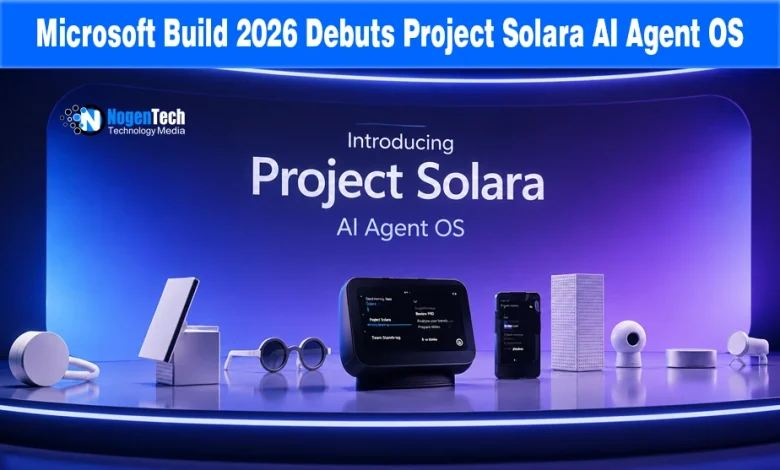
At its Build 2026 developer conference, At Build 2026, Microsoft unveiled Project Solara, an operating system for agent-first devices where users interact directly with advanced AI assistants that understand context and perform tasks across connected services instead of relying on traditional apps and menus.
Microsoft technical fellow Stevie Bathiche delivered the announcement, describing the vision as a “diverse ecosystem of agent-first devices, from small to large, from fixed to hypermobile, from personal to professional.” The platform is not a Windows variant.
It is built on AOSP, meaning it shares a common base with Android, but is stripped of Google’s app layer and rebuilt around Microsoft’s agent infrastructure.
The Badge Concept, and What It Actually Does
The Badge is the more interesting of the two devices, reimagining the access card that information workers, nurses, and front-line workers carry daily.
It has a touchscreen display, a Hello fingerprint sensor, a privacy switch, speaker, side-facing camera, WiFi, Bluetooth, and 5G, running off a Qualcomm wearable chip.
Users can activate AI agents with a button press to capture conversations, generate transcriptions, and analyze their surroundings using visual context.
The platform supports Microsoft 365 Copilot, Researcher, Facilitator, Priority Agent, GitHub Copilot, and future third-party agents through an open architecture.
PCMag noted the badge is genuinely novel as a hardware concept, not because badge-shaped devices are new, but because no previous badge form factor has carried the compute, connectivity, and agent integration required to function as a standalone AI interface.
Analysts also described it as the most unexpected hardware at Build 2026, noting that most people expected AI wearable concepts to look like watches or glasses, not corporate access cards.
The Desk Companion, and What Solara Means for Microsoft’s Bigger Picture
The Desk companion concept is a desktop hub that sits beside a PC, responds to voice commands, signs users in using facial recognition, surfaces the day’s most pressing items, and, with a monitor attached, becomes a full Windows 365 machine running in the cloud.
Microsoft’s idea for the display is a new “Priority Agent” service showing the user what is most important at that moment, while a “Facilitator” captures in-person meetings, transcribes them, and extracts action points.
The badge runs on Qualcomm wearable silicon and the desk hub on MediaTek IoT silicon, the same MediaTek chips OpenAI’s reported AI-agent phone is also being built on, underscoring the competition forming in this category.
Microsoft presented Solara as an open platform rather than a standalone product, inviting hardware manufacturers to build their own agent-first devices, with its success depending on widespread industry adoption.
For context, the Microsoft Copilot Cowork rollout earlier this year already showed Microsoft’s appetite for pushing agents beyond the PC, Project Solara is the hardware layer that completes that ambition
Source: Microsoft Build 2026