Your smartphone is designed to keep you connected, but it often disconnects you from the world around you.
A typical workday often revolves around checking a smartphone for messages, navigation, meetings on Zoom, and updates.
While convenient, this constant screen time can interrupt conversations, affect posture, and divide attention between the digital and physical world. Today’s wearable technology includes:
- AI smart glasses, smartwatches, smart rings, and other connected devices.
- Instant access to notifications, navigation, and communication without reaching for a phone.
- Improved productivity, reduced screen time, better posture, and greater situational awareness.
Among these innovations, AI smart glasses stand out by placing essential information directly within the user’s field of view.
Next, you’ll see how AI smart glasses and wearable technology help professionals stay connected, work efficiently, and engage with the world without always relying on a smartphone.
What Is Wearable Tech and Why Is It Becoming Essential?
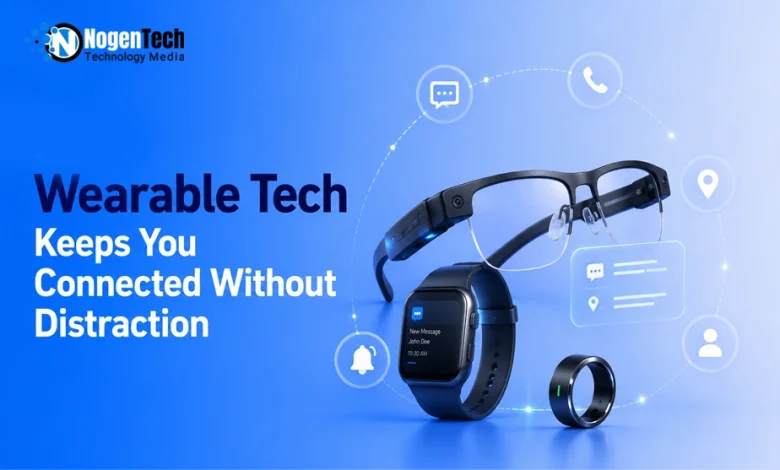
Wearable tech includes smart devices like AI smart glasses, smartwatches, and smart rings that provide hands-free connectivity, productivity, and real-time insights.
Wearable technology combines sensors, software, and wireless connectivity to deliver information without requiring constant smartphone use. Common devices include:
- AI smart glasses
- Smartwatches
- Smart rings
- Fitness trackers
- Medical wearables
Professionals across the United States are adopting wearable tech to reduce screen time, improve productivity, and stay connected while working, traveling, or commuting.
Among these devices, AI smart glasses have their own place. The best AI glasses combine Artificial Intelligence (AI), Augmented Reality (AR), cameras, speakers, and voice assistants into lightweight eyewear. They help professionals:
- Access notifications hands-free
- Navigate with voice guidance
- Capture photos and videos instantly
- Use AI-powered assistance
- Stay aware of their surroundings
As AI, AR, and the Internet of Things (IoT) continue to advance, wearable technology is becoming an essential productivity tool for modern workplaces rather than just another consumer gadget.
How Are AI Smart Glasses Changing the Way Professionals Work?
AI smart glasses improve productivity by delivering hands-free communication, navigation, and real-time information without constant smartphone use.
Frequent smartphone use interrupts focus and increases screen time. AI smart glasses keep essential information within the user’s natural field of view, making it easier to stay connected
The best AI glasses combine Artificial Intelligence (AI), voice assistants, cameras, speakers, and wireless connectivity to support everyday tasks, including:
- Viewing notifications
- Following voice-guided navigation
- Capturing photos and videos
- Accessing AI-powered assistance
- Making and receiving calls
Beyond productivity, smart eyewear can also support healthier digital habits. The American Optometric Association (AOA) recommends reducing unnecessary screen exposure to help minimize digital eye strain, making wearable devices a practical alternative for routine interactions.
This shift reflects the growing adoption of smart home gadgets, which automate everyday tasks in the background. Similarly, AI smart glasses provide timely information without demanding constant attention, helping professionals stay focused on their work instead of their devices.
What Are the Biggest Benefits of Wearable Tech for Professionals?
Wearable tech helps professionals improve productivity, reduce screen time, maintain better posture, and stay connected through hands-free access to essential information.
For professionals, wearable technology simplifies daily tasks without constant smartphone use. It delivers timely information while helping users stay focused and aware of their surroundings.
Key benefits include:
- Higher productivity with instant notifications and AI assistance.
- Reduced screen time through hands-free interactions.
- Better posture by minimizing frequent downward screen viewing.
- Safer navigation with voice-guided directions.
- Greater situational awareness while commuting or working.
- Hands-free communication during meetings, travel, and fieldwork.
The best AI glasses combine these benefits in a lightweight device, giving professionals quick access to information without interrupting their work or movement.
How Secure Is Wearable Tech for Everyday Use?
Modern wearable tech protects user data with encryption, on-device processing, and privacy features that support secure everyday use.
As wearable technology becomes more connected, strong privacy and security features are essential. Leading AI smart glasses include:
- On-device encryption for photos, videos, and voice data.
- Recording indicator lights that signal when your glasses with camera are active.
- Encrypted cloud synchronization for secure data transfers.
- Permission controls to protect sensitive information.
The Federal Trade Commission (FTC) promotes transparent data practices, while the National Institute of Standards and Technology (NIST) provides cybersecurity frameworks that guide secure device design.
Choosing wearable devices with robust privacy features helps professionals protect sensitive information in workplaces and public spaces.
What Is the Future of Wearable Tech?
The future of wearable tech combines AI, AR, and connected devices to deliver personalized, hands-free experiences with less reliance on smartphones.
Advances in Artificial Intelligence (AI), Augmented Reality (AR), and the Internet of Things (IoT) are making wearable technology more intelligent and context-aware.
Future developments include:
- AI-powered assistants for contextual support.
- AR navigation and collaboration.
- Real-time health monitoring with biometric insights.
- Smart home integration for connected device control.
- Personalized recommendations based on user activity.
The best AI glasses already combine communication, navigation, media capture, and AI assistance in a single wearable device. As wearable technology evolves, these devices will continue reducing screen dependence while making everyday interactions faster and more intuitive.
Frequently Asked Questions About Wearable Technology
When Did Wearable Technology Start?
Wearable technology emerged in the 1960s and became mainstream with fitness trackers and smartwatches in the 2010s.
Advances in AI, sensors, and wireless connectivity accelerated adoption across health, fitness, and productivity.
How Many People Use Wearable Technology?
Hundreds of millions of people worldwide use wearable technology for health tracking, communication, productivity, and fitness.
Growing demand for AI smart glasses, smartwatches, and fitness trackers continues to expand the wearable technology market.