Meta’s New Wearables Bet Everything on Muse, Not the Metaverse
From $1,299 VR glasses to a keychain-sized AI gadget to camera-free Ray-Bans built to dodge lawsuits, Meta Connect revealed a hardware lineup organized around one idea: getting Muse onto your body, one way or another.

Meta CEO Mark Zuckerberg unveiled a sweeping hardware lineup at the company’s annual Connect developer conference in Menlo Park, California, on Wednesday, September 23.
The announcements included the $1,299 Meta VR Glasses, a keychain-sized AI device called Muse Charm, and camera-free Ray-Ban Meta Audio glasses expected to ship in October.
Rather than centering the event on virtual reality or the metaverse, Zuckerberg tied the entire lineup to Muse, Meta’s recently launched personal AI agent, calling the moment one where “delivering personal superintelligence is now within reach.”
Meta VR Glasses Trade Bulk for a $1,299 Price Tag
The headline hardware is an actual design departure.
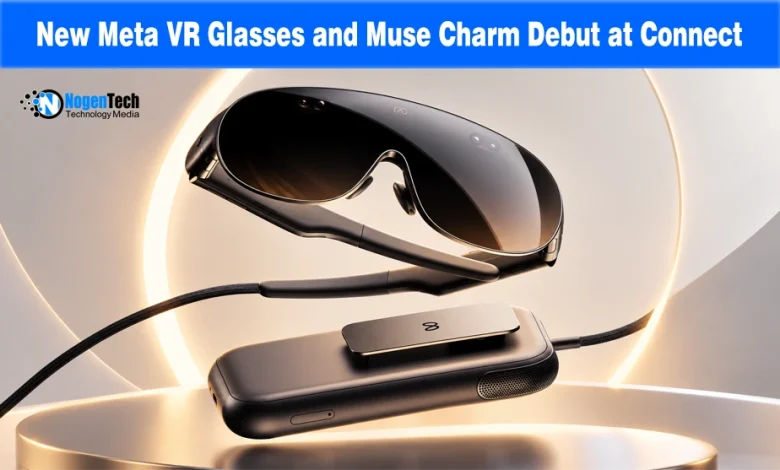
Meta VR Glasses weigh roughly 100 grams, about five times lighter than the Quest 3, built from magnesium alloy.
Rather than stuffing all the tech inside the frame, it offloads the battery and Snapdragon Reality Elite processor to a small, wired puck.
The lenses use micro-OLED panels delivering a 5K Infinite Display at 37 pixels per degree with Dolby Vision and Atmos support.
Meta bills the device as the first IMAX Enhanced-certified VR hardware ever made, with Disney+ bringing select 3D and Marvel titles to the platform in November.
Eye and hand-tracking sensors cut the need for handheld controllers.
At $1,299, shipping spring 2027, it costs more than four times Meta’s $299 Quest 3S from 2024, a bet that entertainment-grade fidelity can justify premium pricing where the struggling metaverse pitch alone could not.
Muse Charm Puts an AI Agent on Your Keychain
Zuckerberg closed the keynote by unveiling Muse Charm, a palm-sized device roughly the size of an AirPods case with a 2-inch touchscreen, built-in 5G, and a fingerprint sensor for instant activation.
The gadget represents the official release of the AI pendant hardware leaked in internal Meta memos, shifting the concept from a clip-on wearable to a standalone keychain gadget.
“We packed the whole Muse experience, including the whole real-time voice and avatar stack, into something that fits on a keychain , into something that fits on a keychain,” TechCrunch noted citing Zuckerberg.
Meta plans to ship the device in December without confirming pricing, and Reuters separately reported that Meta is testing human operators behind some Muse interactions, a detail the company hasn’t fully explained.
Unlike the glasses, Charm needs no smartphone pairing to function, positioning it as Meta’s answer for anyone who wants Muse access without wearing anything on their face at all.
Ray-Ban Meta Audio: Camera-Free Style Meets 48-Hour Power
Meta is also expected to introduce camera-free Ray-Ban Meta Audio glasses, internally codenamed Luna, targeting an October release.
Weighing just 43 grams, the new audio-only frames will come in 23 color and lens combinations including the retro Clubmaster and the classic rectangular Burbank as Wired notes.
Packed with six built-in microphones designed specifically for talking to Muse, the glasses offer 12 hours of continuous playback on a single charge and up to 48 hours of total battery life with the included charging case.
Removing the Lenses: How Meta is Dodging Privacy Lawsuits
The timing of this camera-free design isn’t incidental. Meta is currently facing a proposed class-action lawsuit in California over user privacy protections.
Meanwhile, its camera-equipped frames faced fierce ACLU civil liberty warnings and venue bans across UK and New York courtrooms, yet still managed to top 7 million sales with EssilorLuxottica in 2025 alone.
By stripping out the controversial camera, Meta eliminates its biggest legal liability while repurposing the frames as an FDA-approved over-the-counter hearing aid for $149 a year (or via Meta One).
What Connect actually revealed is a clever liability map: Meta is pricing risk out of its entry-level tech, betting customers will accept a camera-free frame because Muse, not the camera, is the real selling point.
Sources:
Introducing Meta VR Glasses, A New Era for Virtual Reality
Meta made a Tamagotchi-like wearable for its Muse AI agent
Meta’s Answer to the ‘Meta Creep’? Camera-Free Smart Glasses