Meta’s Camera-Free Luna Glasses Could Change How Its AI Wearables Work
The camera-free smart glasses, codenamed Luna, follow a year of privacy controversies surrounding its camera-equipped Ray-Ban smart glasses.

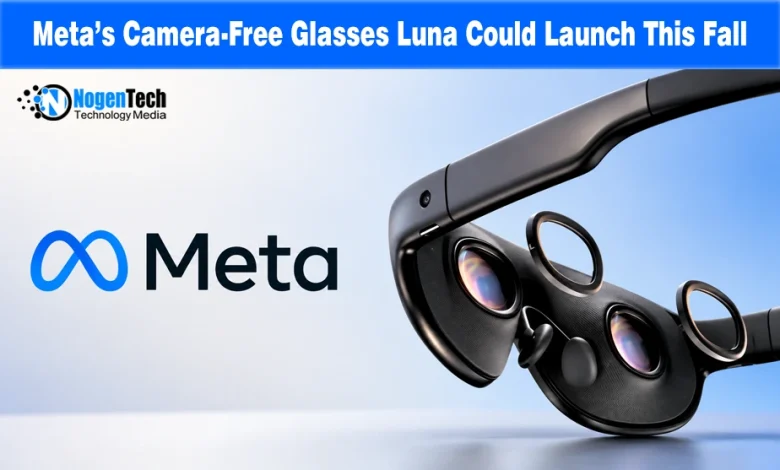
Meta may reveal its camera-free smart glasses, codenamed “Luna,” at its Connect developer conference next week, with an October release targeted, according to The Information.
The glasses reportedly feature six built-in microphones for talking directly to Meta’s AI chatbot and Muse. They also include a side button to quickly activate Meta AI and speakers similar to those in Meta’s current Ray-Ban lineup.
Notably, the hardware has no camera, a deliberate omission for a company whose smart glasses success has largely centered on photo and video capture.
A Year of Privacy Controversies Sets the Backdrop
The camera-free design appears to be linked to the mounting scrutiny over how Meta’s existing glasses handle recorded footage.
A Swedish newspaper investigation earlier this year alleged that contractors reviewing AI training data in Nairobi, Kenya, had seen highly personal footage captured by Meta’s smart glasses.
The allegations triggered a U.S. lawsuit from plaintiffs represented by the Clarkson Law Firm and prompted the UK’s Information Commissioner’s Office to open its own investigation.
Separately, the company received strong backlash from over 75 organizations for its facial recognition features in smart glasses.
Meta also drew criticism this year for privacy policy changes that keep AI camera features active by default unless users manually disable the “Hey Meta” voice command, and for removing the option to opt out of storing voice recordings in the cloud.
Meta Already Tried Patching the Problem Once
In July, Meta updated its second-generation Ray Ban glasses so the camera automatically shuts off if the device detects tampering with its recording LED, the light that signals when video is being captured.
It also cracked down on Facebook Marketplace listings offering ways to disable the light.
The fixes followed years of criticism that the LED wasn’t an adequate warning system, intensified by reports linking Meta glasses to the individual behind a vehicle incident in New Orleans, who reportedly used them to scope out the area beforehand.
Demand remained strong, however. Meta reportedly sold more than 7 million glasses in 2025 alone, with Zuckerberg telling investors the company still can’t build them fast enough.
But the scrutiny has clearly shaped how seriously Meta is treating recording concerns at the design level, not just through software patches.
Meta’s Actual Bet Isn’t Privacy, It’s Optionality
The more interesting point about Luna isn’t that Meta has decided cameras are the problem, but that it appears to be building parallel hardware lines for different kinds of trust.
As Luna reportedly heads toward an October launch, Meta still reportedly continues to develop “supersensing” glasses with cameras that can continuously observe a wearer’s surroundings without manual activation, arguably its most privacy-invasive design yet.
That’s less a contradiction than a deliberate strategy.
Meta appears to be betting that some buyers want an AI companion without the feature driving lawsuits and regulatory scrutiny, while others may eventually want glasses that see everything once Meta can convince them the tradeoff is worthwhile.
Whether Luna rebuilds trust with a wary public or simply offers Meta a lower-controversy product while its always-watching glasses continue developing remains unanswered.
Source: Meta to Launch Camera-Free Smart Glasses Amid Mounting Privacy Concerns


![Top Tech Stories of 24th Week [2026]](https://www.nogentech.org/wp-content/uploads/2026/06/Top-Tech-Stories-of-24th-Week-2026-390x220.webp)