Nadella’s ‘Reverse Information Paradox’ Reads Like a Warning Shot at Anthropic and OpenAI
Microsoft CEO Satya Nadella, in a long essay on X, argued that businesses using AI models are quietly handing over their most valuable asset, their institutional knowledge; the argument lands as a pointed critique of how Anthropic and OpenAI structure access to their models.

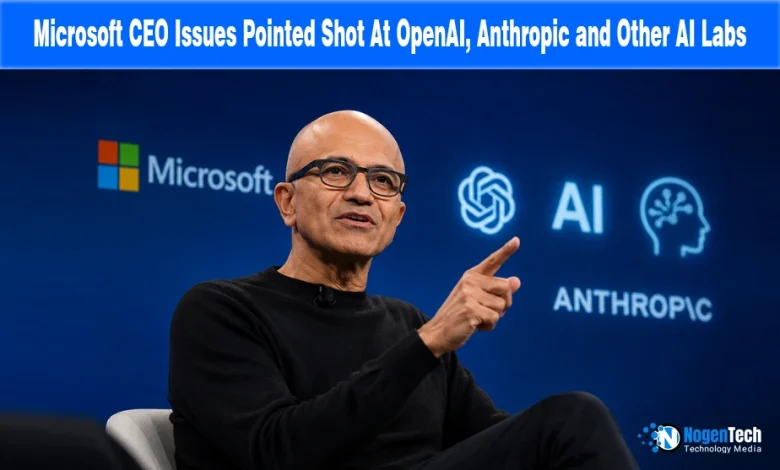
Nadella’s post, which passed two million views within hours of going up, builds its argument around a decades-old economic concept.
He pointed to Nobel Prize-winning economist Kenneth Arrow‘s 1962 “Information Paradox,” which says that once you reveal enough information to show its value, you lose your advantage.
According to Nadella, artificial intelligence has inverted that dynamic entirely, shifting the risk onto the buyer instead.
“You essentially pay for intelligence twice, once with money, and again with something even more valuable: the proprietary knowledge you must reveal to make that intelligence useful,” he wrote, adding that “in consuming intelligence, you are creating intelligence.
And what you create should belong to you.”
The Veiled Target Behind the Argument
Nadella never named Anthropic or OpenAI, but the essay’s main argument appears aimed at how both companies operate.
He said AI providers rely on fair use to train AI models on public data, yet impose restrictive terms preventing customers from doing anything similar with the knowledge those same models absorb during everyday use
Nadella called this collected data “exhaust,” including prompts, agent tool calls, and employee corrections when a model makes mistakes.
He said this feedback is “distilled into institutional know-how” that “leaks almost imperceptibly: trace by trace, correction by correction, eval by eval.”
He warned that if learning flows only to providers of these intelligence models, economic value will concentrate among a few infrastructure owners rather than the businesses generating that knowledge.
A Playbook Built Around Five Principles
To address the imbalance, Nadella, being one of the most influential entrepreneurs, outlined what he called the five C’s: control, capability, choice, cost, and compounding.
In practice, Nadella said businesses should build private evaluation systems instead of relying on vendor benchmarks.
He added that they should keep ownership of the knowledge created through AI interactions, build private AI environments that keep company data under their own control, and avoid relying on a single AI model so they can switch providers without losing context.
Nadella backed his point by quoting Palantir CEO Alex Karp, who said customers want “control over their compute, their models, their data stack, and their alpha.”
He added that companies want to know “they own the means of production” instead of giving that control to someone else.
Weeks earlier, Nadella shared a similar view, where he said there should be “as many models in the world as firms in the world” because a company that outsources all of its learning eventually has to ask, “why exist?”
The Obvious Tension Nadella Doesn’t Address
The essay’s framing sits awkwardly alongside Microsoft’s own position in the AI industry.
The company has invested roughly $13 billion into OpenAI and built Copilot’s core experience around its models.
While also striking a deal with Nvidia and Anthropic in November that put Claude on Azure, backed by up to $5 billion from Microsoft and a $30 billion Azure compute commitment from Anthropic.
Microsoft has simultaneously pushed a multi-model strategy through Azure AI Foundry, adding models from DeepSeek and Nvidia’s optical networking partner Cohere, alongside its own in-house MAI systems.
This approach conveniently benefits Microsoft’s cloud business regardless of which underlying model a customer ultimately chooses.
That doesn’t weaken Nadella’s main point, but it shows Microsoft has a strong financial reason to argue that relying on any single AI lab, including the two it invests in most, is a strategic risk.