OpenAI Launches GPT-5.5 “Spud” Built for the Agent Era Using NVIDIA GB200 Power
GPT-5.5 is OpenAI’s most capable model to date, positioned not as a smarter chatbot but as an autonomous agent runtime that completes messy, multi-step tasks with minimal user direction across ChatGPT and Codex.

OpenAI released GPT-5.5 on April 23, 2026, just six weeks after GPT-5.4 shipped, in what the company frames as the next step toward a new way of getting work done on a computer.
According to the OpenAI official announcement, GPT-5.5 is described as the company’s “smartest and most intuitive to use model yet,” able to understand intent faster, handle complex tasks, and execute them with minimal prompting.
OpenAI President Greg Brockman told reporters in a briefing that the model represents “a new class of intelligence” and “a big step towards more agentic and intuitive computing.”
Why GPT-5.5 Is a Positioning Shift, Not Just a Benchmark Update
The official OpenAI announcement leads not with reasoning scores but with outcomes: it completes the task, uses your tools, and does not need babysitting. That is a deliberate departure from how OpenAI has launched every previous model.
As TechCrunch confirmed, the launch is being framed as a step closer to a ChatGPT superapp, a single interface that handles not just questions but complete workflows involving email, spreadsheets, calendars, software operation, and document creation.
Brockman described the model as “a faster, sharper thinker for fewer tokens” that handles multi-step workflows more autonomously than its predecessor.
As Axios confirmed, the internal codename is “Spud.” Early access teams reported saving up to 10 hours per week, reviewing thousands more documents, and running real-time gut-checks on vibe-coded software.
Despite a capability uplift, OpenAI says GPT-5.5 matches GPT-5.4’s response speed in real-world serving, a notable claim, as larger models are typically slower. The gains, per OpenAI, are strongest in agentic coding, computer use, knowledge work, and early scientific research.
Benchmarks, Cybersecurity, and the Safety Card
OpenAI published benchmark comparisons showing GPT-5.5 outperforming Gemini 3.1 Pro and Claude Opus 4.7 across most evaluations. However, on MCP-Atlas, updated with Scale AI’s April 2026 data, it scores just below both competitors.
OpenAI confirmed GPT-5.5 Pro is available to Pro, Business, and Enterprise users, priced at $30 per million input tokens and $180 per million output tokens in the API; a premium tier for the highest-accuracy use cases.
As CNBC confirmed, cybersecurity was central at the press briefing, following attention around Anthropic’s Claude Mythos earlier this month.
Mia Glaese, OpenAI’s Vice President of Research, said GPT-5.5 underwent extensive third-party safeguard testing and red teaming for cyber and bio risks, with safeguards refined over months alongside more capable models.
OpenAI said API access is delayed while stronger cybersecurity safeguards are added, a delay that distinguishes the ChatGPT rollout from API access and signaling the same dual-use tension Anthropic encountered with Mythos.
Enterprise Adoption and the Scale Behind the Launch
The numbers OpenAI disclosed alongside the launch underscore the competitive stakes.
ChatGPT has reportedly more than 900 million weekly active users, over 50 million subscribers, 9 million paying business users, and 4 million active Codex users.
These figures the company is showing explicitly to countering claims that OpenAI has lost ground to Anthropic, prominently Claude, in enterprise adoption.
Bank of New York Mellon (BNY) which tested GPT-5.5 during the early access period, offered a pointed enterprise-level endorsement.
BNY CIO Leigh-Ann Russell reportedly said GPT-5.5 shows stronger response quality and improved hallucination resistance, marking a meaningful step forward for accuracy in highly regulated banking environments.
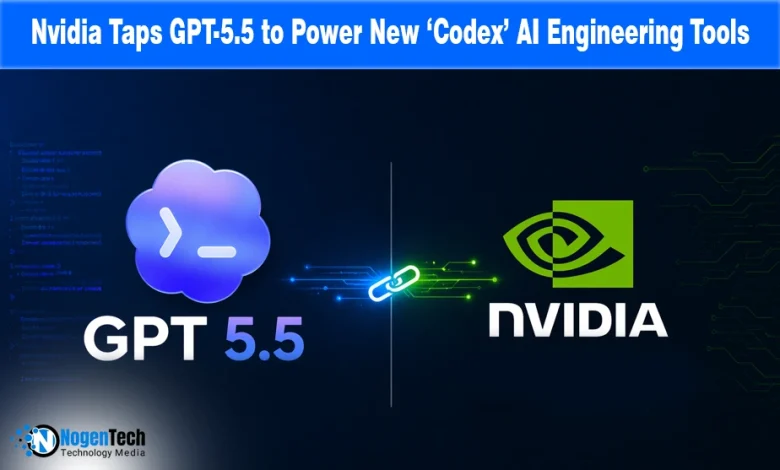
The model runs on NVIDIA GB200 NVL72 rack-scale systems, infrastructure that NVIDIA says delivers 35x lower cost per million tokens and 50x higher token output per second per megawatt compared to prior-generation hardware.
NVIDIA VP of Enterprise Computing Justin Boitano confirmed more in the official company blogpost than 10,000 NVIDIA employees across engineering, product, legal, and finance are already using GPT-5.5-powered Codex.
Source: Introducing GPT‑5.5